Kirjojen hintavertailu. Mukana 11 244 527 kirjaa ja 12 kauppaa.

Kirjahaku

Etsi kirjoja tekijän nimen, kirjan nimen tai ISBN:n perusteella.

8 kirjaa tekijältä D.Z. Phillips

The Problem of Evil and the Problem of God
By his own admission this is by far D Z Phillip’s most systematic attempt to discuss the problem of evil. Within the text the author argues that the majority of Anglo-American philosophers of religion who make a distinction between what is called the logical problem of evil and what is known as the practical, emotive or pastoral problem of evil are making false distinction. He argues that the logical is rooted in the practical. He does not intend to offer one 'correct' response to the problem of evil, but to point out the the confusions that are created by reflecting on the logical, conceptual problem in isolation. He advocates that there will always be more than one response to dealing with the problem of evil, but sees it as the job pf philosophers to point out where conceptual confusion arises.
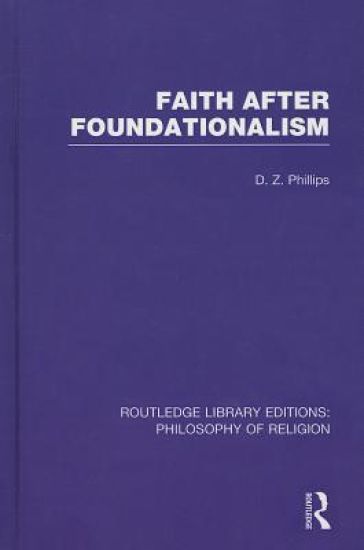
Faith after Foundationalism

Faith after Foundationalism

D.Z. Phillips

Routledge
2013
sidottu
Foundationalism is the view that philosophical propositions are of two kinds, those which need supporting evidence, and those which in themselves provide the evidence which renders them irrefutable. This book, originally published 1988, describes the battle between foundationalism, which places belief in God in the first category, and various other approaches to the problem of faith – ‘Reformed Epistemology’, hermeneutics; and sociological analysis. In the concluding section of the book, an examination of concept formation in religious belief is used to reinterpret the gap between the expressive power of language and the reality of God.
Faith and Philosophical Enquiry

Faith and Philosophical Enquiry

D.Z. Phillips

Routledge
2013
sidottu
The concern of this book is the nature of religious belief and the ways in which philosophical enquiry is related to it. Six chapters present the positive arguments the author wishes to put forward to discusses religion and rationality, scepticism about religion, language-games, belief and the loss of belief.The remaining chapters include criticisms of some contemporary philosophers of religion in the light of the earlier discussions, and the implications for more specific topics, such as religious education, are investigated. The book ends with a general attempt to say something about the character of philosophical enquiry, and to show how important it is to realise this character in the philosophy of religion.
Religion and Friendly Fire

Religion and Friendly Fire

D.Z. Phillips

Ashgate Publishing Limited
2004
sidottu
In locating friendly fire in contemporary philosophy of religion, D.Z. Phillips shows that more harm can be done to religion by its philosophical defenders than by its philosophical despisers. Friendly fire is the result of an uncritical acceptance of empiricism, and Phillips argues that we need to examine critically the claims that individual consciousness is the necessary starting point from which we have to argue: for the existence of an external world and the reality of God; that God is a person without a body, a pure consciousness; and that to assent to a religious belief is essentially to assign a truth value to a proposition independent of any confessional context. When these products of friendly fire are avoided, we arrive at a new understanding of belief, trust and the soul, and refuse to say more or less than we know about the realities of human life in the service of religious apologetics.
Religion and Friendly Fire

Religion and Friendly Fire

D.Z. Phillips

Routledge
2017
nidottu
In locating friendly fire in contemporary philosophy of religion, D.Z. Phillips shows that more harm can be done to religion by its philosophical defenders than by its philosophical despisers. Friendly fire is the result of an uncritical acceptance of empiricism, and Phillips argues that we need to examine critically the claims that individual consciousness is the necessary starting point from which we have to argue: for the existence of an external world and the reality of God; that God is a person without a body, a pure consciousness; and that to assent to a religious belief is essentially to assign a truth value to a proposition independent of any confessional context. When these products of friendly fire are avoided, we arrive at a new understanding of belief, trust and the soul, and refuse to say more or less than we know about the realities of human life in the service of religious apologetics.
Faith and Philosophical Enquiry

Faith and Philosophical Enquiry

D.Z. Phillips

Routledge
2016
nidottu
The concern of this book is the nature of religious belief and the ways in which philosophical enquiry is related to it. Six chapters present the positive arguments the author wishes to put forward to discusses religion and rationality, scepticism about religion, language-games, belief and the loss of belief.The remaining chapters include criticisms of some contemporary philosophers of religion in the light of the earlier discussions, and the implications for more specific topics, such as religious education, are investigated. The book ends with a general attempt to say something about the character of philosophical enquiry, and to show how important it is to realise this character in the philosophy of religion.
Faith after Foundationalism

Faith after Foundationalism

D.Z. Phillips

Routledge
2016
nidottu
Foundationalism is the view that philosophical propositions are of two kinds, those which need supporting evidence, and those which in themselves provide the evidence which renders them irrefutable. This book, originally published 1988, describes the battle between foundationalism, which places belief in God in the first category, and various other approaches to the problem of faith – ‘Reformed Epistemology’, hermeneutics; and sociological analysis. In the concluding section of the book, an examination of concept formation in religious belief is used to reinterpret the gap between the expressive power of language and the reality of God.