Kirjojen hintavertailu. Mukana 12 016 292 kirjaa ja 12 kauppaa.

Kirjahaku

Etsi kirjoja tekijän nimen, kirjan nimen tai ISBN:n perusteella.

4 kirjaa tekijältä Dale Husemöller

Fibre Bundles

Fibre Bundles

Dale Husemöller

Springer-Verlag New York Inc.
1993
sidottu
Fibre bundles play an important role in just about every aspect of modern geometry and topology. Basic properties, homotopy classification, and characteristic classes of fibre bundles have become an essential part of graduate mathematical education for students in geometry and mathematical physics. In this third edition two new chapters on the gauge group of a bundle and on the differential forms representing characteristic classes of complex vector bundles on manifolds have been added. These chapters result from the important role of the gauge group in mathematical physics and the continual usefulness of characteristic classes defined with connections on vector bundles.
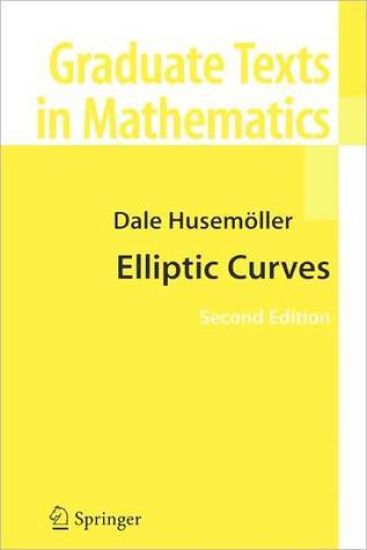
Elliptic Curves

Elliptic Curves

Dale Husemöller

Springer-Verlag New York Inc.
2003
sidottu
There are three new appendices, one by Stefan Theisen on the role of Calabi– Yau manifolds in string theory and one by Otto Forster on the use of elliptic curves in computing theory and coding theory. In the third appendix we discuss the role of elliptic curves in homotopy theory. In these three introductions the reader can get a clue to the far-reaching implications of the theory of elliptic curves in mathematical sciences. During the ?nal production of this edition, the ICM 2002 manuscript of Mike Hopkins became available. This report outlines the role of elliptic curves in ho- topy theory. Elliptic curves appear in the form of the Weierstasse equation and its related changes of variable. The equations and the changes of variable are coded in an algebraic structure called a Hopf algebroid, and this Hopf algebroid is related to a cohomology theory called topological modular forms. Hopkins and his coworkers have used this theory in several directions, one being the explanation of elements in stable homotopy up to degree 60. In the third appendix we explain how what we described in Chapter 3 leads to the Weierstrass Hopf algebroid making a link with Hopkins’ paper.
Elliptic Curves

Elliptic Curves

Dale Husemöller

Springer-Verlag New York Inc.
2010
nidottu
There are three new appendices, one by Stefan Theisen on the role of Calabi– Yau manifolds in string theory and one by Otto Forster on the use of elliptic curves in computing theory and coding theory. In the third appendix we discuss the role of elliptic curves in homotopy theory. In these three introductions the reader can get a clue to the far-reaching implications of the theory of elliptic curves in mathematical sciences. During the ?nal production of this edition, the ICM 2002 manuscript of Mike Hopkins became available. This report outlines the role of elliptic curves in ho- topy theory. Elliptic curves appear in the form of the Weierstasse equation and its related changes of variable. The equations and the changes of variable are coded in an algebraic structure called a Hopf algebroid, and this Hopf algebroid is related to a cohomology theory called topological modular forms. Hopkins and his coworkers have used this theory in several directions, one being the explanation of elements in stable homotopy up to degree 60. In the third appendix we explain how what we described in Chapter 3 leads to the Weierstrass Hopf algebroid making a link with Hopkins’ paper.
Fibre Bundles

Fibre Bundles

Dale Husemöller

Springer-Verlag New York Inc.
2012
nidottu
Fibre bundles play an important role in just about every aspect of modern geometry and topology. Basic properties, homotopy classification, and characteristic classes of fibre bundles have become an essential part of graduate mathematical education for students in geometry and mathematical physics. In this third edition two new chapters on the gauge group of a bundle and on the differential forms representing characteristic classes of complex vector bundles on manifolds have been added. These chapters result from the important role of the gauge group in mathematical physics and the continual usefulness of characteristic classes defined with connections on vector bundles.