Kirjojen hintavertailu. Mukana 12 390 323 kirjaa ja 12 kauppaa.

Kirjahaku

Etsi kirjoja tekijän nimen, kirjan nimen tai ISBN:n perusteella.

10 kirjaa tekijältä Daniel A. Farber

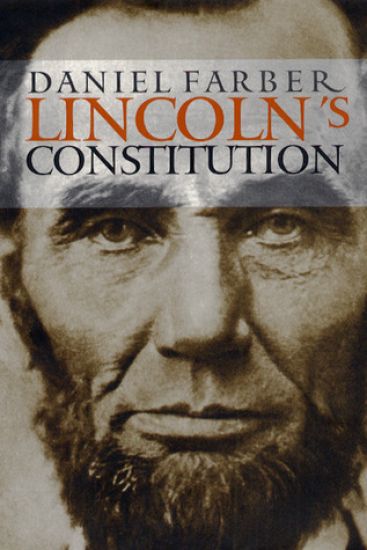
Lincoln's Constitution

Lincoln's Constitution

Daniel A. Farber

University of Chicago Press
2003
sidottu
The Civil War brought pressure on the Constitution that had never been seen before and hasn't been seen since, testing it in much the same way as an engineer tests his materials to destruction to assess their structure. Did the South have the right to secede? Did Abraham Lincoln trample on the Bill of Rights? Can the president go to war without congressional approval? What is the nature of the Union, and what are the limits of states' rights? Forced to confront these issues during the Civil War, Lincoln ran squarely into the conflicts and the issues at the heart of our constitution, issues that remain with us today. Daniel Farber's purpose in "Lincoln's Constitution" is to lead the reader to understand exactly what Lincoln did, what arguments he made in defence of his actions, and how his words and deeds fit into the context of the times. Farber sets the constitutional problems that arose during Lincoln's term within their historical moment, as illuminated by recent work by historians, and investigates how well Lincoln's views hold up today - over a century later. The answers are crucial not only for a better understanding of the Civil War but also for shedding light on issues that the courts struggle with now: state sovereignty, presidential power, and national security limitations on civil liberties. The first book in over 75 years to evaluate Lincoln's legal legacy comprehensively, "Lincoln's Constitution" is a blend of history and constitutional thought. Written for the intelligent reader, its insights speak urgently to us as our nation again finds itself in a time of danger and the limits of constitutional law are once more being tested.
Lincoln's Constitution

Lincoln's Constitution

Daniel A. Farber

University of Chicago Press
2004
nidottu
In Lincoln's Constitution Daniel Farber leads the reader to understand exactly how Abraham Lincoln faced the inevitable constitutional issues brought on by the Civil War. Examining what arguments Lincoln made in defense of his actions and how his words and deeds fit into the context of the times, Farber illuminates Lincoln's actions by placing them squarely within their historical moment. The answers here are crucial not only for a better understanding of the Civil War but also for shedding light on issues-state sovereignty, presidential power, and limitations on civil liberties in the name of national security-that continue to test the limits of constitutional law even today.
Eco-pragmatism

Eco-pragmatism

Daniel A. Farber

University of Chicago Press
1999
sidottu
This text takes on the critical controversies in environmental law in the late 1990s: how to assess the values of future environmental benefits; how to use economic measurements of environmental values; and how to streamline the regulatory process to respond to changing scientific data. Daniel Farber steers a middle course between the "bean counters," who advocate strict cost-benefit analysis, and the "tree huggers," who favour environmental protection at any cost. The book explores fundamental issues in environmental economics, the philosophical disputes over the legitimacy of cost-benefit analysis, and the legal issues involved in applying and interpreting complex environmental statues. Synthesizing the best of our existing regulatory regime, Farber's analysis cuts a path through the thickets surrounding environmental policy.
Eco-pragmatism

Eco-pragmatism

Daniel A. Farber

University of Chicago Press
2000
nidottu
Eco-pragmatism takes on the most critical controversies in environmental law today: how to weigh economic costs against environmental quality and human life, how to assess the long time horizons of environmental problems, and how to make appropriate decisions in the face of scientific uncertainty about the scope of environmental problems."A comprehensive well-argued effort to address many of the most difficult issues facing legislators concerned with environmental issues."—Stephen P. Adamian, Boston Book Review"A timely and well-argued contribution."—Calestous Juma, Nature
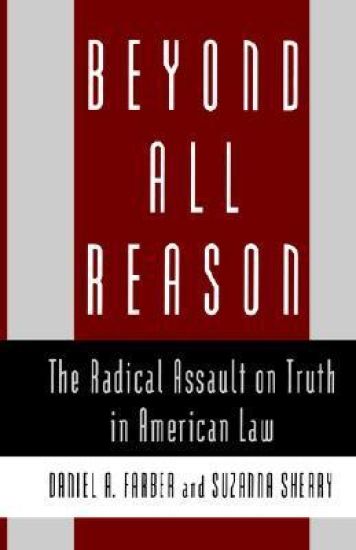
Beyond All Reason

Beyond All Reason

Daniel A. Farber; Suzanna Sherry

Oxford University Press Inc
1998
sidottu
Would you want to be operated on by a surgeon trained at a medical school that did not evaluate its students? Would you want to fly in a plane designed by people convinced that the laws of physics are socially constructed? Would you want to be tried by a legal system indifferent to the distinction between fact and fiction? These questions may seem absurd, but there are theories being seriously advanced by radical multiculturalists that force us to ask such questions. These scholars assert that such concepts as truth and merit are inextricably racist and sexist, that reason and objectivity are merely sophisticated masks for ideological bias, and that reality itself is nothing more than socially constructed mechanism for preserving the power of the ruling elite. In Beyond All Reason, liberal legal scholars Daniel A. Farber and Suzanna Sherry mount the first systematic critique of radical multiculturalism as a form of legal scholarship. Beginning with an incisive overview of the origins and basic tenets of radical multiculturalism, the authors critically examine the work of Derrick Bell, Catherine MacKinnon, Patricia Williams, and Richard Delgado, and explore the alarming implications of their theories. Farber and Sherry push these theories to their logical conclusions and show that radical multiculturalism is destructive of the very goals it wishes to affirm. If, for example, the concept of advancement based on merit is fraudulent, as the multiculturalists claim, the disproportionate success of Jews and Asians in our culture becomes difficult to explain without opening the door to age-old anti-Semitic and racist stereotypes. If historical and scientific truths are entirely relative social constructs, then Holocaust denial becomes merely a matter of perspective, and Creationism has as much "validity" as evolution. The authors go on to show that rather than promoting more dialogue, the radical multiculturalist preference for legal storytelling and identity politics over reasoned argument produces an insular set of positions that resist open debate. Indeed, radical multiculturalists cannot critically examine each others' ideas without incurring vehement accusations of racism and sexism, much less engage in fruitful discussion with a mainstream that does not share their assumptions. Here again, Farber and Sherry show that the end result of such thinking is not freedom but a kind of totalitarianism where dissent cannot be tolerated and only the naked will to power remains to settle differences. Sharply written and brilliantly argued, this book is itself a model of the kind of clarity, civility, and dispassionate critical thinking which the authors seek to preserve from the attacks of the radical multiculturalists. With far-reaching implications for such issues as government control of hate speech and pornography, affirmative action, legal reform, and the fate of all minorities, Beyond All Reason is a provocative contribution to one of the most important controversies of our time.
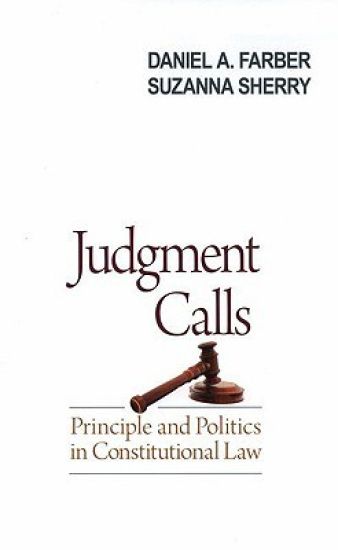
Judgment Calls

Judgment Calls

Daniel A. Farber; Suzanne Sherry

Oxford University Press Inc
2009
sidottu
Judgment Calls tackles one of the most important and controversial legal questions in contemporary America: How should judges interpret the Constitution? Our Constitution contains a great deal of language that is vague, broad, or ambiguous, making its meaning uncertain. Many people believe this uncertainty allows judges too much discretion. They suggest that constitutional adjudication is just politics in disguise, and that judges are legislators in robes who read the Constitution in accordance with their own political views. Some think that political decision making by judges is inevitable, and others think it can be restrained by "strict constructionist" theories like textualism or originalism. But at bottom, both sorts of thinkers believe that judging has to be either tightly constrained and inflexible or purely political and unfettered: There is, they argue, no middle ground. Farber and Sherry disagree, and in this book they describe and defend that middle ground. They show how judging can be--and often is--both principled and flexible. In other words, they attempt to reconcile the democratic rule of law with the recognition that judges have discretion. They explain how judicial discretion can be exercised responsibly, describe the existing constraints that guide and cabin such discretion, and suggest improvements. In exploring how constitutional adjudication works in practice (and how it can be made better), Farber and Sherry cover a wide range of topics that are relevant to their thesis and also independently important, including judicial opinion-writing, the use of precedent, the judicial selection process, the structure of the American judiciary, and the nature of legal education. They conclude with a careful look at how the Supreme Court has treated three of the most significant and sensitive constitutional issues: terrorism, abortion, and affirmative action. Timely, trenchant, and carefully argued, Judgment Calls is a welcome addition to the literature on the intersection of constitutional interpretation and American politics.
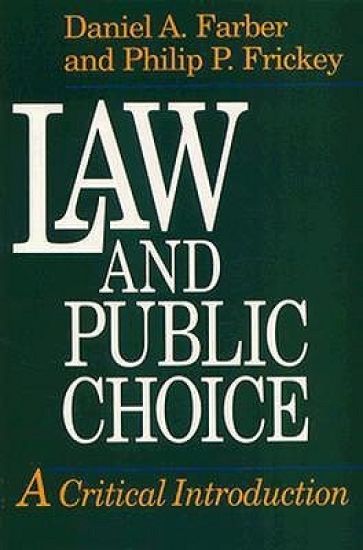
Law and Public Choice

Law and Public Choice

Daniel A. Farber; Philip P. Frickey

University of Chicago Press
1991
sidottu
In Law and Public Choice, Daniel Farber and Philip Frickey present a remarkably rich and accessible introduction to the driving principles of public choice. In this, the first systematic look at the implications of social choice for legal doctrine, Farber and Frickey carefully review both the empirical and theoretical literature about interest group influence and provide a nonmathematical introduction to formal models of legislative action. Ideal for course use, this volume offers a balanced and perceptive analysis and critique of an approach which, within limits, can illuminate the dynamics of government decision-making. "Law and Public Choice is a most valuable contribution to the burgeoning literature. It should be of great interest to lawyers, political scientists, and all others interested in issues at the intersection of government and law."--Cass R. Sunstein, University of Chicago Law School
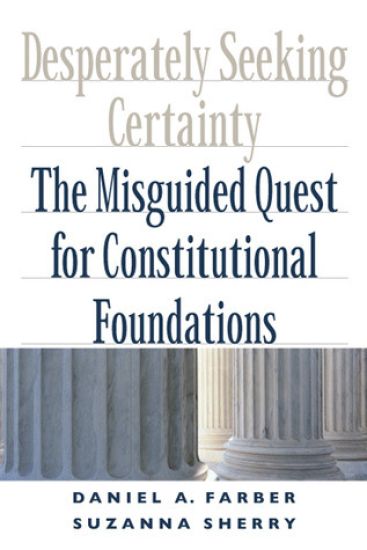
Desperately Seeking Certainty

Desperately Seeking Certainty

Daniel A. Farber; Suzanna Sherry

University of Chicago Press
2002
sidottu
Irreverent, provocative, and engaging, Desperately Seeking Certainty attacks the current legal vogue for grand unified theories of constitutional interpretation. On both the right and the left, prominent legal scholars normally try to build all of constitutional law from a single foundational idea, Daniel Farber and Suzanna Sherry find that in the end no single, all-encompassing theory can successfully guide judges or provide definitive or even sensible answers to every constitutional question. Their book brilliantly reveals how problematic foundationalism is and shows how the pragmatic, multifaceted common law methods already used by the Court provide a far better means of reaching sound decisions and controlling judicial discretion than do any of the grand theories.
Desperately Seeking Certainty

Desperately Seeking Certainty

Daniel A. Farber; Suzanna Sherry

University of Chicago Press
2004
nidottu
Irreverent, provocative, and engaging, Desperately Seeking Certainty attacks the current legal vogue for grand unified theories of constitutional interpretation. On both the right and the left, prominent legal scholars normally try to build all of constitutional law from a single foundational idea, Daniel Farber and Suzanna Sherry find that in the end no single, all-encompassing theory can successfully guide judges or provide definitive or even sensible answers to every constitutional question. Their book brilliantly reveals how problematic foundationalism is and shows how the pragmatic, multifaceted common law methods already used by the Court provide a far better means of reaching sound decisions and controlling judicial discretion than do any of the grand theories.
Law and Public Choice

Law and Public Choice

Philip P. Frickey; Daniel A. Farber

University of Chicago Press
1991
nidottu
In Law and Public Choice, Daniel Farber and Philip Frickey present a remarkably rich and accessible introduction to the driving principles of public choice. In this, the first systematic look at the implications of social choice for legal doctrine, Farber and Frickey carefully review both the empirical and theoretical literature about interest group influence and provide a nonmathematical introduction to formal models of legislative action. Ideal for course use, this volume offers a balanced and perceptive analysis and critique of an approach which, within limits, can illuminate the dynamics of government decision-making. “Law and Public Choice is a most valuable contribution to the burgeoning literature. It should be of great interest to lawyers, political scientists, and all others interested in issues at the intersection of government and law.”—Cass R. Sunstein, University of Chicago Law School