Kirjojen hintavertailu. Mukana 11 342 296 kirjaa ja 12 kauppaa.

Kirjahaku

Etsi kirjoja tekijän nimen, kirjan nimen tai ISBN:n perusteella.

4 kirjaa tekijältä Daniel A. Griffith

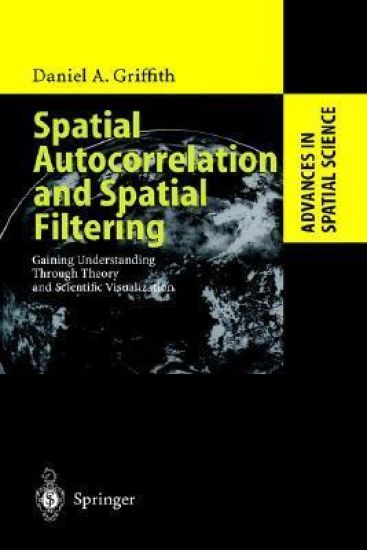
Spatial Autocorrelation and Spatial Filtering

Spatial Autocorrelation and Spatial Filtering

Daniel A. Griffith

Springer-Verlag Berlin and Heidelberg GmbH Co. K
2003
sidottu
Exploiting the old maxim that "a picture is worth a thousand words," scientific visualization may be defined as the transformation of numerical scientific data into informative graphical displays. It introduces a nonverbal model into subdisciplines that hitherto employed mostly or only mathematical or verbal-conceptual models. The focus of this monograph is on how scientific visualization can help revolutionize the manner in which the tendencies for (dis)similar numerical values to cluster together in location on a map are explored and analyzed, affording spatial data analyses that are better understood, presented, and used. In doing so, the concept known as spatial autocorrelation - which characterizes these tendencies and is one of the key features of georeferenced data, or data tagged to the earth's surface - is further de-mystified. This self-correlation arises from relative locations in geographic space.
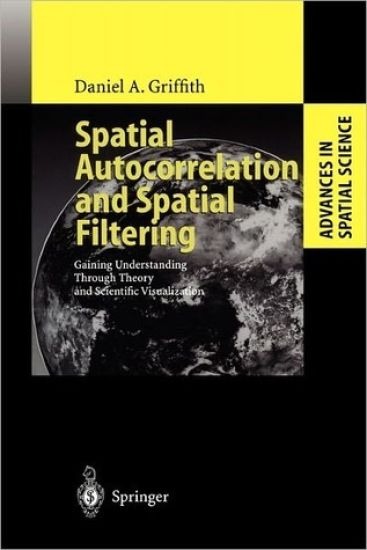
Spatial Autocorrelation and Spatial Filtering

Spatial Autocorrelation and Spatial Filtering

Daniel A. Griffith

Springer-Verlag Berlin and Heidelberg GmbH Co. K
2010
nidottu
Exploiting the old maxim that "a picture is worth a thousand words," scientific visualization may be defined as the transformation of numerical scientific data into informative graphical displays. It introduces a nonverbal model into subdisciplines that hitherto employed mostly or only mathematical or verbal-conceptual models. The focus of this monograph is on how scientific visualization can help revolutionize the manner in which the tendencies for (dis)similar numerical values to cluster together in location on a map are explored and analyzed, affording spatial data analyses that are better understood, presented, and used. In doing so, the concept known as spatial autocorrelation - which characterizes these tendencies and is one of the key features of georeferenced data, or data tagged to the earth's surface - is further de-mystified. This self-correlation arises from relative locations in geographic space.

Advanced Spatial Statistics

Advanced Spatial Statistics

Daniel A. Griffith

Kluwer Academic Publishers
1988
sidottu
In recent years there has been a growing interest in and concern for the development of a sound spatial statistical body of theory. This work has been undertaken by geographers, statisticians, regional scientists, econometricians, and others (e. g. , sociologists). It has led to the publication of a number of books, including Cliff and Ord's Spatial Processes (1981), Bartlett's The Statistical Analysis of Spatial Pattern (1975), Ripley's Spatial Statistics (1981), Paelinck and Klaassen's Spatial Economet~ics (1979), Ahuja and Schachter's Pattern Models (1983), and Upton and Fingleton's Spatial Data Analysis by Example (1985). The first of these books presents a useful introduction to the topic of spatial autocorrelation, focusing on autocorrelation indices and their sampling distributions. The second of these books is quite brief, but nevertheless furnishes an eloquent introduction to the rela­ tionship between spatial autoregressive and two-dimensional spectral models. Ripley's book virtually ignores autoregressive and trend surface modelling, and focuses almost solely on point pattern analysis. Paelinck and Klaassen's book closely follows an econometric textbook format, and as a result overlooks much of the important material necessary for successful spatial data analy­ sis. It almost exclusively addresses distance and gravity models, with some treatment of autoregressive modelling. Pattern Models supplements Cliff and Ord's book, which in combination provide a good introduction to spatial data analysis. Its basic limitation is a preoccupation with the geometry of planar patterns, and hence is very narrow in scope.
Advanced Spatial Statistics

Advanced Spatial Statistics

Daniel A. Griffith

Springer
2011
nidottu
In recent years there has been a growing interest in and concern for the development of a sound spatial statistical body of theory. This work has been undertaken by geographers, statisticians, regional scientists, econometricians, and others (e. g. , sociologists). It has led to the publication of a number of books, including Cliff and Ord's Spatial Processes (1981), Bartlett's The Statistical Analysis of Spatial Pattern (1975), Ripley's Spatial Statistics (1981), Paelinck and Klaassen's Spatial Economet~ics (1979), Ahuja and Schachter's Pattern Models (1983), and Upton and Fingleton's Spatial Data Analysis by Example (1985). The first of these books presents a useful introduction to the topic of spatial autocorrelation, focusing on autocorrelation indices and their sampling distributions. The second of these books is quite brief, but nevertheless furnishes an eloquent introduction to the rela­ tionship between spatial autoregressive and two-dimensional spectral models. Ripley's book virtually ignores autoregressive and trend surface modelling, and focuses almost solely on point pattern analysis. Paelinck and Klaassen's book closely follows an econometric textbook format, and as a result overlooks much of the important material necessary for successful spatial data analy­ sis. It almost exclusively addresses distance and gravity models, with some treatment of autoregressive modelling. Pattern Models supplements Cliff and Ord's book, which in combination provide a good introduction to spatial data analysis. Its basic limitation is a preoccupation with the geometry of planar patterns, and hence is very narrow in scope.