Kirjojen hintavertailu. Mukana 11 627 220 kirjaa ja 12 kauppaa.

Kirjahaku

Etsi kirjoja tekijän nimen, kirjan nimen tai ISBN:n perusteella.

5 kirjaa tekijältä Daniel B. Klein

Knowledge and Coordination

Knowledge and Coordination

Daniel B. Klein

Oxford University Press Inc
2014
nidottu
Adam Smith and Friedrich Hayek saw the liberty principle as focal and accorded it strong presumption, but their wisdom invokes how little we can know. In Knowledge and Coordination, Daniel Klein re-examines the elements of economic liberalism. He interprets Hayek's notion of spontaneous order from the aestheticized perspective of a Smithian spectator, real or imagined. Klein addresses issues economists have had surrounding the notion of coordination by distinguishing the concatenate coordination of Hayek, Ronald Coase, and Michael Polanyi from the mutual coordination of Thomas Schelling and game theory. Clarifying the meaning of cooperation, he resolves debates over whether entrepreneurial innovation enhances or upsets coordination, and thus interprets entrepreneurship in terms of discovery or new knowledge. Beyond information, knowledge entails interpretation and judgment, emergent from tacit reaches of the "society of mind," itself embedded in actual society. Rejecting homo economicus in favor of the "deepself," Klein offers a distinctive formulation of knowledge economics, entailing asymmetric interpretation, judgment, entrepreneurship, error, and correction-and kinds of discovery-which all serve the cause of liberty. This richness of knowledge joins agent and analyst, and meaningful theory depends on tacit affinities between the two. Knowledge and Coordination highlights the recurring connections to underlying purposes and sensibilities, of analysts as well as agents. Behind economic talk of market communication and social error and correction lies Klein's Smithian allegory, with the allegorical spectator representing a conception of the social. Knowledge and Coordination instructs us to declare such allegory. Knowledge and Coordination is an authoritative take on how, by confessing the looseness of its judgments and the by-and-large status of its claims, laissez-faire liberalism makes its economic doctrines more robust and its presumption of liberty more viable.
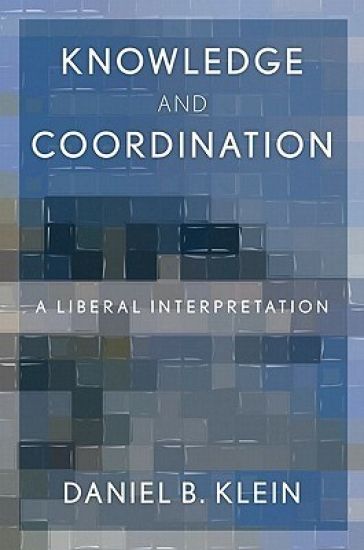
Knowledge and Coordination

Knowledge and Coordination

Daniel B. Klein

Oxford University Press Inc
2012
sidottu
Adam Smith and Friedrich Hayek saw the liberty principle as focal and accorded it strong presumption. But their wisdom invokes how little we can know. In Knowledge and Coordination, Daniel Klein re-examines the elements of economic liberalism. He interprets Hayek's notion of spontaneous order from the aestheticized perspective of a Smithian spectator, real or imagined. Klein addresses issues economists have had surrounding the notion of coordination by distinguishing the concatenate coordination of Hayek, Ronald Coase, and Michael Polanyi from the mutual coordination of Thomas Schelling and game theory. Clarifying the meaning of cooperation, he resolves debates over whether entrepreneurial innovation enhances or upsets coordination, and thus interprets entrepreneurship in terms of discovery, or new knowledge. Beyond information, knowledge entails interpretation and judgment, emergent from tacit reaches of the "society of mind," itself embedded in actual society. Rejecting homo economicus in favor of the "deepself," Klein offers a distinctive formulation of knowledge economics, entailing asymmetric interpretation, judgment, entrepreneurship, error, and correction-and kinds of discovery-which all serve the cause of liberty. This richness of knowledge joins agent and analyst, and meaningful theory depends on tacit affinities between the two. Knowledge and Coordination highlights the recurring connections to underlying purposes and sensibilities, of analysts as well as agents. Behind economic talk of market communication and social error and correction lies Klein's Smithian allegory, with the allegorical spectator representing a conception of the social. Knowledge and Coordination instructs us to declare such allegory. Knowledge and Coordination is an authoritative take on how, by confessing the looseness of its judgments and the by-and-large status of its claims, laissez-faire liberalism makes its economic doctrines more robust and its presumption of liberty more viable.
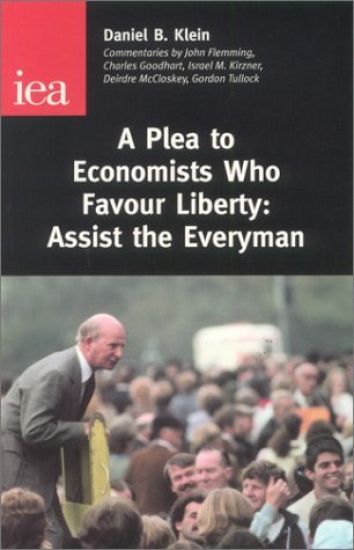
A Plea to Economists Who Favour Liberty

A Plea to Economists Who Favour Liberty

Daniel B. Klein

Institute of Economic Affairs
2001
sidottu
Should economists remain as detached scholars, pursuing their research to the satisfaction of themselves and fellow academics? Or should they try to educate their fellow men and women in economic ideas, hoping to have an impact on economic policy? In this Occasional Paper, Professor Daniel B. Klein addresses these issues, concluding that if economists want to be influential in policy-making, they must be willing to communicate with the 'Everyman'. Scholasticism is valuable in encouraging high research standards, but it has been carried too far in the economics profession, to the detriment of research and teaching which are relevant to policy. Five well-known economists - John Flemming, Charles Goodhart, Israel Kirzner, Deirdre McCloskey and Gordon Tullock - then comment on Klein's paper.
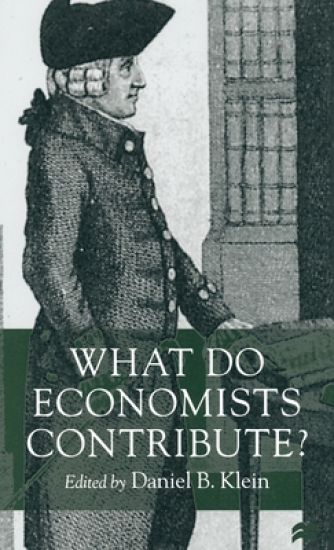
What Do Economists Contribute?

What Do Economists Contribute?

Daniel B. Klein

Palgrave Macmillan
1999
sidottu
The title of this book raises a provocative question that should make all economists think. What is our raison d'etre ? Only a few economists have specifically addressed the issue. Several of the more challenging efforts are included here. Do economists have much influence on government policy, particularly over, say, five or ten years? Is that because they don't try hard enough or is it because politicians care more about the next election than about the opinion of economists? In this splendid collection, some published as long ago as the 1930s, nine great economists consider these questions. The editor's illuminating introduction sorts out the area of agreement and disagreement between them.
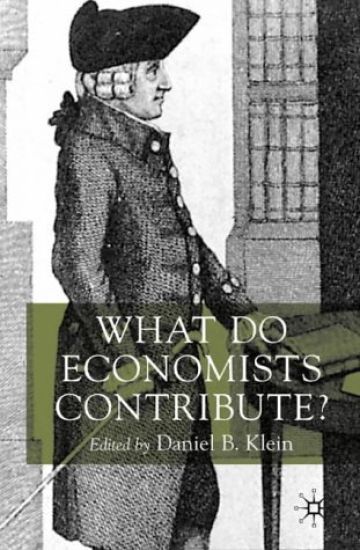
What Do Economists Contribute?

What Do Economists Contribute?

Daniel B. Klein

Palgrave Macmillan
1999
nidottu
The title of this book raises a provocative question that should make all economists think. What is our raison d'etre ? Only a few economists have specifically addressed the issue. Several of the more challenging efforts are included here. Do economists have much influence on government policy, particularly over, say, five or ten years? Is that because they don't try hard enough or is it because politicians care more about the next election than about the opinion of economists? In this splendid collection, some published as long ago as the 1930s, nine great economists consider these questions. The editor's illuminating introduction sorts out the area of agreement and disagreement between them.