Kirjojen hintavertailu. Mukana 12 152 606 kirjaa ja 12 kauppaa.

Kirjahaku

Etsi kirjoja tekijän nimen, kirjan nimen tai ISBN:n perusteella.

5 kirjaa tekijältä Daniel Halliday

Inheritance of Wealth

Inheritance of Wealth

Daniel Halliday

Oxford University Press
2018
sidottu
Daniel Halliday examines the moral grounding of the right to bequeath or transfer wealth. He engages with contemporary concerns about wealth inequality, class hierarchy, and taxation, while also drawing on the history of the egalitarian, utilitarian, and liberal traditions in political philosophy. He presents an egalitarian case for restricting inherited wealth, arguing that unrestricted inheritance is unjust to the extent that it enables and enhances the intergenerational replication of inequality. Here, inequality is understood in a group-based sense: the unjust effects of inheritance are principally in its tendency to concentrate certain opportunities into certain groups. This results in what Halliday describes as 'economic segregation'. He defends a specific proposal about how to tax inherited wealth: roughly, inheritance should be taxed more heavily when it comes from old money. He rebuts some sceptical arguments against inheritance taxes, and makes suggestions about how tax schemes should be designed.

Inheritance of Wealth

Inheritance of Wealth

Daniel Halliday

Oxford University Press
2020
nidottu
Daniel Halliday examines the moral grounding of the right to bequeath or transfer wealth. He engages with contemporary concerns about wealth inequality, class hierarchy, and taxation, while also drawing on the history of the egalitarian, utilitarian, and liberal traditions in political philosophy. He presents an egalitarian case for restricting inherited wealth, arguing that unrestricted inheritance is unjust to the extent that it enables and enhances the intergenerational replication of inequality. Here, inequality is understood in a group-based sense: the unjust effects of inheritance are principally in its tendency to concentrate certain opportunities into certain groups. This results in what Halliday describes as 'economic segregation'. He defends a specific proposal about how to tax inherited wealth: roughly, inheritance should be taxed more heavily when it comes from old money. He rebuts some sceptical arguments against inheritance taxes, and makes suggestions about how tax schemes should be designed.

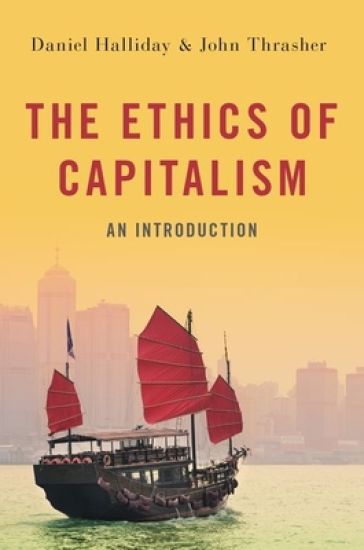
The Ethics of Capitalism

The Ethics of Capitalism

Daniel Halliday; John Thrasher

Oxford University Press Inc
2020
sidottu
Can capitalism have moral foundations? Though this question may seem strange in today's world of vast economic disparities and widespread poverty, discussions originating with the birth of capitalism add a critical perspective to the current debate on the efficacy and morality of capitalist economies. Authors Daniel Halliday and John Thrasher use this question to introduce classical political philosophy as a framework by which to evaluate the ethics of capitalism today. They revisit and reconstruct historical eighteenth- and nineteenth-century defenses of capitalism, as written by key proponents such as Adam Smith and John Stuart Mill. They ask what these early advocates of market order would say about contemporary economies, and argue for the importance of connecting these foundational defenses to discussions of economic systems and the roles they play in economic justice and injustice today. The textbook covers longstanding problems that are as old as the discussion of capitalism itself, such as wage inequality, global trade, and the connection between paid labor and human flourishing. It also addresses new challenges, such as climate change, the welfare state, and competitive consumption, and provides topical global case studies. Additionally, it includes study questions at the end of each chapter and an author-created companion website to help guide classroom discussion.
The Ethics of Capitalism

The Ethics of Capitalism

Daniel Halliday; John Thrasher

Oxford University Press Inc
2020
nidottu
Can capitalism have moral foundations? Though this question may seem strange in today's world of vast economic disparities and widespread poverty, discussions originating with the birth of capitalism add a critical perspective to the current debate on the efficacy and morality of capitalist economies. Authors Daniel Halliday and John Thrasher use this question to introduce classical political philosophy as a framework by which to evaluate the ethics of capitalism today. They revisit and reconstruct historical eighteenth- and nineteenth-century defenses of capitalism, as written by key proponents such as Adam Smith and John Stuart Mill. They ask what these early advocates of market order would say about contemporary economies, and argue for the importance of connecting these foundational defenses to discussions of economic systems and the roles they play in economic justice and injustice today. The textbook covers longstanding problems that are as old as the discussion of capitalism itself, such as wage inequality, global trade, and the connection between paid labor and human flourishing. It also addresses new challenges, such as climate change, the welfare state, and competitive consumption, and provides topical global case studies. Additionally, it includes study questions at the end of each chapter and an author-created companion website to help guide classroom discussion.