Kirjojen hintavertailu. Mukana 12 390 323 kirjaa ja 12 kauppaa.

Kirjahaku

Etsi kirjoja tekijän nimen, kirjan nimen tai ISBN:n perusteella.

11 kirjaa tekijältä Daniel K. Williams

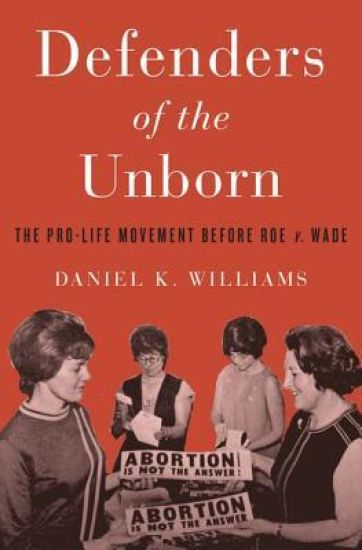
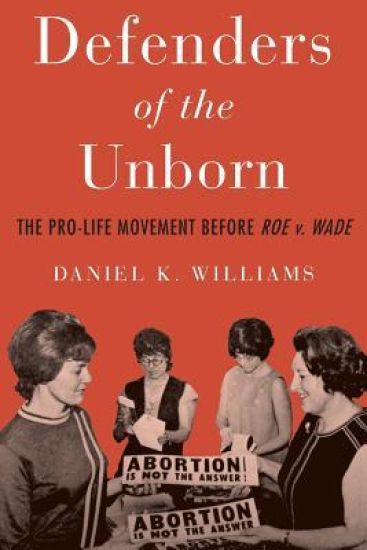
Defenders of the Unborn

Defenders of the Unborn

Daniel K. Williams

Oxford University Press Inc
2019
nidottu
On April 16, 1972, ten thousand people gathered in Central Park to protest New York's liberal abortion law. Emotions ran high, reflecting the nation's extreme polarization over abortion. Yet the divisions did not fall neatly along partisan or religious lines-the assembled protesters were far from a bunch of fire-breathing culture warriors. In Defenders of the Unborn, Daniel K. Williams reveals the hidden history of the pro-life movement in America, showing that a cause that many see as reactionary and anti-feminist began as a liberal crusade for human rights. For decades, the media portrayed the pro-life movement as a Catholic cause, but by the time of the Central Park rally, that stereotype was already hopelessly outdated. The kinds of people in attendance at pro-life rallies ranged from white Protestant physicians, to young mothers, to African American Democratic legislators-even the occasional member of Planned Parenthood. One of New York City's most vocal pro-life advocates was a liberal Lutheran minister who was best known for his civil rights activism and his protests against the Vietnam War. The language with which pro-lifers championed their cause was not that of conservative Catholic theology, infused with attacks on contraception and women's sexual freedom. Rather, they saw themselves as civil rights crusaders, defending the inalienable right to life of a defenseless minority: the unborn fetus. It was because of this grounding in human rights, Williams argues, that the right-to-life movement gained such momentum in the early 1960s. Indeed, pro-lifers were winning the battle before Roe v. Wade changed the course of history. Through a deep investigation of previously untapped archives, Williams presents the untold story of New Deal-era liberals who forged alliances with a diverse array of activists, Republican and Democrat alike, to fight for what they saw as a human rights cause. Provocative and insightful, Defenders of the Unborn is a must-read for anyone who craves a deeper understanding of a highly-charged issue.
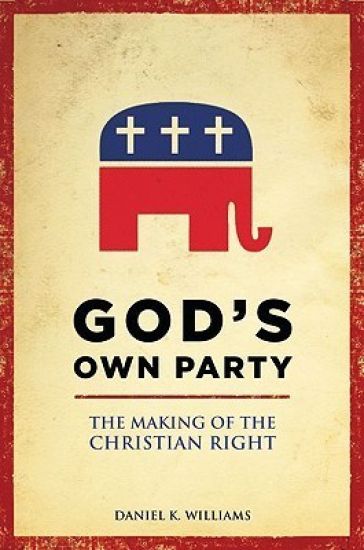
God's Own Party

God's Own Party

Daniel K. Williams

Oxford University Press Inc
2010
sidottu
When the Christian Right burst onto the scene in the late 1970s, many political observers were shocked. But, God's Own Party demonstrates, they shouldn't have been. The Christian Right goes back much farther than most journalists, political scientists, and historians realize. Relying on extensive archival and primary source research, Daniel K. Williams presents the first comprehensive history of the Christian Right, uncovering how evangelicals came to see the Republican Party as the vehicle through which they could reclaim America as a Christian nation. The conventional wisdom has been that the Christian Right arose in response to Roe v. Wade and the liberal government policies of the 1970s. Williams shows that the movement's roots run much deeper, dating to the 1920s, when fundamentalists launched a campaign to restore the influence of conservative Protestantism on American society. He describes how evangelicals linked this program to a political agenda-resulting in initiatives against evolution and Catholic political power, as well as the national crusade against communism. Williams chronicles Billy Graham's alliance with the Eisenhower White House, Richard Nixon's manipulation of the evangelical vote, and the political activities of Jerry Falwell, Pat Robertson, and others, culminating in the presidency of George W. Bush. Though the Christian Right has frequently been declared dead, Williams shows, it has come back stronger every time. Today, no Republican presidential candidate can hope to win the party's nomination without its support. A fascinating and much-needed account of a key force in American politics, God's Own Party is the only full-scale analysis of the electoral shifts, cultural changes, and political activists at the movement's core-showing how the Christian Right redefined politics as we know it.
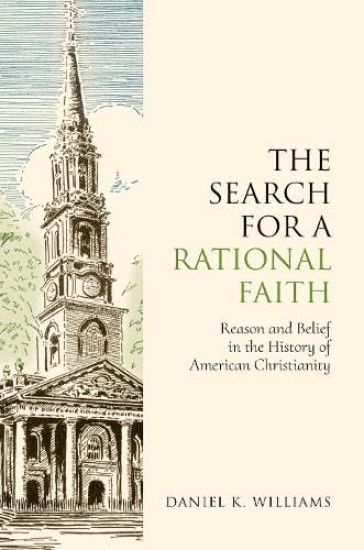
The Search for a Rational Faith

The Search for a Rational Faith

Daniel K. Williams

OXFORD UNIVERSITY PRESS INC
2025
sidottu
The Enlightenment and Darwinism posed threats to traditional Christianity. So why have so many highly educated Americans remained committed believers? The Search for a Rational Faith challenges popular theories of secularization with a sweeping 400-year history of Anglo-American Protestant defenses of the Christian faith. Through a detailed study of the arguments of those who found Christian faith compatible with Enlightenment reason, Daniel K. Williams explains why Christian faith has continued to remain a viable intellectual option in the United States even for educated people who accept modern science. From the seventeenth-century New England Puritans who founded Harvard College to the twentieth-century university professors who believed that Christian theism was the only viable grounding for morality in the atomic age, faith and reason have been an integral part of the Anglo-American experience. This book chronicles that story. It is a story that intersects with the spiritual lives of well-known figures such as Isaac Newton, John Locke, John Adams, Harriet Beecher Stowe, Reinhold Niebuhr, and Martin Luther King Jr., all of whom wrestled with the question of the reason to believe. It is the story of Christian apologists who crafted intellectually sophisticated defenses of the faith. And above all, it is the story of the development of an idea-the idea that there is a rational basis for Christian belief. This book shows how that idea was transmitted from England to America in the seventeenth century and how it continued to develop and transform over the next four centuries in response to the Enlightenment, Darwinian evolution, historical criticism of the Bible, new theories of religious epistemology, and the ethical challenge of the civil rights movement. The Search for a Rational Faith is the story of what that idea meant in the past and what it still means today, in a new era of secularization.
Defenders of the Unborn

Defenders of the Unborn

Daniel K. Williams

Oxford University Press Inc
2016
sidottu
Abortion is the most divisive issue in America's culture wars, seemingly creating a clear division between conservative members of the Religious Right and people who align themselves with socially and politically liberal causes. In Defenders of the Unborn, historian Daniel K. Williams complicates this perspective by offering a detailed, engagingly written narrative of the pro-life movement's mid-twentieth-century origins. He explains that the movement began long before Roe v. Wade, and traces its fifty-year history to explain how and why abortion politics have continued to polarize the nation up to the present day. As this book shows, the pro-life movement developed not because of a backlash against women's rights, the sexual revolution, or the power of the Supreme Court, but because of an anxiety that devout Catholics-as well as Orthodox Jews, liberal Protestants, and others not commonly associated with the movement-had about living in a society in which the "inalienable" right to life was no longer protected in public law. As members of a movement grounded in the liberal human rights tradition of the 1960s, pro-lifers were winning the political debate on abortion policy up until the decision in Roe v.Wade deprived them of victory and forced them to ally with political conservatives, a move that eventually required a compromise of some of their core values. Defenders of the Unborn draws from a wide range of previously unexamined archival sources to offer a new portrayal of the pro-life movement that will surprise people on both sides of the abortion debate.
God's Own Party

God's Own Party

Daniel K. Williams

Oxford University Press Inc
2012
nidottu
When the Christian Right burst onto the scene in the late 1970s, many political observers were shocked. But, as God's Own Party demonstrates, they shouldn't have been. The Christian Right goes back much farther than most journalists, political scientists, and historians realize. Relying on extensive archival and primary source research, Daniel K. Williams presents the first comprehensive history of the Christian Right, uncovering how evangelicals came to see the Republican Party as the vehicle through which they could reclaim America as a Christian nation. A fascinating and much-needed account of a key force in American politics, God's Own Party is the only full-scale analysis of the electoral shifts, cultural changes, and political activists at the movement's core--showing how the Christian Right redefined politics as we know it.
Abortion and America's Churches

Abortion and America's Churches

Daniel K. Williams

UNIVERSITY OF NOTRE DAME PRESS
2025
sidottu
Abortion and America's Churches explores the surprising history of how American Christians think about abortion. Many people assume that Christians have steadfastly condemned abortion throughout the United States's history. Daniel K. Williams overthrows all assumptions about the unity, consistency, or simplicity of American Christian thought and belief in this groundbreaking new book. He demonstrates that churches in the United States have fought among themselves and with the wider culture as they developed and enforced their stance on abortion, revealing major struggles to define their often-changing positions. Far from a cynical exercise of political interest, changes and disagreements arose from serious theological considerations informed by each tradition's approach to the faith. These theological shifts—and corresponding shifts in interreligious political alliances—led to the changing fortunes of Roe v. Wade. By capturing the fascinating and complicated history informing each faith's position, Abortion and America's Churches restores much-needed context to the sharp polarization over abortion today.
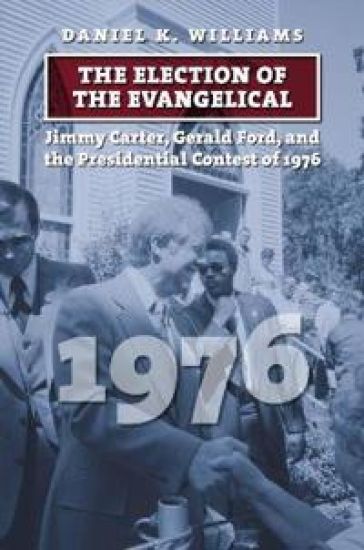
The Election of the Evangelical

The Election of the Evangelical

Daniel K. Williams

University Press of Kansas
2020
sidottu
From where we stand now, the election of 1976 can look like an alternate reality: southern white evangelicals united with African Americans, northern Catholics, and Jews in support of a Democratic presidential candidate; the Republican candidate, a social moderate whose wife proudly proclaimed her support for Roe v. Wade, was able to win over Great Plains farmers as well as cultural liberals in Oregon, California, Connecticut, and New Jersey - even as he lost Ohio, Texas, and nearly the entire South. The Election of the Evangelical offers an unprecedented, behind-the-headlines analysis of this now almost unimaginable political moment, which proved to be a pivotal turning point in polarizing American political parties along ideological and cultural lines and eventually in destroying the winning coalition that Jimmy Carter created.The big story immediately following the election was that a self-described evangelical Christian and improbably dark-horse candidate from the Deep South had won the presidency, leading Newsweek to call 1976 the 'year of the evangelical.' What pundits overlooked at the time, and what Daniel K. Williams delves into in this book, was the profound effect of the election on the nation's political parties. In the first comprehensive historical study of this consequential election, Williams mines untapped archival materials to uncover the strategies of the Ford, Carter, and Reagan campaigns and Republican and Democratic leaders in 1976. His work explains why, despite Ford's and Carter's efforts to the contrary, the 1976 presidential election reshaped the political parties along ideologically polarized lines. As he examines the role that religion and 'values voting' played in 1976, Williams reveals why Carter was the last Democrat to hold together a New Deal-style coalition of white southern evangelicals, northern Catholics, and African Americans. His findings dispel the most common myths about why Ford lost the election and clarify what his defeat meant for the future of the Republican Party.An eye-opening account of electoral politics at an epochal crossroads, this book provides valuable historical perspective and critical insight in a time of seemingly ever-increasing partisan polarization in American political life.
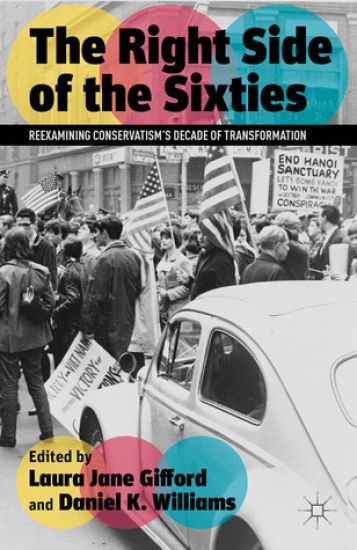
The Right Side of the Sixties

The Right Side of the Sixties

Laura Jane Gifford; Daniel K. Williams

Palgrave Macmillan
2012
sidottu
The 1960s were a transformative era for American politics, but much is still unknown about the growth of conservatism during the period when it was radically reshaped and became the national political force that it is today. In their efforts to chronicle the national politicians and organizations that led the movement, previous histories have often neglected local perspectives, the role of religion, transnational exchange, and other aspects that help to explain conservatism's enduring influence in American politics. Taken together, the contributions gathered here offer a cutting-edge synthesis that incorporates these overlooked developments and provides new insights into the way that the 1960s shaped the trajectory of postwar conservatism.
The Right Side of the Sixties

The Right Side of the Sixties

Laura Jane Gifford; Daniel K. Williams

Palgrave Macmillan
2012
nidottu
The 1960s were a transformative era for American politics, but much is still unknown about the growth of conservatism during the period when it was radically reshaped and became the national political force that it is today. In their efforts to chronicle the national politicians and organizations that led the movement, previous histories have often neglected local perspectives, the role of religion, transnational exchange, and other aspects that help to explain conservatism's enduring influence in American politics. Taken together, the contributions gathered here offer a cutting-edge synthesis that incorporates these overlooked developments and provides new insights into the way that the 1960s shaped the trajectory of postwar conservatism.