Kirjojen hintavertailu. Mukana 11 244 527 kirjaa ja 12 kauppaa.

Kirjahaku

Etsi kirjoja tekijän nimen, kirjan nimen tai ISBN:n perusteella.

13 kirjaa tekijältä Daniel N. Robinson

Toward a Science of Human Nature

Toward a Science of Human Nature

Daniel N. Robinson

Columbia University Press
1982
sidottu
Robinson unfolds the vision of four influential writers on psychology---J.S. Mill, F. Hegel, Wilhelm Wundt, and William James---who considered the world, its persons and problems, its possibilities and conflicts, its scientific facts and its moral ambiguities, and proceeded to devise a means by which to improve it. Robinson shows how in thinking about psychology, these individuals provided an intellectual context within which the discipline could be refined.
Toward a Science of Human Nature

Toward a Science of Human Nature

Daniel N. Robinson

Columbia University Press
1982
pokkari
Robinson unfolds the vision of four influential writers on psychology---J.S. Mill, F. Hegel, Wilhelm Wundt, and William James---who considered the world, its persons and problems, its possibilities and conflicts, its scientific facts and its moral ambiguities, and proceeded to devise a means by which to improve it. Robinson shows how in thinking about psychology, these individuals provided an intellectual context within which the discipline could be refined.
Consciousness and Mental Life

Consciousness and Mental Life

Daniel N. Robinson

Columbia University Press
2007
sidottu
In recent decades, issues that reside at the center of philosophical and psychological inquiry have been absorbed into a scientific framework variously identified as "brain science," "cognitive science," and "cognitive neuroscience." Scholars have heralded this development as revolutionary, but a revolution implies an existing method has been overturned in favor of something new. What long-held theories have been abandoned or significantly modified in light of cognitive neuroscience? Consciousness and Mental Life questions our present approach to the study of consciousness and the way modern discoveries either mirror or contradict understandings reached in the centuries leading up to our own. Daniel N. Robinson does not wage an attack on the emerging discipline of cognitive science. Rather, he provides the necessary historical context to properly evaluate the relationship between issues of consciousness and neuroscience and their evolution over time. Robinson begins with Aristotle and the ancient Greeks and continues through to Rene Descartes, David Hume, William James, Daniel Dennett, John Searle, Richard Rorty, Hilary Putnam, and Derek Parfit. Approaching the issue from both a philosophical and a psychological perspective, Robinson identifies what makes the study of consciousness so problematic and asks whether cognitive neuroscience can truly reveal the origins of mental events, emotions, and preference, or if these occurrences are better understood by studying the whole person, not just the brain. Well-reasoned and thoroughly argued, Consciousness and Mental Life corrects many claims made about the success of brain science and provides a valuable historical context for the study of human consciousness.
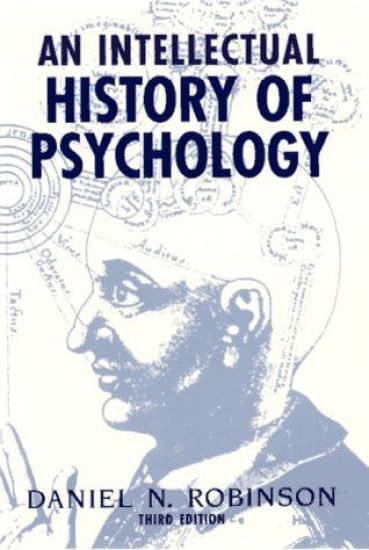
An Intellectual History of Psychology

An Intellectual History of Psychology

Daniel N. Robinson

University of Wisconsin Press
1995
nidottu
An Intellectual History of Psychology, already a classic in its field, is now available in a concise third edition. It presents psychological ideas as part of a greater web of thinking throughout history about the essentials of human nature, interwoven with ideas from philosophy, science, religion, art, literature, and politics.Daniel N. Robinson demonstrates that from the dawn of rigorous and self-critical inquiry in ancient Greece, reflections about human nature have been inextricably linked to the cultures from which they arose, and each definable historical age has added its own character and tone to this long tradition. An Intellectual History of Psychology not only explores the most significant ideas about human nature from ancient to modern times, but also examines the broader social and scientific contexts in which these concepts were articulated and defended. Robinson treats each epoch, whether ancient Greece or Renaissance Florence or Enlightenment France, in its own terms, revealing the problems that dominated the age and engaged the energies of leading thinkers.Robinson also explores the abiding tension between humanistic and scientific perspectives, assessing the most convincing positions on each side of the debate. Invaluable as a text for students and as a stimulating and insightful overview for scholars and practicing psychologists, this volume can be read either as a history of psychology in both its philosophical and aspiring scientific periods or as a concise history of Western philosophy's concepts of human nature.
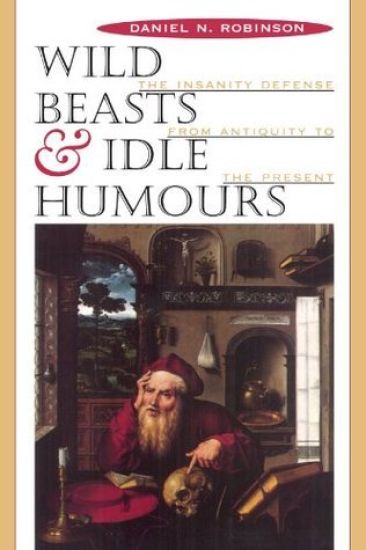
Wild Beasts and Idle Humours

Wild Beasts and Idle Humours

Daniel N. Robinson

Harvard University Press
1998
nidottu
How does the law regard and define mental incompetence, when faced with the problem of meting out justice? To what extent has the law relied on extra-legal authorities—be they religious or scientific—to frame its own categories of mental incompetence and madness? Wild Beasts and Idle Humours takes us on an illuminating journey through the changing historical landscape of human nature and offers an unprecedented look at the legal conceptions of insanity from the pre-classical Greek world to the present. Although actual trial records are either totally lacking or incomplete until the eighteenth century, there are other sources from which the insanity defenses can be constructed.In this book Daniel N. Robinson, a distinguished historian of psychology, pores over centuries of written law, statements by legal commentators, summaries of crimes, and punishments, to glean from these sources an understanding of epochal views of responsibility and competence. From the Greek phrenesis to the Roman notions of furiosus and non compos mentis, from the seventeenth-century witch trials to today’s interpretation of mens rea, Robinson takes us through history and provides the intricate story of how the insanity defense has been construed as a meeting point of the law and those professions that chart human behavior and conduct: namely religion, medicine, and psychology. The result is a rare historical account of “insanity” within Western civilization.Wild Beasts and Idle Humours will be essential reading for anyone interested in the evolution of thinking not merely about legal insanity but about such core concepts as responsibility, fitness for the rule of law, competence to enter into contracts and covenants, the role of punishments, and the place of experts within the overall juridical context.
Praise and Blame

Praise and Blame

Daniel N. Robinson

Princeton University Press
2002
sidottu
How should a prize be awarded after a horse race? Should it go to the best rider, the best person, or the one who finishes first? To what extent are bystanders blameworthy when they do nothing to prevent harm? Are there any objective standards of moral responsibility with which to address such perennial questions? In this fluidly written and lively book, Daniel Robinson takes on the prodigious task of setting forth the contours of praise and blame. He does so by mounting an important and provocative new defense of a radical theory of moral realism and offering a critical appraisal of prevailing alternatives such as determinism and behaviorism and of their conceptual shortcomings. The version of moral realism that arises from Robinson's penetrating inquiry--an inquiry steeped in Aristotelian ethics but deeply informed by modern scientific knowledge of human cognition--is independent of cognition and emotion. At the same time, Robinson carefully explores how such human attributes succeed or fail in comprehending real moral properties. Through brilliant analyses of constitutional and moral luck, of biosocial and genetic versions of psychological determinism, and of relativistic-anthropological accounts of variations in moral precepts, he concludes that none of these conceptions accounts either for the nature of moral properties or the basis upon which they could be known. Ultimately, the theory that Robinson develops preserves moral properties even while acknowledging the conditions that undermine the powers of human will.
How is Nature Possible?

How is Nature Possible?

Daniel N. Robinson

Continuum Publishing Corporation
2012
nidottu
How is Nature Possible?: Kants Project in the First Critique presents a clear and systematic appraisal of what is perhaps the most difficult treatise in the philosophical canon. Daniel N. Robinson situates Kants undertaking in the First Critique within the context of the history of philosophy and as a response to the challenges of scepticism. Kants central task in the First Critique is to tie his metaphysical analysis to the very possibility of nature itself. Where others assumed the validity or the weakness of perception and reason, Kant presents a critical appraisal of both, thereby establishing the very limits of sense and reason as instruments of discovery. Ideal for students at all levels, this fascinating introduction clarifies the aims and significance of Kants project, locates its place within the history of philosophy and identifies the strengths and weaknesses reasonably attributed to this most significant contribution to the history of philosophical reflection.
How is Nature Possible?

How is Nature Possible?

Daniel N. Robinson

Continuum Publishing Corporation
2012
sidottu
This is a concise commentary on Kant's aims and arguments in his celebrated "First Critique", within the context of the dominant schools of philosophy of his time. "How is Nature Possible?: Kant's Project in the First Critique" presents a clear and systematic appraisal of what is perhaps the most difficult treatise in the philosophical canon. Daniel N. Robinson situates Kant's undertaking in the "First Critique" within the context of the history of philosophy and as a response to the challenges of scepticism. Kant's central task in the "First Critique" is to tie his metaphysical analysis to the very possibility of nature itself. Where others assumed the validity or the weakness of perception and reason, Kant presents a critical appraisal of both, thereby establishing the very limits of sense and reason as instruments of discovery. Ideal for students at all levels, this fascinating introduction clarifies the aims and significance of Kant's project, locates its place within the history of philosophy and identifies the strengths and weaknesses reasonably attributed to this most significant contribution to the history of philosophical reflection.