Kirjojen hintavertailu. Mukana 11 699 587 kirjaa ja 12 kauppaa.

Kirjahaku

Etsi kirjoja tekijän nimen, kirjan nimen tai ISBN:n perusteella.

11 kirjaa tekijältä Daniel Nelson

Farm and Factory

Farm and Factory

Daniel Nelson

Indiana University Press
1995
sidottu
"Nelson . . . [is] one of the country's leading labor scholars. . . . [His] work provides an invaluable . . . guide to understanding a critical region . . . ." —Ohio History ". . . I learned quite a lot from reading Farm and Factory, and this will certainly be the case for all who pick up this valuable and informative book." —Minnesota History ". . . a valuable source for anyone concerned with regional and national tendencies in labor relations and ecomomic change over the last century." —American Political Science Review ". . . a useful and well written synthesis of labor history in the Midwest in the period between 1880 and 1990." —Labor History ". . . Nelson's work is most impressive in both its scope and depth. . . . a long-overdue study of the Midwest as a region distinct and important in the history of American labor." —Northwest Ohio Quarterly ". . . a richly textured and much needed regional overview." —Journal of the West ". . . a well written synthesis useful for classroom assignment in regional and social history. It is also a good starting point for a discussion of the future of the midwestern economy." —Wisconsin Magazine of History " . . . a work of superior scholarship [that] makes an original and important contribution to the field." —Nancy Gabin "A useful source for the demographic and economic dynamics of the Midwest and a good starting point for entering the voluminous secondary literature on the nation's heartland." —The Journal of American History ". . . it provides an insightful, wide-ranging look at work and workers in the Midwest. It will certainly be a basic resource on regional history for years to come, as well as a book that adds to our broader understanding of the nation's labor and economic history." —Indiana Magazine of History "Solidly researched and eloquently written, Nelson's work will long occupy well-deserved status as a redefinition of traditional midwestern history." —Illinois Historical Journal "The great strength of Nelson's book lies in its up-to-date synthesis of various social history literatures . . . the study forms an exemplary American labor history." —Michigan Historical Review "The writing is a model of clarity and economy; the examples are well chosen and the sources are complete. Nelson has presented a blueprint for a new way to think about and present labor history." —Agricultural History "Farm and Factory deserves to take a place among the most respected books consulted by students of midwestern history" —The Annals of Iowa Daniel Nelson illuminates the importance of the Midwest in U.S. labor history.
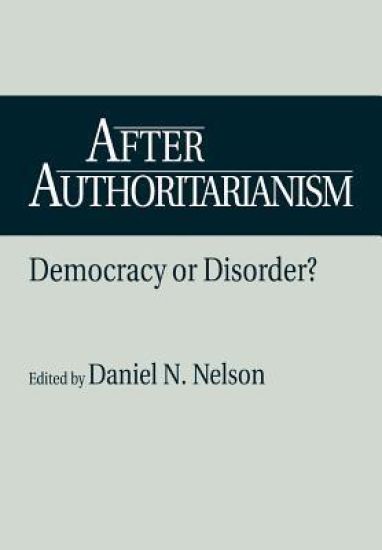
After Authoritarianism

After Authoritarianism

Daniel Nelson

Praeger Publishers Inc
1995
nidottu
The 1980s and 1990s have witnessed a wave of democratization across the world. This trend has led to some basic questions about the future of democracy and its ability to survive. This theme is examined from two focal points—that of praxis and that of security.Major theorists such as Robert Dahl and noted democractic leaders such as former Argentine President Raul Alfonsin join forces to spell out the essential ingredients for avoiding disaster in transitional periods of post-authoritarian states. This edited collection challenges some of the existing views about democratization around the world and considers basic questions of both praxis and security. Part of this unique overview deals with practical lessons learned in various countries; part focuses on links between democracy and security. Several themes underline the work. First, that democracy cannot be made from above. Second, that the survival of democracy is directly linked to security issues. It becomes clear that the future of democracy after authoritarianism may not be as bright as thought. Excellent text for courses in world politics, democratic theory, and comparative politics.
After Authoritarianism

After Authoritarianism

Daniel Nelson

Praeger Publishers Inc
1995
sidottu
The 1980s and 1990s have witnessed a wave of democratization across the world. This trend has led to some basic questions about the future of democracy and its ability to survive. This theme is examined from two focal points—that of praxis and that of security.Major theorists such as Robert Dahl and noted democractic leaders such as former Argentine President Raul Alfonsin join forces to spell out the essential ingredients for avoiding disaster in transitional periods of post-authoritarian states. This edited collection challenges some of the existing views about democratization around the world and considers basic questions of both praxis and security. Part of this unique overview deals with practical lessons learned in various countries; part focuses on links between democracy and security. Several themes underline the work. First, that democracy cannot be made from above. Second, that the survival of democracy is directly linked to security issues. It becomes clear that the future of democracy after authoritarianism may not be as bright as thought. Excellent text for courses in world politics, democratic theory, and comparative politics.
American Rubber Workers & Organized Labor, 1900-1941

American Rubber Workers & Organized Labor, 1900-1941

Daniel Nelson

Princeton University Press
2014
pokkari
In 1900 the manufacture of rubber products in the United States was concentrated in several hundred small plants around New York and Boston that employed low-paid immigrant workers with no intervention from unions. By the mid-1930s, thanks to the automobile and the Depression, production was concentrated in Ohio, the labor force was largely native born and highly paid, and labor organizations had a decisive influence on the industry. Daniel Nelson tells the story of these changes as a case study of union growth against a background of critical developments in twentieth-century economic life. The author emphasizes the years after 1910, when a crucial distinction arose between big, mass-production rubber producers and those that were smaller and more labor intensive. In the 1930s mass-production workers took the lead in organizing the labor movement, and they dominated the international union, the United Rubber Workers, until the end of the decade. Professor Nelson discusses not only labor's triumph over adversity but also the problems that occurred with union victories: the flight of the industry to low-wage communities in the South and Midwest, internal tensions in the union, and rivalry with the American Federation of Labor. The experiences of the URW in the late 1930s foreshadowed the longer-term challenges that the labor movement has faced in recent decades. Originally published in 1988. The Princeton Legacy Library uses the latest print-on-demand technology to again make available previously out-of-print books from the distinguished backlist of Princeton University Press. These editions preserve the original texts of these important books while presenting them in durable paperback and hardcover editions. The goal of the Princeton Legacy Library is to vastly increase access to the rich scholarly heritage found in the thousands of books published by Princeton University Press since its founding in 1905.
American Rubber Workers & Organized Labor, 1900-1941

American Rubber Workers & Organized Labor, 1900-1941

Daniel Nelson

Princeton University Press
2016
sidottu
In 1900 the manufacture of rubber products in the United States was concentrated in several hundred small plants around New York and Boston that employed low-paid immigrant workers with no intervention from unions. By the mid-1930s, thanks to the automobile and the Depression, production was concentrated in Ohio, the labor force was largely native born and highly paid, and labor organizations had a decisive influence on the industry. Daniel Nelson tells the story of these changes as a case study of union growth against a background of critical developments in twentieth-century economic life. The author emphasizes the years after 1910, when a crucial distinction arose between big, mass-production rubber producers and those that were smaller and more labor intensive. In the 1930s mass-production workers took the lead in organizing the labor movement, and they dominated the international union, the United Rubber Workers, until the end of the decade. Professor Nelson discusses not only labor's triumph over adversity but also the problems that occurred with union victories: the flight of the industry to low-wage communities in the South and Midwest, internal tensions in the union, and rivalry with the American Federation of Labor. The experiences of the URW in the late 1930s foreshadowed the longer-term challenges that the labor movement has faced in recent decades. Originally published in 1988. The Princeton Legacy Library uses the latest print-on-demand technology to again make available previously out-of-print books from the distinguished backlist of Princeton University Press. These editions preserve the original texts of these important books while presenting them in durable paperback and hardcover editions. The goal of the Princeton Legacy Library is to vastly increase access to the rich scholarly heritage found in the thousands of books published by Princeton University Press since its founding in 1905.
I: The Withering

I: The Withering

Daniel Nelson

Talen10th Publishing
2017
nidottu
The fa ade of the Emolian Empire has fallen The black-eyed blotted elf witnessed the beast being freed upon Xahmore, his mother sacrificing herself to save him, and the death of thousands within moments of each other. Now I, along with the army of light, must protect the world knowing that they are all that stands between life and oblivion In this second story of Xahmore, I: The Withering, I's destiny takes his mind, body, and soul to new plateaus while the story builds upon the world of Xahmore. We are introduced to new characters and will further explore the ones we've already come to love and side with as well as the ones we've hated and opposed in the first story of Xahmore, I: The Emolian Empire. In contrast, this second story also delves deeper into the history of the beast, even revealing its name to the races for the first time The beast is focused on an agenda fueled by revenge and hate, and if it succeeds, nothing will remain in its way. To extract his revenge, the beast sends his armies to ravage the land while it hunts the most powerful beings left, the dragons No one of Xahmore could have foreseen wrath such as this The captors and prisoners of the beast face judgment, the races face extinction, and new threats emerge from old alliances. Xahmore faces the worst period in its existence Will all be lost or will the Creator's chosen survive the withering?
Nature's Burdens

Nature's Burdens

Daniel Nelson

Utah State University Press
2017
nidottu
Nature's Burdens is a political and intellectual history of American natural resource conservation from the 1980s into the twenty-first century--a period of intense political turmoil, shifting priorities among federal policymakers, and changing ideas about the goals of conservation. Telling a story of persistent activism, conflict, and frustration but also of striking achievement, it is an account of how new ideas and policies regarding human relationships to plants, animals, and their surroundings have become vital features of modern environmentalism.In the 1960s and 1970s, Congress embraced the largely dormant movement to preserve distinctive landscapes and the growing demand for outdoor recreation, establishing an unprecedented number of parks, monuments, and recreation areas. The election of Ronald Reagan and a shift to a Republican-controlled Senate brought this activity to an abrupt halt and introduced a period of intense partisanship and legislative gridlock that extends to the present. In this political climate, three developments largely defined the role of conservation in contemporary society: environmental organizations have struggled to defend the legal status quo, private land conservation has become increasingly important, and the emergence of potent scientific voices has promoted the protection of animals and plants and injected a new sense of urgency into the larger cause.These developments mark this period as a distinctive and important chapter in the history of American conservation. Scrupulously researched, scientifically and politically well informed, concise, and accessibly written, Nature's Burdens is the most comprehensive examination of recent efforts to protect and enhance the natural world. It will be of interest to environmental historians, environmental activists, and any general reader interested in conservation.
Northern Landscapes

Northern Landscapes

Daniel Nelson

Resources for the Future Press (RFF Press)
2004
sidottu
Alaska in the early 1950s was one of the world's last great undeveloped areas. Yet sweeping changes were underway. In l958 Congress awarded the new state over 100 million acres to promote economic development. In 1971, it gave Native groups more than 40 million acres to settle land claims and facilitate the building of an 800-mile oil pipeline. Spurred by the newly militant environmental movement, it also began to consider the preservation of Alaska's magnificent scenery and wildlife. Northern Landscapes is an essential guide to Alaska's recent past and to contemporary local and national debates over the future of public lands and resources. It is the first comprehensive examination of the campaign to preserve wild Alaska through the creation of a vast system of parks and wildlife refuges. Drawing on archival sources and interviews, Daniel Nelson traces disputes over resources alongside the politics of the Alaska statehood movement. He provides in-depth coverage of the growth of Alaskan environmental organizations, their partnerships with national groups, and their participation in political campaigns into the 1970s and after. Engagingly written, Northern Landscapes focuses on efforts to persuade public officials to recognize the value of Alaska's mountains, forests, and wildlife. That activity culminated in the passage of the Alaska National Interest Lands Conservation Act (ANILCA) of 1980, which set aside more than 100 million acres, doubling the size of the national park and wildlife refuge systems, and tripling the size of the wilderness preservation system. Arguably the single greatest triumph of environmentalism, ANILCA also set the stage for continuing battles over the Arctic National Wildlife Refuge and Alaska's national forests.
Northern Landscapes

Northern Landscapes

Daniel Nelson

Resources for the Future Press (RFF Press)
2004
nidottu
Alaska in the early 1950s was one of the world's last great undeveloped areas. Yet sweeping changes were underway. In l958 Congress awarded the new state over 100 million acres to promote economic development. In 1971, it gave Native groups more than 40 million acres to settle land claims and facilitate the building of an 800-mile oil pipeline. Spurred by the newly militant environmental movement, it also began to consider the preservation of Alaska's magnificent scenery and wildlife. Northern Landscapes is an essential guide to Alaska's recent past and to contemporary local and national debates over the future of public lands and resources. It is the first comprehensive examination of the campaign to preserve wild Alaska through the creation of a vast system of parks and wildlife refuges. Drawing on archival sources and interviews, Daniel Nelson traces disputes over resources alongside the politics of the Alaska statehood movement. He provides in-depth coverage of the growth of Alaskan environmental organizations, their partnerships with national groups, and their participation in political campaigns into the 1970s and after. Engagingly written, Northern Landscapes focuses on efforts to persuade public officials to recognize the value of Alaska's mountains, forests, and wildlife. That activity culminated in the passage of the Alaska National Interest Lands Conservation Act (ANILCA) of 1980, which set aside more than 100 million acres, doubling the size of the national park and wildlife refuge systems, and tripling the size of the wilderness preservation system. Arguably the single greatest triumph of environmentalism, ANILCA also set the stage for continuing battles over the Arctic National Wildlife Refuge and Alaska's national forests.