Kirjojen hintavertailu. Mukana 11 417 647 kirjaa ja 12 kauppaa.

Kirjahaku

Etsi kirjoja tekijän nimen, kirjan nimen tai ISBN:n perusteella.

11 kirjaa tekijältä Daniel R. Headrick

Humans versus Nature

Humans versus Nature

Daniel R. Headrick

Oxford University Press Inc
2020
sidottu
Since the appearance of Homo sapiens on the planet hundreds of thousands of years ago, human beings have sought to exploit their environments, extracting as many resources as their technological ingenuity has allowed. As technologies have advanced in recent centuries, that impulse has remained largely unchecked, exponentially accelerating the human impact on the environment. Humans versus Nature tells a history of the global environment from the Stone Age to the present, emphasizing the adversarial relationship between the human and natural worlds. Nature is cast as an active protagonist, rather than a mere backdrop or victim of human malfeasance. Daniel R. Headrick shows how environmental changes--epidemics, climate shocks, and volcanic eruptions--have molded human societies and cultures, sometimes overwhelming them. At the same time, he traces the history of anthropogenic changes in the environment--species extinctions, global warming, deforestation, and resource depletion--back to the age of hunters and gatherers and the first farmers and herders. He shows how human interventions such as irrigation systems, over-fishing, and the Industrial Revolution have in turn harmed the very societies that initiated them. Throughout, Headrick examines how human-driven environmental changes are interwoven with larger global systems, dramatically reshaping the complex relationship between people and the natural world. In doing so, he roots the current environmental crisis in the deep past.

Humans versus Nature

Humans versus Nature

Daniel R. Headrick

Oxford University Press Inc
2020
nidottu
Since the appearance of Homo sapiens on the planet hundreds of thousands of years ago, human beings have sought to exploit their environments, extracting as many resources as their technological ingenuity has allowed. As technologies have advanced in recent centuries, that impulse has remained largely unchecked, exponentially accelerating the human impact on the environment. Humans versus Nature tells a history of the global environment from the Stone Age to the present, emphasizing the adversarial relationship between the human and natural worlds. Nature is cast as an active protagonist, rather than a mere backdrop or victim of human malfeasance. Daniel R. Headrick shows how environmental changes--epidemics, climate shocks, and volcanic eruptions--have molded human societies and cultures, sometimes overwhelming them. At the same time, he traces the history of anthropogenic changes in the environment--species extinctions, global warming, deforestation, and resource depletion--back to the age of hunters and gatherers and the first farmers and herders. He shows how human interventions such as irrigation systems, over-fishing, and the Industrial Revolution have in turn harmed the very societies that initiated them. Throughout, Headrick examines how human-driven environmental changes are interwoven with larger global systems, dramatically reshaping the complex relationship between people and the natural world. In doing so, he roots the current environmental crisis in the deep past.

The Tentacles of Progress

The Tentacles of Progress

Daniel R. Headrick

Oxford University Press Inc
1990
nidottu
Daniel Headrick examines why the massive transfer of Western technology to European colonies did not spark an industrial revolution in those countries. Rather than spurring economic progress, he argues, the transfer of stock technology between 1850 and 1940 caused the traditional self-sufficient economies of the colonial regions to be stuck in a state of underdevelopment, a legacy which burdens these countries to this day.
The Invisible Weapon

The Invisible Weapon

Daniel R. Headrick

Oxford University Press Inc
1992
sidottu
Telecommunication is, and always has been, a political technology, as the timely flow of information is a vital instrument of power. This book examines the political history of telecommunications between 1851, the year the first telegraph cable linked France and Britain, and the end of World War II. Headrick argues that telecommunication gives people options, not orders. During periods of peace, cables and radio were, as many had predicted, instruments of peace; in times of tension, they became instruments of politics, tools for rival interests, and weapons of war. the book illuminates the political aspects of information technology: the speed of telegraphy, which could diffuse conflicts in far-flung empires, but which also hastened the deterioration of diplomacy on the brink of the First World War; the broad coverage of radio, which increased public knowledge and public pressure on governments, and consequently the political interest in controlling news; and the security of telecommunications, which made communications strategy, communications intelligence, and cryptography decisive tools during the two World Wars.
When Information Came of Age

When Information Came of Age

Daniel R. Headrick

Oxford University Press Inc
2001
sidottu
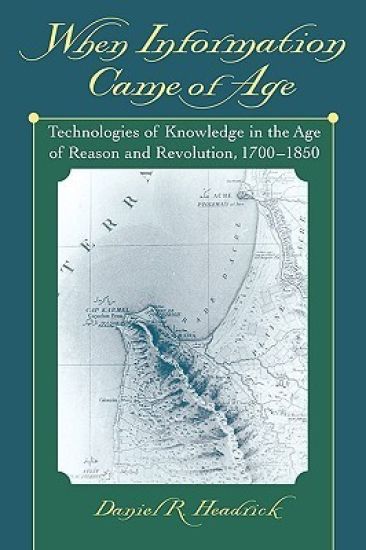
Although the Information Age is often described as a new era, a cultural leap springing directly from the invention of modern computers, it is simply the latest step in a long cultural process. Its conceptual roots stretch back to the profound changes that occurred during the Age of Reason and Revolution. When Information Came of Age argues that the key to the present era lies in understanding the systems developed in the eighteenth and early nineteenth centuries to gather, store, transform, display, and communicate information. The book provides a concise and readable survey of the many conceptual developments between 1700 and 1850 and draws connections to leading technologies of today. It documents three breakthroughs in information systems that date to the period: the classification and nomenclature of Linneaus, the chemical system devised by Lavoisier, and the metric system. It shows how eighteenth-century political arithmetricians and demographers pioneered statistics and graphs as a means for presenting data succinctly and visually. It describes the transformation of cartography from art to science as it incorporated new methods for determining longitude at sea and new data on the measure the arc of the meridian on land. Finally, it looks at the early steps in codifying and transmitting information, including the development of dictionaries, the invention of semaphore telegraphs and naval flag signaling, and the conceptual changes in the use and purpose of postal services. When Information Came of Age shows that like the roots of democracy and industrialization, the foundations of the Information Age were built in the eighteenth and early nineteenth century.
When Information Came of Age

When Information Came of Age

Daniel R. Headrick

Oxford University Press Inc
2002
nidottu
Although the Information Age is often described as a new era, a cultural leap springing directly from the invention of modern computers, it is simply the latest step in a long cultural process. Its conceptual roots stretch back to the profound changes that occurred during the Age of Reason and Revolution. When Information Came of Age argues that the key to the present era lies in understanding the systems developed in the eighteenth and early nineteenth centuries to gather, store, transform, display, and communicate information. The book provides a concise and readable survey of the many conceptual developments between 1700 and 1850 and draws connections to leading technologies of today. It documents three breakthroughs in information systems that date to the period: the classification and nomenclature of Linneaus, the chemical system devised by Lavoisier, and the metric system. It shows how eighteenth-century political arithmetricians and demographers pioneered statistics and graphs as a means for presenting data succinctly and visually. It describes the transformation of cartography from art to science as it incorporated new methods for determining longitude at sea and new data on the measure the arc of the meridian on land. Finally, it looks at the early steps in codifying and transmitting information, including the development of dictionaries, the invention of semaphore telegraphs and naval flag signaling, and the conceptual changes in the use and purpose of postal services. When Information Came of Age shows that like the roots of democracy and industrialization, the foundations of the Information Age were built in the eighteenth and early nineteenth century.
Technology

Technology

Daniel R. Headrick

Oxford University Press Inc
2009
sidottu
Today technology has created a world of dazzling progress, growing disparities of wealth and poverty, and looming threats to the environment. Technology: A World History offers an illuminating backdrop to our present moment--a brilliant history of invention around the globe. Historian Daniel R. Headrick ranges from the Stone Age and the beginnings of agriculture to the Industrial Revolution and the electronic revolution of the recent past. In tracing the growing power of humans over nature through increasingly powerful innovations, he compares the evolution of technology in different parts of the world, providing a much broader account than is found in other histories of technology. We also discover how small changes sometimes have dramatic results--how, for instance, the stirrup revolutionized war and gave the Mongols a deadly advantage over the Chinese. And how the nailed horseshoe was a pivotal breakthrough for western farmers. Enlivened with many illustrations, Technology offers a fascinating look at the spread of inventions around the world, both as boons for humanity and as weapons of destruction.
Technology

Technology

Daniel R. Headrick

Oxford University Press Inc
2009
nidottu
Today technology has created a world of dazzling progress, growing disparities of wealth and poverty, and looming threats to the environment. Technology: A World History offers an illuminating backdrop to our present moment—a brilliant history of invention around the globe. Historian Daniel R. Headrick ranges from the Stone Age and the beginnings of agriculture to the Industrial Revolution and the electronic revolution of the recent past. In tracing the growing power of humans over nature through increasingly powerful innovations, he compares the evolution of technology in different parts of the world, providing a much broader account than is found in other histories of technology. We also discover how small changes sometimes have dramatic results—how, for instance, the stirrup revolutionized war and gave the Mongols a deadly advantage over the Chinese. And how the nailed horseshoe was a pivotal breakthrough for western farmers. Enlivened with many illustrations, Technology offers a fascinating look at the spread of inventions around the world, both as boons for humanity and as weapons of destruction.
The Invisible Weapon

The Invisible Weapon

Daniel R. Headrick

Oxford University Press Inc
2012
nidottu
A vital instrument of power, telecommunications is and has always been a political technology. In this book, Headrick examines the political history of telecommunications from the mid-nineteenth century to the end of World War II. He argues that this technology gave society new options. In times of peace, the telegraph and radio were, as many predicted, instruments of peace; in times of tension, they became instruments of politics, tools for rival interests, and weapons of war. Writing in a lively, accessible style, Headrick illuminates the political aspects of information technology, showing how in both World Wars, the use of radio led to a shadowy war of disinformation, cryptography, and communications intelligence, with decisive consequences.
Power over Peoples

Power over Peoples

Daniel R. Headrick

Princeton University Press
2009
sidottu
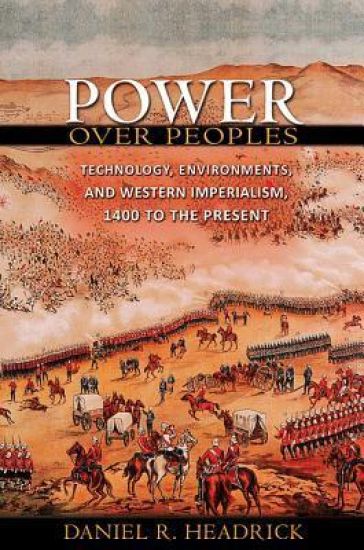
For six hundred years, the nations of Europe and North America have periodically attempted to coerce, invade, or conquer other societies. They have relied on their superior technology to do so, yet these technologies have not always guaranteed success. Power over Peoples examines Western imperialism's complex relationship with technology, from the first Portuguese ships that ventured down the coast of Africa in the 1430s to America's conflicts in the Middle East today. Why did the sailing vessels that gave the Portuguese a century-long advantage in the Indian Ocean fail to overcome Muslim galleys in the Red Sea? Why were the same weapons and methods that the Spanish used to conquer Mexico and Peru ineffective in Chile and Africa? Why didn't America's overwhelming air power assure success in Iraq and Afghanistan? In Power over Peoples, Daniel Headrick traces the evolution of Western technologies--from muskets and galleons to jet planes and smart bombs--and sheds light on the environmental and social factors that have brought victory in some cases and unforeseen defeat in others. He shows how superior technology translates into greater power over nature and sometimes even other peoples, yet how technological superiority is no guarantee of success in imperialist ventures--because the technology only delivers results in a specific environment, or because the society being attacked responds in unexpected ways. Breathtaking in scope, Power over Peoples is a revealing history of technological innovation, its promise and limitations, and its central role in the rise and fall of empire.
Power over Peoples

Power over Peoples

Daniel R. Headrick

Princeton University Press
2012
pokkari
For six hundred years, the nations of Europe and North America have periodically attempted to coerce, invade, or conquer other societies. They have relied on their superior technology to do so, yet these technologies have not always guaranteed success. Power over Peoples examines Western imperialism's complex relationship with technology, from the first Portuguese ships that ventured down the coast of Africa in the 1430s to America's conflicts in the Middle East today. Why did the sailing vessels that gave the Portuguese a century-long advantage in the Indian Ocean fail to overcome Muslim galleys in the Red Sea? Why were the same weapons and methods that the Spanish used to conquer Mexico and Peru ineffective in Chile and Africa? Why didn't America's overwhelming air power assure success in Iraq and Afghanistan? In Power over Peoples, Daniel Headrick traces the evolution of Western technologies--from muskets and galleons to jet planes and smart bombs--and sheds light on the environmental and social factors that have brought victory in some cases and unforeseen defeat in others. He shows how superior technology translates into greater power over nature and sometimes even other peoples, yet how technological superiority is no guarantee of success in imperialist ventures--because the technology only delivers results in a specific environment, or because the society being attacked responds in unexpected ways. Breathtaking in scope, Power over Peoples is a revealing history of technological innovation, its promise and limitations, and its central role in the rise and fall of empire.