Kirjojen hintavertailu. Mukana 12 016 292 kirjaa ja 12 kauppaa.

Kirjahaku

Etsi kirjoja tekijän nimen, kirjan nimen tai ISBN:n perusteella.

8 kirjaa tekijältä Daniel R. Schwartz

1 Maccabees

1 Maccabees

Daniel R. Schwartz

YALE UNIVERSITY PRESS
2022
sidottu
A new translation and commentary on I Maccabees that offers a fresh interpretation of the author’s values and purpose First Maccabees, composed in the second century BCE, chronicles four decades of clashes between Hellenistic Syria and Judea, from Antiochus Epiphanes’s ascent to the throne in 175 BCE to the Hasmoneans’ establishment of an independent Judean state, ruled by Simon and his sons. In this volume, Daniel R. Schwartz provides a new translation of the Greek text and analyzes its historical significance. In dialogue with contemporary scholarship, the introduction surveys the work’s themes, sources, and transmission, while the commentary addresses textual details and issues of historical reconstruction, often devoting special attention to the lost Hebrew original and its associations. Schwartz demonstrates that 1 Maccabees, despite its Hebraic biblical style and its survival within the Christian canon, deviates from biblical and Judaic works by marginalizing God, evincing scorn for martyrs, and ascribing to human power and valor crucial historical roles. This all fits its mandate: justification of the Hasmonean dynasty, especially the Simonides.
Judeans and Jews

Judeans and Jews

Daniel R. Schwartz

University of Toronto Press
2014
sidottu
In writing in English about the classical era, is it more appropriate to refer to “Jews” or to “Judeans”? What difference does it make? Today, many scholars consider “Judeans” the more authentic term, and “Jews” and “Judaism” merely anachronisms. In Judeans and Jews, Daniel R. Schwartz argues that we need both terms in order to reflect the dichotomy between the tendencies of those, whether in Judea or in the Disapora, whose identity was based on the state and the land (Judeans), and those whose identity was based on a religion and culture (Jews). Presenting the Second Temple era as an age of transition between a territorial past and an exilic and religious future, Judeans and Jews not only sharpens our understanding of this important era but also sheds important light on the revolution in Jewish identity caused by the creation of the modern state of Israel.
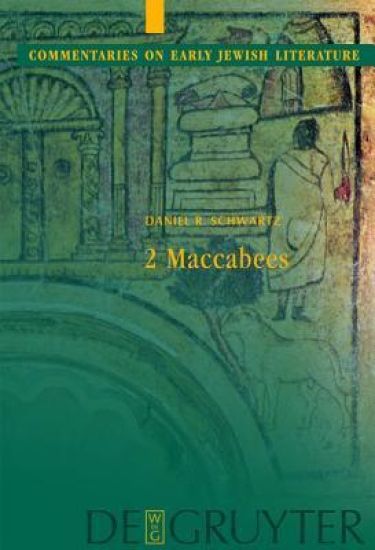
2 Maccabees

2 Maccabees

Daniel R. Schwartz

De Gruyter
2008
sidottu
2 Maccabees is a Jewish work composed during the 2nd century BCE and preserved by the Church. Written in Hellenistic Greek and told from a Jewish-Hellenistic perspective, 2 Maccabees narrates and interprets the ups and downs of events that took place in Jerusalem prior to and during the Maccabean revolt: institutionalized Hellenization and the foundation of Jerusalem as a polis; the persecution of Jews by Antiochus Epiphanes, accompanied by famous martyrdoms; and the rebellion against Seleucid rule by Judas Maccabaeus. 2 Maccabees is an important source both for the events it describes and for the values and interests of the Judaism of the Hellenistic diaspora that it reflects - which are often quite different from those represented by its competitor, 1 Maccabees.
Between Jewish Posen and Scholarly Berlin

Between Jewish Posen and Scholarly Berlin

Daniel R. Schwartz

De Gruyter Oldenbourg
2016
sidottu
The life of Philipp Jaffé (1819–1870), from his youth in Posen; his studies with Leopold von Ranke and career – as a close friend of Theodor Mommsen – at the pinnacle of historical scholarship in Berlin, first at the Monumenta Germaniae Historica and then, after his feud with Georg Heinrich Pertz, with his unprecedented 1862 appointment, while still a Jew, to a Berlin professorship; and on to his baptism in 1868 and suicide in 1870, was a life of transition between East and West and between Judaism and Christianity – and a life of devotion to scholarship, of loneliness, of success and of frustration. Forgotten today, except by medievalists who depend on his numerous editions of Latin texts, Jaffé was a central figure in the heydays of German scholarship. His career illustrates the working conditions of such scholars, their friendships and feuds, and also the limits that hemmed Jews in and the ways they could be overcome. This volume documents Jaffé’s life, accomplishments, and struggles, and also offers insight into his soul via more than two hundred of his letters (in German) – about half to his parents in Posen and half to colleagues around Europe, especially Pertz and Mommsen.
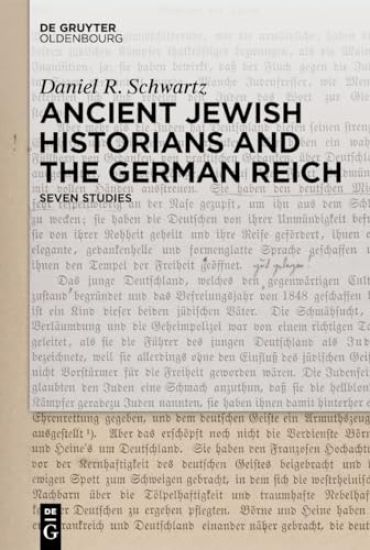
Ancient Jewish Historians and the German Reich
Apart from an opening survey of modern study of ancient Jewish history, which emphasizes the foundational role of German-Jewish scholars, the studies united in this volume apply philological methods to the writings of four of them: Heinrich Graetz, Isaak Heinemann, Elias Bickerman(n), and Abraham Schalit. In each case, it is argued that some seemingly trivial anomaly or infelicity, in a publication about such ancient characters as Antiochus Epiphanes, Herod, and Josephus, points to the way in which the historian constructed, and revised, his understanding of the Jews’ situation under Greeks or Romans in light of his perception of the Jews’ situation under the Second or Third Reich. The collection also includes a study that focuses on a Jewish medievalist, Philipp Jaffé, and unravels the indirect but inexorable process that led from a scholarly feud about the editing of medieval Latin texts, in the 1860s, to the “Berlin Antisemitism Dispute” (Berliner Antisemitismusstreit) of 1879–1881, which is commonly viewed as the opening act of modern German antisemitism.
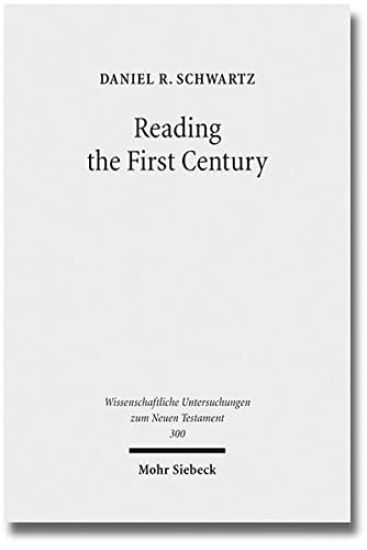
Reading the First Century

Reading the First Century

Daniel R. Schwartz

Mohr Siebeck
2014
nidottu
The writings of Flavius Josephus provide much of what we know about the first century CE - which witnessed the birth of Christianity, the destruction of the Second Temple of Jerusalem, and the concomitant rise of rabbinic Judaism. However, Josephus was an author, not a video camera, and what he wrote often reflects much apart from what actually happened in the first century: Josephus' works were affected both by his literary models and by current events, and they functioned in various ways for Josephus as an individual and also as a Jew and a Roman, writing in a time of tumult and radical change. Daniel R. Schwartz argues that by building from the bottom up - first establishing the text and its meaning, then moving on to issues of Josephus' models, sources, and purposes - we may nevertheless reconstruct, with some confidence, the events and processes of this crucial era.
Flavius Josephus: Translation and Commentary, Volume 8: Judean Antiquities, Books 18-20
These last three books of Josephus's Antiquities detail Jewish history between the establishment of direct Roman rule in Judea in 6 CE and the outbreak of the Judean rebellion against Rome in 66 - a rebellion that culminated in 70 with the destruction of Jerusalem and its Temple. Along the way, these books also constitute the main source for the context in which Christianity was born. This volume offers a translation of Josephus's Greek text, along with a commentary that aims to clarify the history to which Josephus testifies and also its meaning for him as an exiled Jerusalemite and rebel-turned-historian.