Kirjojen hintavertailu. Mukana 11 342 296 kirjaa ja 12 kauppaa.

Kirjahaku

Etsi kirjoja tekijän nimen, kirjan nimen tai ISBN:n perusteella.

3 kirjaa tekijältä Daniel W. Bromley

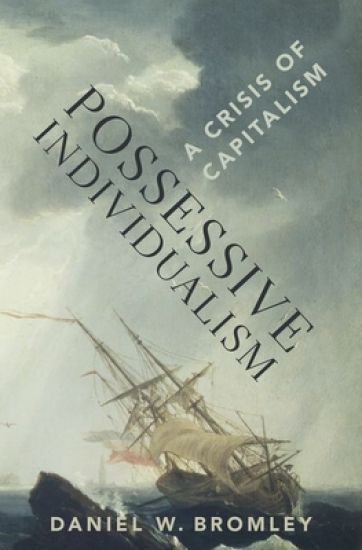
Possessive Individualism

Possessive Individualism

Daniel W. Bromley

Oxford University Press Inc
2019
sidottu
Anxiety and alienation threaten modern democracies. Political anger runs rampant in the United States, Britain voted to leave the European Union, authoritarian governments control several European countries, and millions of desperate migrants are streaming north out of the Middle East, Africa, and Latin America. Many people blame stagnant household incomes and economic inequality. However, Possessive Individualism argues that the origins of world disorder are in the failure of the Enlightenment to anticipate the acquisitive individual as a creature of global capitalism. Daniel Bromley provides a fundamental critique of contemporary capitalism to explain why the world now finds itself in widespread disorder. Capitalism's basic flaw, he argues, is "possessive individualism." Glorification of the rational individual motivated by acquisitiveness prevents the adoption of necessary government programs that would ease the economic burden on beleaguered households. Meanwhile, possessive individualism enables managerial capitalism-controlled by the "one percent"-to suppress wages and salaries, embrace automation, and move jobs overseas. Capitalism is no longer an engine of improved livelihoods and social hope. Drawing on evolutionary institutional economics and political theory this book offers two remedies to the crisis of modern capitalism. Escape from the crisis requires that the isolated acquisitive individual rediscovers a sense of loyalty to others-as neighbors, as colleagues, and as participants in the shared social process of living. Escape also requires that the private firm be reimagined as a public trust in which the economic well-being of employees becomes a central part of its purpose. In the absence of these dual transformations, capitalism as we know it cannot endure.
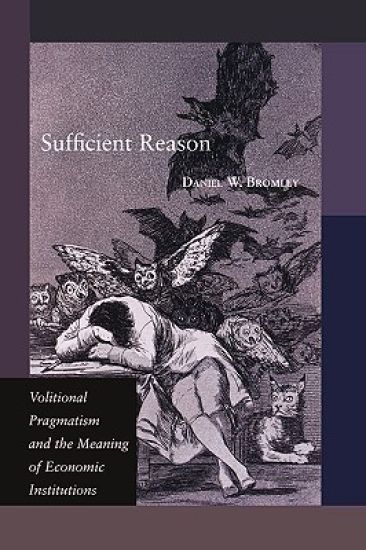
Sufficient Reason

Sufficient Reason

Daniel W. Bromley

Princeton University Press
2009
pokkari
In the standard analysis of economic institutions--which include social conventions, the working rules of an economy, and entitlement regimes (property relations)--economists invoke the same theories they use when analyzing individual behavior. In this profoundly innovative book, Daniel Bromley challenges these theories, arguing instead for "volitional pragmatism" as a plausible way of thinking about the evolution of economic institutions. Economies are always in the process of becoming. Here is a theory of how they become. Bromley argues that standard economic accounts see institutions as mere constraints on otherwise autonomous individual action. Some approaches to institutional economics--particularly the "new" institutional economics--suggest that economic institutions emerge spontaneously from the voluntary interaction of economic agents as they go about pursuing their best advantage. He suggests that this approach misses the central fact that economic institutions are the explicit and intended result of authoritative agents--legislators, judges, administrative officers, heads of states, village leaders--who volitionally decide upon working rules and entitlement regimes whose very purpose is to induce behaviors (and hence plausible outcomes) that constitute the sufficient reasons for the institutional arrangements they create. Bromley's approach avoids the prescriptive consequentialism of contemporary economics and asks, instead, that we see these emergent and evolving institutions as the reasons for the individual and aggregate behavior their very adoption anticipates. These hoped-for outcomes comprise sufficient reasons for new laws, judicial decrees, and administrative rulings, which then become instrumental to the realization of desired individual behaviors and thus aggregate outcomes.
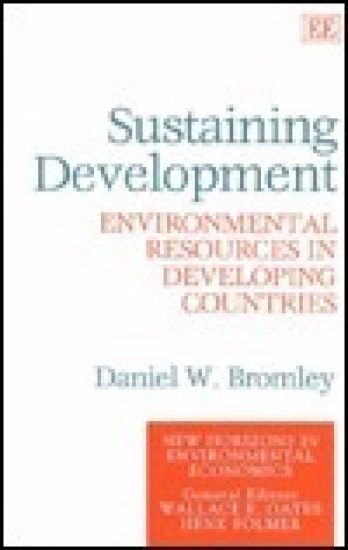
Sustaining Development

Sustaining Development

Daniel W. Bromley

Edward Elgar Publishing Ltd
1999
sidottu
Sustaining Development brings together, in one accessible volume, a selection of Daniel W. Bromley's path-breaking theoretical and empirical papers on economic development and environmental problems in the developing world.The book emphasizes the institutional dimensions of the environment and development problem, paying particular attention to the role of property regimes in understanding the causes and consequences of environmental degradation. Daniel W. Bromley, one of the world's leading environmental scholars, addresses the conceptual and empirical issues of alternative property rights, institutions and incentives as they relate to environmental resources. Drawing on empirical work, he sheds new light on the pressing problems faced by governments in the developing world as they struggle with the twin challenges of poverty and resource degradation. Throughout the book Professor Bromley pays careful attention to the policy implications and policy formulation of the issues under discussion.Sustaining Development will be welcomed by environmental and development economists as well as policymakers in both the industrialized and developing world.