Kirjojen hintavertailu. Mukana 11 607 999 kirjaa ja 12 kauppaa.

Kirjahaku

Etsi kirjoja tekijän nimen, kirjan nimen tai ISBN:n perusteella.

4 kirjaa tekijältä Daniela Vallega-Neu

Heidegger's Poietic Writings

Heidegger's Poietic Writings

Daniela Vallega-Neu

Indiana University Press
2018
sidottu
Engaging the development of Heidegger's non-public writings on the event between 1936 and 1941, Daniela Vallega-Neu reveals what Heidegger's private writings kept hidden. Vallega-Neu takes readers on a journey through these volumes, which are not philosophical works in the traditional sense as they read more like fragments, collections of notes, reflections, and expositions. In them, Vallega-Neu sees Heidegger searching for a language that does not simply speak about being, but rather allows a sense of being to emerge in his thinking and saying. She focuses on striking shifts in the tone and movement of Heidegger's thinking during these important years. Skillfully navigating the unorthodox and intimate character of these writings, Vallega-Neu provides critical insights into questions of attunement, language, the body, and historicity in Heidegger's thinking.

Heidegger's Poietic Writings

Heidegger's Poietic Writings

Daniela Vallega-Neu

Indiana University Press
2018
pokkari
Engaging the development of Heidegger's non-public writings on the event between 1936 and 1941, Daniela Vallega-Neu reveals what Heidegger's private writings kept hidden. Vallega-Neu takes readers on a journey through these volumes, which are not philosophical works in the traditional sense as they read more like fragments, collections of notes, reflections, and expositions. In them, Vallega-Neu sees Heidegger searching for a language that does not simply speak about being, but rather allows a sense of being to emerge in his thinking and saying. She focuses on striking shifts in the tone and movement of Heidegger's thinking during these important years. Skillfully navigating the unorthodox and intimate character of these writings, Vallega-Neu provides critical insights into questions of attunement, language, the body, and historicity in Heidegger's thinking.

Heidegger's Contributions to Philosophy

Heidegger's Contributions to Philosophy

Daniela Vallega-Neu

Indiana University Press
2003
pokkari
"For those who want to think rigorously with Heidegger and with the movement of thinking set forth in Contributions, Vallega-Neu's book will prove to be an invaluable guide and resource. One of the great virtues of the book is its impeccable clarity and readability." —Peter Warnek In her concise introduction to Martin Heidegger's second most important work, Contributions to Philosophy (From Enowning), Daniela Vallega-Neu provides guidance and structure to readers attempting to navigate this much-discussed but difficult text. Contributions reflects Heidegger's struggle to think at the edge of words and to bring to language what remains beyond the written or the spoken. In view of the centrality of Being and Time to Heidegger interpretation in recent decades, Vallega-Neu introduces Contributions first by reconsidering Being and Time in light of the transformative turn from prepositional thought to the poietic, performative character of thinking and language that marks the passage between the two works. She then discusses each of the "joinings" that structure the composition of Contributions. This graceful introduction provides students and scholars with a much-needed key for unlocking the thinking that underlies Heidegger's later writings.
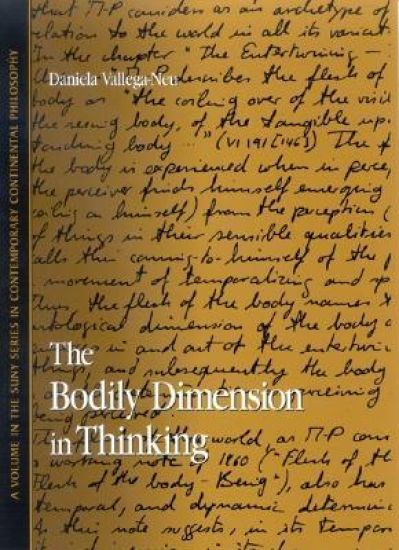
The Bodily Dimension in Thinking

The Bodily Dimension in Thinking

Daniela Vallega-Neu

State University of New York Press
2005
sidottu
An ontology of bodily being featuring Plato, Nietzsche, Scheler, Merleau-Ponty, Heidegger, and Foucault.Daniela Vallega-Neu questions the ontological meaning of body and thinking by carefully taking into account how we come to experience thought bodily. She engages six prominent figures of the Western philosophical tradition-Plato, Nietzsche, Scheler, Merleau-Ponty, Heidegger, and Foucault-and considers how they understand thinking to occur in relation to the body as well as how their thinking is itself bodily. Through a deconstructive and performative reading, she explores how their thinking reveals a bodily dimension that is prior to what classical metaphysics comes to conceive as mind-body duality. Thus, Vallega-Neu uncovers the bodily dimension that sustains their thought and their work. As she contends, the trace of the body in our thought not only exposes the strangers we are to ourselves, but may also lead to a new understanding of how we come to be who we are in relation to the world we live in.