Kirjojen hintavertailu. Mukana 11 342 296 kirjaa ja 12 kauppaa.

Kirjahaku

Etsi kirjoja tekijän nimen, kirjan nimen tai ISBN:n perusteella.

6 kirjaa tekijältä Darrell A. Turkington

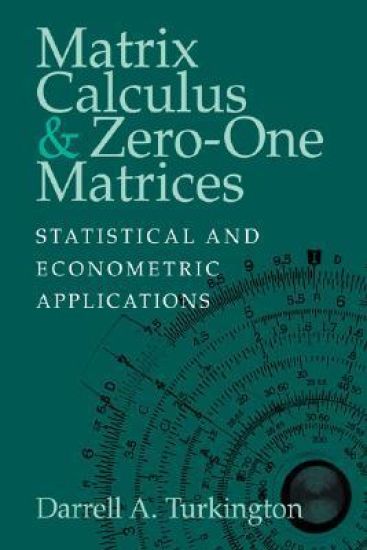
Matrix Calculus and Zero-One Matrices

Matrix Calculus and Zero-One Matrices

Darrell A. Turkington

Cambridge University Press
2005
pokkari
This 2002 book presents the reader with mathematical tools taken from matrix calculus and zero-one matrices and demonstrates how these tools greatly facilitate the application of classical statistical procedures to econometric models. The matrix calculus results are derived from a few basic rules that are generalizations of the rules of ordinary calculus. These results are summarized in a useful table. Well-known zero-one matrices, together with some newer ones, are defined, their mathematical roles explained, and their useful properties presented. The basic building blocks of classical statistics, namely the score vector, the information matrix, and the Cramer-Rao lower bound, are obtained for a sequence of linear econometric models of increasing statistical complexity. From these are obtained interactive interpretations of maximum likelihood estimators, linking them with efficient econometric estimators. Classical test statistics are also derived and compared for hypotheses of interest.
Matrix Calculus and Zero-One Matrices

Matrix Calculus and Zero-One Matrices

Darrell A. Turkington

Cambridge University Press
2001
sidottu
This 2002 book presents the reader with mathematical tools taken from matrix calculus and zero-one matrices and demonstrates how these tools greatly facilitate the application of classical statistical procedures to econometric models. The matrix calculus results are derived from a few basic rules that are generalizations of the rules of ordinary calculus. These results are summarized in a useful table. Well-known zero-one matrices, together with some newer ones, are defined, their mathematical roles explained, and their useful properties presented. The basic building blocks of classical statistics, namely the score vector, the information matrix, and the Cramer-Rao lower bound, are obtained for a sequence of linear econometric models of increasing statistical complexity. From these are obtained interactive interpretations of maximum likelihood estimators, linking them with efficient econometric estimators. Classical test statistics are also derived and compared for hypotheses of interest.
Generalized Vectorization, Cross-Products, and Matrix Calculus

Generalized Vectorization, Cross-Products, and Matrix Calculus

Darrell A. Turkington

Cambridge University Press
2013
sidottu
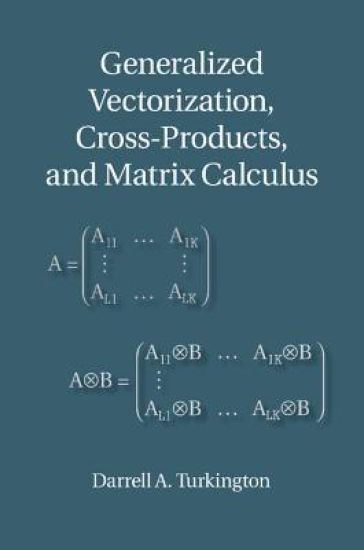
This book presents the reader with new operators and matrices that arise in the area of matrix calculus. The properties of these mathematical concepts are investigated and linked with zero-one matrices such as the commutation matrix. Elimination and duplication matrices are revisited and partitioned into submatrices. Studying the properties of these submatrices facilitates achieving new results for the original matrices themselves. Different concepts of matrix derivatives are presented and transformation principles linking these concepts are obtained. One of these concepts is used to derive new matrix calculus results, some involving the new operators and others the derivatives of the operators themselves. The last chapter contains applications of matrix calculus, including optimization, differentiation of log-likelihood functions, iterative interpretations of maximum likelihood estimators and a Lagrangian multiplier test for endogeneity.
Generalized Vectorization, Cross-Products, and Matrix Calculus

Generalized Vectorization, Cross-Products, and Matrix Calculus

Darrell A. Turkington

Cambridge University Press
2014
pokkari
This book presents the reader with new operators and matrices that arise in the area of matrix calculus. The properties of these mathematical concepts are investigated and linked with zero-one matrices such as the commutation matrix. Elimination and duplication matrices are revisited and partitioned into submatrices. Studying the properties of these submatrices facilitates achieving new results for the original matrices themselves. Different concepts of matrix derivatives are presented and transformation principles linking these concepts are obtained. One of these concepts is used to derive new matrix calculus results, some involving the new operators and others the derivatives of the operators themselves. The last chapter contains applications of matrix calculus, including optimization, differentiation of log-likelihood functions, iterative interpretations of maximum likelihood estimators and a Lagrangian multiplier test for endogeneity.
Mathematical Tools for Economics

Mathematical Tools for Economics

Darrell A. Turkington

Wiley-Blackwell (an imprint of John Wiley Sons Ltd)
2006
sidottu
Designed to demonstrate the essential mathematical concepts—comprehensively and economically—without re-teaching basic material or laboring over superfluous ideas, this text locates the necessary information in a practical economics context. Utilizing clear exposition and dynamic pedagogical features, Mathematical Tools for Economics provides students with the analytical skills they need to better grasp their field of study. A short introduction to mathematics for students of economics Demonstrates essential mathematical concepts necessary for economic analysis, such as matrix algebra and calculus, simultaneous linear equations, and concrete and discrete time Incorporates applications to econometrics and statistics, and includes computational exercises illustrating the methods and concepts discussed in the text Clear explanations and dynamic pedagogical features provide students with the analytical skills they need to better grasp their field of study. Mathematical Tools for Economics is supported by an instructor's manual featuring solutions, available at www.blackwellpublishing.com/turkington
Mathematical Tools for Economics

Mathematical Tools for Economics

Darrell A. Turkington

Wiley-Blackwell (an imprint of John Wiley Sons Ltd)
2006
nidottu
Designed to demonstrate the essential mathematical concepts—comprehensively and economically—without re-teaching basic material or laboring over superfluous ideas, this text locates the necessary information in a practical economics context. Utilizing clear exposition and dynamic pedagogical features, Mathematical Tools for Economics provides students with the analytical skills they need to better grasp their field of study. A short introduction to mathematics for students of economics Demonstrates essential mathematical concepts necessary for economic analysis, such as matrix algebra and calculus, simultaneous linear equations, and concrete and discrete time Incorporates applications to econometrics and statistics, and includes computational exercises illustrating the methods and concepts discussed in the text Clear explanations and dynamic pedagogical features provide students with the analytical skills they need to better grasp their field of study. Mathematical Tools for Economics is supported by an instructor's manual featuring solutions, available at www.blackwellpublishing.com/turkington