Kirjojen hintavertailu. Mukana 11 244 527 kirjaa ja 12 kauppaa.

Kirjahaku

Etsi kirjoja tekijän nimen, kirjan nimen tai ISBN:n perusteella.

4 kirjaa tekijältä Dave Beech

Art and Postcapitalism

Art and Postcapitalism

Dave Beech

Pluto Press
2019
pokkari
Artistic labour was exemplary for Utopian Socialist theories of 'attractive labour', and Marxist theories of 'nonalienated labour', but the rise of the anti-work movement and current theories of 'fully automated luxury communism' have seen art topple from its privileged place within the left's political imaginary as the artist has been reconceived as a prototype of the precarious 24/7 worker. Art and Postcapitalism argues that art remains essential for thinking about the intersection of labour, capitalism and postcapitalism not insofar as it merges work and pleasure but as an example of noncapitalist production. Reassessing the contemporary politics of work by revisiting debates about art, technology and in the nineteenth and twentieth century, Dave Beech challenges the aesthetics of labour in John Ruskin, William Morris and Oscar Wilde with a value theory of the supersession of capitalism that sheds light on the anti-work theory by Silvia Federici, Andre Gorz, Kathi Weeks and Maurizio Lazzarato, as well as the technological Cockayne of Srnicek and Williams and Paul Mason. Formulating a critique of contemporary postcapitalism, and developing a new understanding of art and labour within the political project of the supersession of value production, this book is essential for activists, scholars and anyone interested in the real and imagined escape routes from capitalism.
Art and Postcapitalism

Art and Postcapitalism

Dave Beech

Pluto Press
2019
sidottu
Artistic labour was exemplary for Utopian Socialist theories of 'attractive labour', and Marxist theories of 'nonalienated labour', but the rise of the anti-work movement and current theories of 'fully automated luxury communism' have seen art topple from its privileged place within the left's political imaginary as the artist has been reconceived as a prototype of the precarious 24/7 worker. Art and Postcapitalism argues that art remains essential for thinking about the intersection of labour, capitalism and postcapitalism not insofar as it merges work and pleasure but as an example of noncapitalist production. Reassessing the contemporary politics of work by revisiting debates about art, technology and in the nineteenth and twentieth century, Dave Beech challenges the aesthetics of labour in John Ruskin, William Morris and Oscar Wilde with a value theory of the supersession of capitalism that sheds light on the anti-work theory by Silvia Federici, Andre Gorz, Kathi Weeks and Maurizio Lazzarato, as well as the technological Cockayne of Srnicek and Williams and Paul Mason. Formulating a critique of contemporary postcapitalism, and developing a new understanding of art and labour within the political project of the supersession of value production, this book is essential for activists, scholars and anyone interested in the real and imagined escape routes from capitalism.
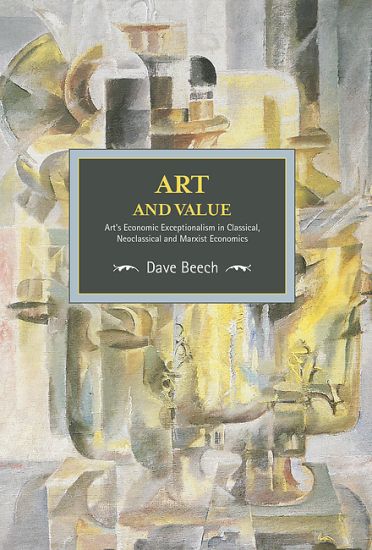
Art And Value: Art's Economic Exceptionalism In Classical, Neoclassical And Marxist Economics
Art and Value is the first comprehensive analysis of art's political economy throughout classical, neoclassical and Marxist economics. It provides a critical-historical survey of the theories of art's economic exceptionalism, of art as a merit good, and of the theories of art's commodification, the culture industry and real subsumption. Key debates on the economics of art are examined in detail. Subjecting mainstream and Marxist theories of art's economics to an exacting critique, Art and Value concludes with a new Marxist theory of art's economic exceptionalism.
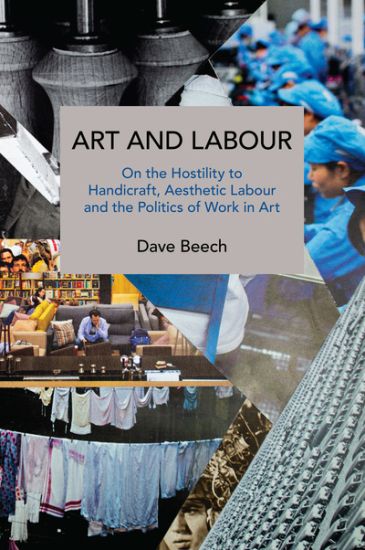
Art and Labour

Art and Labour

Dave Beech

Haymarket Books
2021
pokkari
This book provides a ground breaking re-examination of the changing relationship between art, craft, and industry focusing on the transition from workshop to studio, apprentice to pupil, guild to gallery and artisan to artist. Responding to the question whether the artist is a relic of the feudal mode of production or is a commodity producer corresponding to the capitalist mode of cultural production, Beech reveals, instead, that the history of the formation of art as distinct from handicraft, commerce, and industry can be traced back to the dissolution of the dual system of guild and court. This essential history needs to be revisited in order to rethink the categories of aesthetic labour, attractive labour, alienated labour, nonalienated labour and unwaged labour that shape the modern and contemporary politics of work in art.