Kirjojen hintavertailu. Mukana 12 363 183 kirjaa ja 12 kauppaa.

Kirjahaku

Etsi kirjoja tekijän nimen, kirjan nimen tai ISBN:n perusteella.

5 kirjaa tekijältä David A. Rothery

Satellites of the Outer Planets

Satellites of the Outer Planets

David A. Rothery

Oxford University Press Inc
2000
nidottu
Extensively revised and updated, this new edition of David A. Rothery's acclaimed geological guide to the outer solar system includes results and close-up color and black and white images from the 1995-1999 Galileo mission to Jupiter and from the Voyager space probe. Rothery, a noted planetary scientist, explains the geological aspects of the major satellites of the outer bodies, from Jupiter to Neptune to the Pluto-Charon system. In particular he shows how tectonic and volcanic processes, driven by heat from within, have shaped the rigid outer layers of these bodies. Rothery also discusses the similarities and differences among these planets, and reveals how they resemble Earth-like planets. This fascinating book is written in an introductory style ideal for first- or second-year college courses. Amateur geologists and astronomers will also find its insights rewarding.
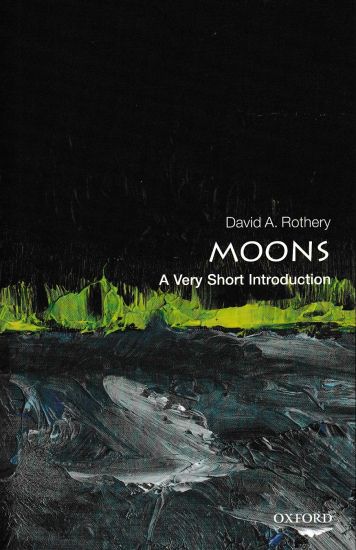
Moons

Moons

David A. Rothery

Oxford University Press
2015
nidottu
Proving to be both varied and fascinating, moons are far more common than planets in our Solar System. Our own Moon has had a profound influence on Earth, not only through tidal effects, but even on the behaviour of some marine animals. Many remarkable things have been discovered about the moons of the giant outer planets from Voyager, Galileo, Cassini, and other spacecraft. Scientists have glimpsed volcanic activity on Io, found oceans of water on Titan, and captured photos of icy geysers bursting from Enceladus. It looks likely that microbial life beyond the Earth may be discovered on a moon rather than a planet. In this Very Short Introduction David Rothery introduces the reader to the moons of our Solar System, beginning with the early discoveries of Galileo and others, describing their variety of mostly mythological names, and the early use of Jupiter's moons to establish position at sea and to estimate the speed of light. Rothery discusses the structure, formation, and influence of our Moon, and those of the other planets, and ends with the recent discovery of moons orbiting asteroids, whilst looking forward to the possibility of finding moons of exoplanets in planetary systems far beyond our own. ABOUT THE SERIES: The Very Short Introductions series from Oxford University Press contains hundreds of titles in almost every subject area. These pocket-sized books are the perfect way to get ahead in a new subject quickly. Our expert authors combine facts, analysis, perspective, new ideas, and enthusiasm to make interesting and challenging topics highly readable.
Planets

Planets

David A. Rothery

Oxford University Press
2010
nidottu
This Very Short Introduction looks deep into space and describes the worlds that make up our Solar System: terrestrial planets, giant planets, dwarf planets and various other objects such as satellites (moons), asteroids and Trans-Neptunian objects. It considers how our knowledge has advanced over the centuries, and how it has expanded at a growing rate in recent years. David A. Rothery gives an overview of the origin, nature, and evolution of our Solar System, including the controversial issues of what qualifies as a planet, and what conditions are required for a planetary body to be habitable by life. He looks at rocky planets and the Moon, giant planets and their satellites, and how the surfaces have been sculpted by geology, weather, and impacts. ABOUT THE SERIES: The Very Short Introductions series from Oxford University Press contains hundreds of titles in almost every subject area. These pocket-sized books are the perfect way to get ahead in a new subject quickly. Our expert authors combine facts, analysis, perspective, new ideas, and enthusiasm to make interesting and challenging topics highly readable.
Planet Mercury

Planet Mercury

David A. Rothery

Springer International Publishing AG
2014
sidottu
A new and detailed picture of Mercury is emerging thanks to NASA’s MESSENGER mission that spent four years in orbit about the Sun’s innermost planet. Comprehensively illustrated by close-up images and other data, the author describes Mercury’s landscapes from a geological perspective: from sublimation hollows, to volcanic vents, to lava plains, to giant thrust faults. He considers what its giant core, internal structure and weird composition have to tell us about the formation and evolution of a planet so close to the Sun. This is of special significance in view of the discovery of so many exoplanets in similarly close orbits about their stars. Mercury generates its own magnetic field, like the Earth (but unlike Venus, Mars and the Moon), and the interplay between Mercury’s and the Sun’s magnetic field affects many processes on its surface and in the rich and diverse exosphere of neutral and charged particles surrounding the planet.There is much about Mercury that we still don’t understand. Accessible to the amateur, but also a handy state-of-the-art digest for students and researchers, the book shows how our knowledge of Mercury developed over the past century of ground-based, fly-by and orbital observations, and looks ahead at the mysteries remaining for future missions to explore.
Planet Mercury

Planet Mercury

David A. Rothery

Springer International Publishing AG
2016
nidottu
A new and detailed picture of Mercury is emerging thanks to NASA’s MESSENGER mission that spent four years in orbit about the Sun’s innermost planet. Comprehensively illustrated by close-up images and other data, the author describes Mercury’s landscapes from a geological perspective: from sublimation hollows, to volcanic vents, to lava plains, to giant thrust faults. He considers what its giant core, internal structure and weird composition have to tell us about the formation and evolution of a planet so close to the Sun. This is of special significance in view of the discovery of so many exoplanets in similarly close orbits about their stars. Mercury generates its own magnetic field, like the Earth (but unlike Venus, Mars and the Moon), and the interplay between Mercury’s and the Sun’s magnetic field affects many processes on its surface and in the rich and diverse exosphere of neutral and charged particles surrounding the planet.There is much about Mercury that we still don’t understand. Accessible to the amateur, but also a handy state-of-the-art digest for students and researchers, the book shows how our knowledge of Mercury developed over the past century of ground-based, fly-by and orbital observations, and looks ahead at the mysteries remaining for future missions to explore.