Kirjojen hintavertailu. Mukana 12 363 183 kirjaa ja 12 kauppaa.

Kirjahaku

Etsi kirjoja tekijän nimen, kirjan nimen tai ISBN:n perusteella.

3 kirjaa tekijältä David A. Strauss

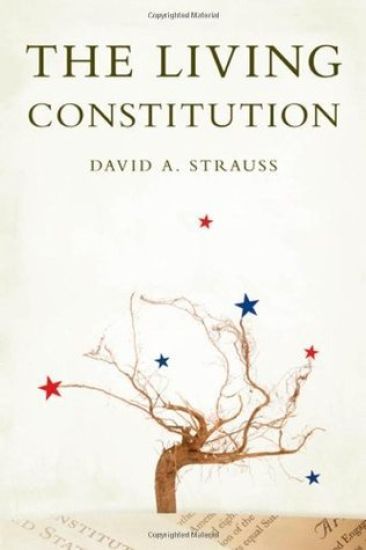
The Living Constitution

The Living Constitution

David A. Strauss

Oxford University Press Inc
2010
sidottu
Supreme Court Justice Antonin Scalia once remarked that the theory of an evolving, "living" Constitution effectively "rendered the Constitution useless." He wanted a "dead Constitution," he joked, arguing it must be interpreted as the framers originally understood it. In The Living Constitution, leading constitutional scholar David Strauss forcefully argues against the claims of Scalia, Clarence Thomas, Robert Bork, and other "originalists," explaining in clear, jargon-free English how the Constitution can sensibly evolve, without falling into the anything-goes flexibility caricatured by opponents. The living Constitution is not an out-of-touch liberal theory, Strauss further shows, but a mainstream tradition of American jurisprudence--a common-law approach to the Constitution, rooted in the written document but also based on precedent. Each generation has contributed precedents that guide and confine judicial rulings, yet allow us to meet the demands of today, not force us to follow the commands of the long-dead Founders. Strauss explores how judicial decisions adapted the Constitution's text (and contradicted original intent) to produce some of our most profound accomplishments: the end of racial segregation, the expansion of women's rights, and the freedom of speech. By contrast, originalism suffers from fatal flaws: the impossibility of truly divining original intent, the difficulty of adapting eighteenth-century understandings to the modern world, and the pointlessness of chaining ourselves to decisions made centuries ago. David Strauss is one of our leading authorities on Constitutional law--one with practical knowledge as well, having served as Assistant Solicitor General of the United States and argued eighteen cases before the United States Supreme Court. Now he offers a profound new understanding of how the Constitution can remain vital to life in the twenty-first century.
Global Insurgency to Reestablish the Caliphate: Identifying and Understanding the Enemy
Since the attacks on September 11, 2001, the United States (US) has waged a Global War on Terror (GWOT) based upon the flawed strategy of countering a tactic, terrorism, as opposed to a strategy built on understanding and identifying its enemy. By focusing exclusively on terrorist organizations, the US failed to recognize the broader-based movement of establishing a dominant Islamic world power. Analysis should have been conducted encompassing the ways, means and ends of a known adversary, such as Islamic fundamentalists. Using this group as a source of comparison, this monograph demonstrates how other diverse groups, operating with different ideological ways but using similar means of technology, are attempting to achieve a common ends; the reestablishment of the Caliphate. There is no "one thing" that causes, allows or facilitates the situation. It is the relationship between the various actors, agents and artifacts that contributes to understanding the system and creates the environment where conflict is probable. Germane to this article is the assemblage of Western culture based on a liberal-democratic politics and an Islamic culture based on the Qur'an, Shari'a and the Sunnah. Where these two cultures meet there is, to quote Huntington, a "Clash of Civilizations". Where GWOT focuses on countering a tactic, terrorism, it fails to address the ideology which draws upon Islam for its legitimacy. It requires critically analyzing how Islam is able to give some form of legitimacy to those who would do Western nations harm, and how groups not normally seen as adversaries hold to the same theocratic ideology. The internet provides a forum for loosely interconnected, semi-independent groups to maintain contact with one another and with members of other terrorist groups, providing dispersed organizational actors the ability to communicate swiftly and coordinate effectively. Where once insurgencies were forced to rely on bank robberies, blackmail, ransoming hostages and p This work has been selected by scholars as being culturally important, and is part of the knowledge base of civilization as we know it. This work was reproduced from the original artifact, and remains as true to the original work as possible. Therefore, you will see the original copyright references, library stamps (as most of these works have been housed in our most important libraries around the world), and other notations in the work. This work is in the public domain in the United States of America, and possibly other nations. Within the United States, you may freely copy and distribute this work, as no entity (individual or corporate) has a copyright on the body of the work. As a reproduction of a historical artifact, this work may contain missing or blurred pages, poor pictures, errant marks, etc. Scholars believe, and we concur, that this work is important enough to be preserved, reproduced, and made generally available to the public. We appreciate your support of the preservation process, and thank you for being an important part of keeping this knowledge alive and relevant.
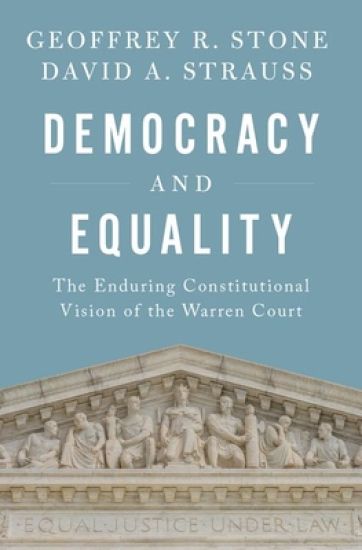
Democracy and Equality

Democracy and Equality

Geoffrey R. Stone; David A. Strauss

Oxford University Press Inc
2020
sidottu
From 1953 to 1969, the Supreme Court under Chief Justice Earl Warren brought about many of the proudest achievements of American constitutional law. The Warren declared racial segregation and laws forbidding interracial marriage to be unconstitutional; it expanded the right of citizens to criticize public officials; it held school prayer unconstitutional; and it ruled that people accused of a crime must be given a lawyer even if they can't afford one. Yet, despite those and other achievements, conservative critics have fiercely accused the justices of the Warren Court of abusing their authority by supposedly imposing their own opinions on the nation. As the eminent legal scholars Geoffrey R. Stone and David A. Strauss demonstrate in Democracy and Equality, the Warren Court's approach to the Constitution was consistent with the most basic values of our Constitution and with the most fundamental responsibilities of our judiciary. Stone and Strauss describer the Warren Court's extraordinary achievements by reviewing its jurisprudence across a range of issues addressing our nation's commitment to the values of democracy and equality. In each chapter, they tell the story of a critical decision, exploring the historical and legal context of each case, the Court's reasoning, and how the justices of the Warren Court fulfilled the Court's most important responsibilities. This powerfully argued evaluation of the Warren Court's legacy, in commemoration of the 50th anniversary of the end of the Warren Court, both celebrates and defends the Warren Court's achievements against almost sixty-five years of unrelenting and unwarranted attacks by conservatives. It demonstrates not only why the Warren Court's approach to constitutional interpretation was correct and admirable, but also why the approach of the Warren Court was far superior to that of the increasingly conservative justices who have dominated the Supreme Court over the past half-century.