Kirjojen hintavertailu. Mukana 11 244 527 kirjaa ja 12 kauppaa.

Kirjahaku

Etsi kirjoja tekijän nimen, kirjan nimen tai ISBN:n perusteella.

11 kirjaa tekijältä David B. Resnik

The Price of Truth

The Price of Truth

David B. Resnik

Oxford University Press Inc
2007
sidottu
Modern science is big business. Governments, universities, and corporations have invested billions of dollars in scientific and technological research in the hope of obtaining power and profit. For the most part, this investment has benefited science and society, leading to new discoveries, inventions, disciplines, specialties, jobs, and career opportunities. However, there is a dark side to the influx of money into science. Unbridled pursuit of financial gain in science can undermine scientific norms, such as objectivity, honesty, openness, respect for research participants, and social responsibility. In The Price of Truth, David B. Resnik examines some of the important and difficult questions resulting from the financial and economic aspects of modern science. How does money affect scientific research? Have scientists become entrepreneurs bent on making money instead of investigators searching for the truth? How does the commercialization of research affect the public's perception of science? Can scientists prevent money from corrupting the research enterprise? What types of rules, polices, and guidelines should scientists adopt to prevent financial interests from adversely affecting research and the public's opinion of science?
Playing Politics with Science

Playing Politics with Science

David B. Resnik

Oxford University Press Inc
2009
sidottu
In the last decade, science in the United States has become increasingly politicized, as government officials have been accused of manipulating, distorting, subverting, and censoring science for ideological purposes. Political gamesmanship has played a major role in many different areas of science, including the debate over global climate change, embryonic stem cell research, government funding of research, the FDA's approval process, military intelligence related to Iraq, research with human subjects, and the teaching of evolution in public schools. In Playing Politics with Science, David B. Resnik explores the philosophical, political, and ethical issues related to the politicalization of science and develops a conceptual framework for thinking about government restrictions on scientific practice. Resnik argues that the public has a right and a duty to oversee scientific research to protect important social values and hold scientists accountable for their actions, but that inappropriate government control over science can erode the integrity and trustworthiness of research, hamper scientific creativity and innovation, undermine the fairness and effectiveness of government and policies informed by science, discourage talented researchers from working for the government, and violate the freedom of scientists. Resnik also makes policy recommendations for protecting science from politicalization, and maintains that scientific autonomy and government control must be properly balanced so that restrictions on science can benefit society without undermining scientific research, education, and expert advice.
The Ethics of Science

The Ethics of Science

David B. Resnik

Routledge
1998
sidottu
Ethics of Science is a comprehensive and student-friendly introduction to the study of ethics in science and scientific research. The book covers: * Science and Ethics * Ethical Theory and Applications * Science as a Profession * Standards of Ethical Conduct in Science * Objectivity in Research * Ethical Issues in the Laboratory * The Scientist in Society * Toward a More Ethical Science * Actual case studies include: Baltimore Affair * cold fusion * Milikan's oil drop experiments * human and animal cloning * Cold War experiments * Strategic Defence Initiative * the Challenger accident * Tobacco Research.
The Ethics of Science

The Ethics of Science

David B. Resnik

Routledge
1998
nidottu
Ethics of Science is a comprehensive and student-friendly introduction to the study of ethics in science and scientific research. The book covers: * Science and Ethics * Ethical Theory and Applications * Science as a Profession * Standards of Ethical Conduct in Science * Objectivity in Research * Ethical Issues in the Laboratory * The Scientist in Society * Toward a More Ethical Science * Actual case studies include: Baltimore Affair * cold fusion * Milikan's oil drop experiments * human and animal cloning * Cold War experiments * Strategic Defence Initiative * the Challenger accident * Tobacco Research.
Environmental Health Ethics

Environmental Health Ethics

David B. Resnik

Cambridge University Press
2012
sidottu
Environmental Health Ethics illuminates the conflicts between protecting the environment and promoting human health. In this study, David B. Resnik develops a method for making ethical decisions on environmental health issues. He applies this method to various issues, including pesticide use, antibiotic resistance, nutrition policy, vegetarianism, urban development, occupational safety, disaster preparedness and global climate change. Resnik provides readers with the scientific and technical background necessary to understand these issues. He explains that environmental health controversies cannot simply be reduced to humanity versus environment and explores the ways in which human values and concerns - health, economic development, rights and justice - interact with environmental protection.
Environmental Health Ethics

Environmental Health Ethics

David B. Resnik

Cambridge University Press
2012
pokkari
Environmental Health Ethics illuminates the conflicts between protecting the environment and promoting human health. In this study, David B. Resnik develops a method for making ethical decisions on environmental health issues. He applies this method to various issues, including pesticide use, antibiotic resistance, nutrition policy, vegetarianism, urban development, occupational safety, disaster preparedness and global climate change. Resnik provides readers with the scientific and technical background necessary to understand these issues. He explains that environmental health controversies cannot simply be reduced to humanity versus environment and explores the ways in which human values and concerns - health, economic development, rights and justice - interact with environmental protection.
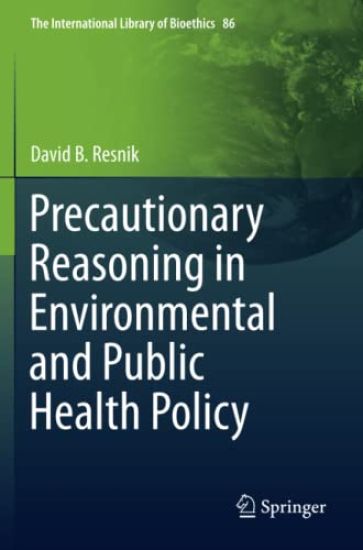
Precautionary Reasoning in Environmental and Public Health Policy

Precautionary Reasoning in Environmental and Public Health Policy

David B. Resnik

Springer Nature Switzerland AG
2021
sidottu
This book fills a gap in the literature on the Precautionary Principle by placing the principle within the wider context of precautionary reasoning and uses philosophical arguments and case studies to demonstrate when it does—and does not—apply. The book invites the reader to take a step back from the controversy surrounding the Precautionary Principle and consider the overarching rationales for responding to threats to the environment or public health. It provides practical guidance and probing insight for the intended audience, including scholars, students, journalists, and policymakers.
Precautionary Reasoning in Environmental and Public Health Policy

Precautionary Reasoning in Environmental and Public Health Policy

David B. Resnik

Springer Nature Switzerland AG
2022
nidottu
This book fills a gap in the literature on the Precautionary Principle by placing the principle within the wider context of precautionary reasoning and uses philosophical arguments and case studies to demonstrate when it does—and does not—apply. The book invites the reader to take a step back from the controversy surrounding the Precautionary Principle and consider the overarching rationales for responding to threats to the environment or public health. It provides practical guidance and probing insight for the intended audience, including scholars, students, journalists, and policymakers.
The Ethics of Research with Human Subjects

The Ethics of Research with Human Subjects

David B. Resnik

Springer International Publishing AG
2025
sidottu
In The Ethics of Research with Human Subjects, David B. Resnik, PhD/JD, develops and defends an approach to thinking about ethical and policy dilemmas in research with human subjects based on the notion of trust. The book explains why trust is important not only between investigators and research subjects but also between and among other stakeholders involved in the research enterprise, including research staff, sponsors, institutions, communities, oversight committees, government agencies, and the public. Dr. Resnik argues that trust should be viewed as a distinct ethical principle for research with human subjects that complements other principles, such as respect for human dignity, beneficence, non-maleficence, and justice. The book applies the principle of trust to numerous issues, including informed consent, confidentiality/privacy, risk minimization, risk/benefit assessment, payments for participation, protection of vulnerable subjects, experimental design, research integrity, and research oversight. The book also includes discussions of the history of research involving human subjects, moral theories and principles, contemporary cases, and proposed regulatory reforms. This second edition of The Ethics of Research with Human Subjects expands upon and clarifies arguments and ideas discussed in the first edition and includes new material on emerging issues in human research ethics, including community-based research, citizen science research, challenge studies (including COVID-19 experiments), public health research, genomics research, social and behavioral research, xenotransplantation experiments, alternative study designs, and research with people with compromised decisional capacity, employees, and students. The book is of interest to undergraduate and graduate students who are studying ethical and policy issues related to research with human subjects, as well as scientists and scholars who are interested learning more about the issues and thinking about what it means to promote integrity and trust in research with human subjects.
The Ethics of Research with Human Subjects

The Ethics of Research with Human Subjects

David B. Resnik

Springer International Publishing AG
2018
sidottu
This book provides a framework for approaching ethical and policy dilemmas in research with human subjects from the perspective of trust. It explains how trust is important not only between investigators and subjects but also between and among other stakeholders involved in the research enterprise, including research staff, sponsors, institutions, communities, oversight committees, government agencies, and the general public. The book argues that trust should be viewed as a distinct ethical principle for research with human subjects that complements other principles, such as autonomy, beneficence, non-maleficence, and justice. The book applies the principle of trust to numerous issues, including informed consent, confidentiality, risk minimization, risks and benefits, protection of vulnerable subjects, experimental design, research integrity, and research oversight.This work also includes discussions of the history of research involving human subjects, moral theories and principles,contemporary cases, and proposed regulatory reforms. The book is useful for undergraduate and graduate students studying ethical policy issues related to research with human subjects, as well as for scientists and scholars who are interested in thinking about this topic from the perspective of trust.
The Ethics of Research with Human Subjects

The Ethics of Research with Human Subjects

David B. Resnik

Springer International Publishing AG
2019
nidottu
This book provides a framework for approaching ethical and policy dilemmas in research with human subjects from the perspective of trust. It explains how trust is important not only between investigators and subjects but also between and among other stakeholders involved in the research enterprise, including research staff, sponsors, institutions, communities, oversight committees, government agencies, and the general public. The book argues that trust should be viewed as a distinct ethical principle for research with human subjects that complements other principles, such as autonomy, beneficence, non-maleficence, and justice. The book applies the principle of trust to numerous issues, including informed consent, confidentiality, risk minimization, risks and benefits, protection of vulnerable subjects, experimental design, research integrity, and research oversight.This work also includes discussions of the history of research involving human subjects, moral theories and principles,contemporary cases, and proposed regulatory reforms. The book is useful for undergraduate and graduate students studying ethical policy issues related to research with human subjects, as well as for scientists and scholars who are interested in thinking about this topic from the perspective of trust.