Kirjojen hintavertailu. Mukana 11 615 256 kirjaa ja 12 kauppaa.

Kirjahaku

Etsi kirjoja tekijän nimen, kirjan nimen tai ISBN:n perusteella.

11 kirjaa tekijältä David Birch

Navigating the Moral Maze: A Teaching Guide to the Problems of Life, Death, Freedom and Justice
Navigating the Moral Maze is a teaching resource to help students understand and critically engage with the most pressing issues in the world today. From the ruin of Gaza to the climate emergency, from the repeal of Roe v Wade to rising inequality, young people are growing up in a world beset with moral concerns and predicaments. With this book teachers can equip students with the critical skills and conceptual clarity needed to navigate through these issues and reach a clear and articulate understanding of their own views.Each chapter features numerous lesson ideas with activities, texts and thought experiments that help refine and enrich students' thoughts on the topics while promoting discussion and reflection. Topics covered include:ReproductionEuthanasiaPovertyEnvironmentBordersWarApplicable to Religious Studies, Philosophy and Ethics, and touching on topics relevant to PSHE, History and Geography, this will be a valuable resource for secondary teachers wanting to enhance their students' critical writing and thinking skills.
Navigating the Moral Maze: A Teaching Guide to the Problems of Life, Death, Freedom and Justice
Navigating the Moral Maze is a teaching resource to help students understand and critically engage with the most pressing issues in the world today. From the ruin of Gaza to the climate emergency, from the repeal of Roe v Wade to rising inequality, young people are growing up in a world beset with moral concerns and predicaments. With this book teachers can equip students with the critical skills and conceptual clarity needed to navigate through these issues and reach a clear and articulate understanding of their own views.Each chapter features numerous lesson ideas with activities, texts and thought experiments that help refine and enrich students' thoughts on the topics while promoting discussion and reflection. Topics covered include:ReproductionEuthanasiaPovertyEnvironmentBordersWarApplicable to Religious Studies, Philosophy and Ethics, and touching on topics relevant to PSHE, History and Geography, this will be a valuable resource for secondary teachers wanting to enhance their students' critical writing and thinking skills.
Pandora's Book

Pandora's Book

David Birch

John Hunt Publishing
2021
nidottu
Dare to think. Are you inside your body? Does yesterday still exist? Is it possible to have dignified sex? This book is filled with such questions, hundreds of them. Its aim is not to teach or lecture, but to jolt you into thinking for yourself. It asks you to embrace the spirit of Pandora. To open your mind, release your thoughts and let curiosity get the better of you. David Birch draws on a cornucopia of excerpts from a range of writers and philosophers. You are not entirely left to your own devices: from Plato to Isaac Newton to D. H. Lawrence, these thinkers will be your partners in conversation, galvanising and challenging your thinking.
Befuddled

Befuddled

David Birch

Collective Ink
2023
nidottu
A book for thinkers young and old, Befuddled is a journey back in time to explore the lives, legends and ideas of ancient philosophers. Theories on the origin of the universe, the nature of the mind, and much more are presented alongside bizarre stories of mad emperors and talking skulls. Featuring an array of iconic figures, including Socrates, Pythagoras and the Buddha, Befuddled superbly illustrates how lives devoted to confusion and wonder not only give rise to fascinating ideas about reality, they also brim with wild moments and remarkable tales. Author David Birch invites you to add your own life to the collection. With questions and activities designed to start you on your own extraordinary explorations, Befuddled will help you discover your own powers of thought while you experience for yourself the freaky thrills of befuddlement.
Identity is the New Money

Identity is the New Money

David Birch

London Publishing Partnership
2014
nidottu
This book argues that identity is changing profoundly and that money is changing equally profoundly. Because of technological change the two trends are converging so that all that we need for transacting will be our identities captured in the unique record of our online social contacts. Social networks and mobile phones are the key technologies. They will enable the building of an identity infrastructure that can enhance both privacy and security - there is no trade-off. The long-term consequences of these changes are impossible to predict, partly because how they take shape will depend on how companies (probably not banks) take advantage of business opportunities to deliver transaction services. But one prediction made here is that cash will soon be redundant - and a good thing too. In its place we will see a proliferation of new digital currencies.
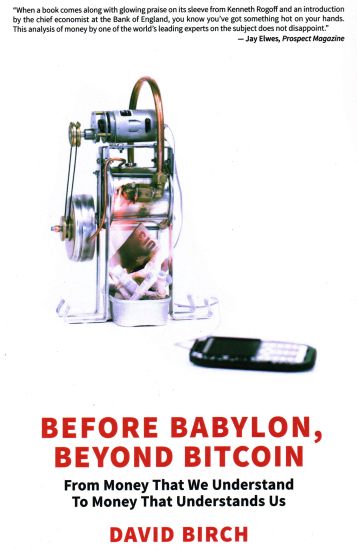
Before Babylon, Beyond Bitcoin

Before Babylon, Beyond Bitcoin

David Birch

London Publishing Partnership
2017
sidottu
Money is changing, and this book looks at where the technology of money might be taking us in the future. Technology has moved our concept of money from physical things, to unseen bits of information. With the arrival of smart cards, mobile phones and Bitcoin, it has become easier than ever to create new forms of money. Crucially, money is also inextricably connected with our identities. Your card or phone can identify you for security - and also enable information about you to be associated with your money (think for example of store 'points' cards). To understand all of this and to see where we might be going, the author first of all looks back over the whole history of money, which spans thousands of years. He sees evidence for possible futures in the past, both recent and ancient. After all, not all 'future' starts from today. For example, it can be argued that the future of money began back in 1971, when money became a claim backed by reputation rather than by commodities of any kind. At this point, money became bits. Looking much further back to a world before cash and central banks we see multiple 'currencies' operating at the level of communities, and the use of barter.The newest technologies will take money back to where it came from: a substitute for memory, to record mutual debt obligations within multiple overlapping communities. This time though money will be smart. It will be money that reflects the values of the communities that produced it. Future money will know where it has been, who has been using it and what they have been using it for.
Before Babylon, Beyond Bitcoin

Before Babylon, Beyond Bitcoin

David Birch

London Publishing Partnership
2019
nidottu
Money is changing, and this book looks at where the technology of money might be taking us in the future. Technology has moved our concept of money from physical things, to unseen bits of information. With the arrival of smart cards, mobile phones and Bitcoin, it has become easier than ever to create new forms of money. Crucially, money is also inextricably connected with our identities. Your card or phone can identify you for security - and also enable information about you to be associated with your money (think for example of store 'points' cards). To understand all of this and to see where we might be going, the author first of all looks back over the whole history of money, which spans thousands of years. He sees evidence for possible futures in the past, both recent and ancient. After all, not all 'future' starts from today. For example, it can be argued that the future of money began back in 1971, when money became a claim backed by reputation rather than by commodities of any kind. At this point, money became bits. Looking much further back to a world before cash and central banks we see multiple 'currencies' operating at the level of communities, and the use of barter.The newest technologies will take money back to where it came from: a substitute for memory, to record mutual debt obligations within multiple overlapping communities. This time though money will be smart. It will be money that reflects the values of the communities that produced it. Future money will know where it has been, who has been using it and what they have been using it for.

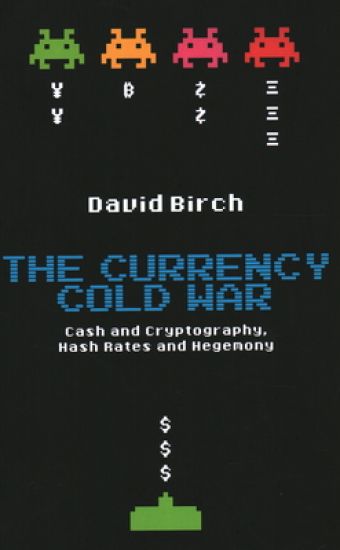
The Currency Cold War

The Currency Cold War

David Birch

London Publishing Partnership
2020
sidottu
The way that money works now is a blip. It’s a temporary institutional arrangement agreed in response to specific political, technological and economic circumstances. As these circumstances change, so money must change. Many people think that it will undergo a pretty significant change in the very near future and we need to start planning for the coming era of digital currency. The historian Niall Ferguson wrote in 2019 that “if America is smart, it will wake up and start competing for dominance in digital payments”. Competing for this new currency dominance could mean a new cold war in cyberspace with, for example, Facebook’s private currency facing off against China’s public currency facing off against a digital euro. Or would a digital dollar win this new space race? This is not just the concern of wide-eyed technologists obsessed with Bitcoin. In a 2019 speech the governor of the Bank of England said that a form of global digital currency could be “the answer to the destabilising dominance of the US dollar in today’s global monetary system”. But which digital currency? Will we really be choosing between the Federal Reserve and Microsoft (between dollar bills and Bill’s dollars)? Or between Facebook’s Libra and the Chinese Digital Currency/Electronic Payment system “DC/EP”? Between spendable SDRs and Kardashian Kash? It would be a mistake to see this as a technical debate about cryptocurrencies and blockchains, about hash rates and key lengths. It matters far beyond the virtual boundaries of the new age. The dollar’s dominance gives America the ability to exert soft power through the International Monetary and Financial System. A serious implication of replacing existing monetary arrangements with new infrastructure based on digital currency is that this power might be constrained. How might America respond to losing its hegemony? Now that the technologists, the business strategists, the economists and the national and international regulators are beginning to glance in the direction of these alternatives, the whole topic of digital currency needs to be explored. In this book, industry expert David Birch sets out the economic and technological imperatives, discusses the potential impact, and highlights a series of tensions—between public and private and, most importantly, between East and West—to contribute to the high-level debate that we must have to begin to shape the International Monetary and Financial System financial system of the near future.