Kirjojen hintavertailu. Mukana 11 244 527 kirjaa ja 12 kauppaa.

Kirjahaku

Etsi kirjoja tekijän nimen, kirjan nimen tai ISBN:n perusteella.

8 kirjaa tekijältä David Boucher

Political Theories of International Relations

Political Theories of International Relations

David Boucher

Oxford University Press
1998
nidottu
David Boucher uses the ideas of western philosophy's most significant thinkers to trace the history of political theory in international relations. He examines current conceptions, offering an alternative thematic interpretation of how the most significant thinkers in the Western tradition perceived relations between communities, nations, states, and the discovery of the new world. His organizing principle centres on the idea that the great philosophers were searching for a criterion of state conduct associated with different theories of human nature and which were used for justificatory, appraisive, and injunctive purposes. The author asserts that great thinkers from Thucydides to Marx formulated and applied these criteria to interpret the changing international system and concludes by showing how contemporary theories compare with and extend the themes addressed by their predecessors.
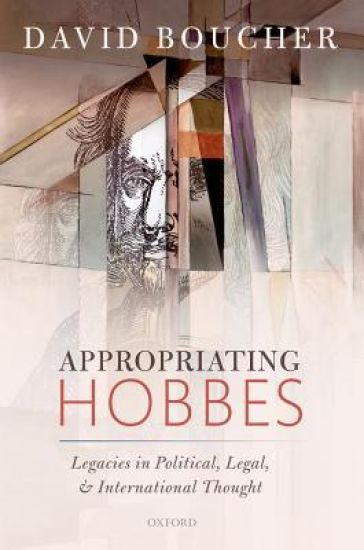
Appropriating Hobbes

Appropriating Hobbes

David Boucher

Oxford University Press
2018
sidottu
This book explores how Hobbes's political philosophy has occupied a pertinent place in different contexts, and how his interpreters see their own images reflected in him, or how they define themselves in contrast to him. Appropriating Hobbes argues that there is no Hobbes independent of the interpretations that arise from his appropriation in these various contexts and which serve to present him to the world. There is no one perfect context that enables us to get at what Hobbes 'really meant', despite the numerous claims to the contrary. He is almost indistinguishable from the context in which he is read. This contention is justified with reference to hermeneutics, and particularly the theories of Gadamer, Koselleck, and Ricoeur, contending that through a process of 'distanciation' Hobbes's writings have been appropriated and commandeered to do service in divergent contexts such as philosophical idealism; debates over the philosophical versus historical understanding of texts; as well as in ideological disputations, and emblematic characterisations of him by various disciplines such as law, politics, and international relations. This volume illustrates the capacity of a text to take on the colouration of its surroundings by exploring and explicating the importance of contexts in reading and understanding how and why particular interpretations of Hobbes have emerged, such as those of Carl Schmitt and Michael Oakeshott, or the international jurists of the seventeenth, eighteenth, and nineteenth centuries.
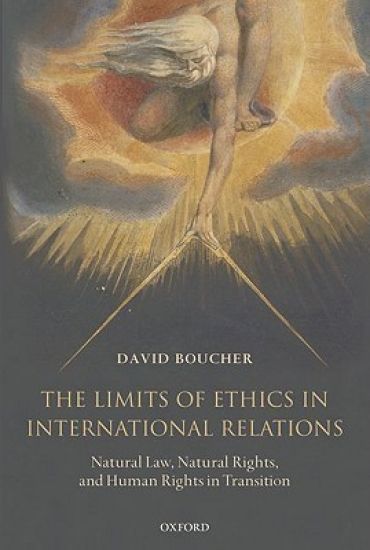
The Limits of Ethics in International Relations

The Limits of Ethics in International Relations

David Boucher

Oxford University Press
2009
sidottu
Ethical constraints on relations among individuals within and between societies have always reflected or invoked a higher authority than the caprices of human will. For over two thousand years Natural Law and Natural Rights were the constellations of ideas and presuppositions that fulfilled this role in the west, and exhibited far greater similarities than most commentators want to admit. Such ideas were the lens through which Europeans evaluated the rest of the world. In his major new book David Boucher rejects the view that Natural Rights constituted a secularisation of Natural Law ideas by showing that most of the significant thinkers in the field, in their various ways, believed that reason leads you to the discovery of your obligations, while God provides the ground for discharging them. Furthermore, the book maintains that Natural Rights and Human Rights are far less closely related than is often asserted because Natural Rights never cast adrift the religious foundationalism, whereas Human Rights, for the most part, have jettisoned the Christian metaphysics upon which both Natural Law and Natural Rights depended. Human Rights theories, on the whole, present us with foundationless universal constraints on the actions of individuals, both domestically and internationally. Finally, one of the principal contentions of the book is that these purportedly universal rights and duties almost invariably turn out to be conditional, and upon close scrutiny end up being 'special' rights and privileges as the examples of multicultural encounters, slavery and racism, and women's rights demonstrate.
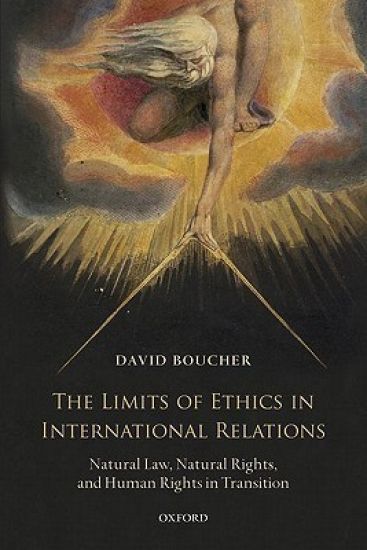
The Limits of Ethics in International Relations

The Limits of Ethics in International Relations

David Boucher

Oxford University Press
2011
nidottu
Ethical constraints on relations among individuals within and between societies have always reflected or invoked a higher authority than the caprices of human will. For over two thousand years natural law and natural rights were the constellations of ideas and presuppositions that fulfilled this role in the West, and exhibited far greater similarities than most commentators want to admit. Such ideas were the lens through which Europeans evaluated the rest of the world. In his major new book David Boucher rejects the view that natural rights constituted a secularization of natural law ideas by showing that most of the significant thinkers in the field, in their various ways, believed that reason leads you to the discovery of your obligations, while God provides the ground for discharging them. Furthermore, the book maintains that natural rights and human rights are far less closely related than is often asserted because natural rights can never be cast adrift from their religious foundations, whereas human rights, for the most part, have jettisoned the Christian metaphysics upon which both natural law and natural rights depended. Human rights theories, on the whole, present us with foundationless universal constraints on the actions of individuals, both domestically and internationally. Finally, one of the principal contentions of the book is that these purportedly universal rights and duties almost invariably turn out to be conditional, and upon close scrutiny end up being 'special' rights and privileges as the examples of multicultural encounters, slavery, racism, and women's rights demonstrate.
The Social and Political Thought of R. G. Collingwood

The Social and Political Thought of R. G. Collingwood

David Boucher

Cambridge University Press
2003
pokkari
This is the first comprehensive study of the political philosophy of the British philosopher R. G. Collingwood, best known for his contributions to aesthetics and the philosophy of history. However his political thought, and in particular his book The New Leviathan, have been neglected, even dismissed in some quarters. Professor Boucher argues for the importance of this political theory and provides a perspicuous account of its development and originality. He contends that The New Leviathan is an attempt to reconcile philosophy and history, theory and practice. Collingwood’s distinctive contribution to modern political and social thought is seen as his sustained project of distinguishing utility from right, and right from duty; the passion for history coincides with the ethical thought because Collingwood wishes to identify dutiful, or moral, action with a historical civilization. Drawing on a wealth of manuscript material, this book will prove invaluable to political philosophers and intellectual historians.
Dylan and Cohen

Dylan and Cohen

David Boucher

Continuum International Publishing Group Ltd.
2004
nidottu
Bob Dylan and Leonard Cohen are widely acknowledged as the great pop poets of the 1960s, transforming the popular song into a medium for questioning the personal, social and political norms of their times. They emerge at a time when the music industry was moulding and packaging the revolutionary sound of black music into something bland, homogenous and fit for mass consumption, when populist politics had come to the fore with a serious division emerging between the values of young and old. For many disorientated and disillusioned members of this generation, Dylan and Cohen were able to articulate what they were feeling and could not express: Dylan the anti-establishment anger, Cohen the angst and despondency. Dylan and Cohen is a fascinating political, psychological and artistic profile of two iconic writers and performers. With reference to both biographical details and lyrics, David Boucher explores their similarities and differences, tracing the development of religious, political and social themes in their work and the ways in which those ideas engaged a new audience. He also looks at their poetic influences, using aesthetic ideas from Lorca, Collingwood and others to delve more deeply than previous commentators into the phases of their writing and to reveal their enduring influence on poetry and song, and the relationship between the two. A must-read for all serious fans of either Dylan or Cohen, this book will also engage anyone interested in 1960s America or more generally in the relationship between music, identity and politics.
Texts in Context

Texts in Context

David Boucher

Kluwer Academic Publishers
1985
sidottu
The methodology of the study of the history of political thought is an area of study which has occupied my interests for nearly a decade. I was introduced to the subject in University College, Swansea. My teachers there provided me with an excellent grounding in political studies. I am particularly indebted to Bruce Haddock, Peter Nicholson and W. H. Greenleaf. Professor Greenleaf was kind enough to supply me with a copy of his bibliography and copies of two of his unpublished papers. I continued to pursue my interest in methodology at the London School of Economics and Political Science. I am indebted to Ken Minogue and Robert Orr who taught me there. My greatest debt is to Dr. Joseph Femia ofthe University of Liverpool who devoted a great deal of time to considering the arguments presented here. His criticisms and suggestions for improvement proved to be invaluable. I would also like to thank Alan Ryan for his general comments and encouraging advice. It would be remiss of me if I neglected to express my gratitude to Dewi Beynon who was my first teacher of politics. The research for this project was carried out in the following places; The British Library of Political Science, London; The Sidney Jones Library, University of Liverpool; The National Library of Scotland, Edinburgh; The Main Library, University of Edinburgh; The Arts and Social Science Library, University College, Cardiff; and the Bodleian Library, Oxford.
Texts in Context

Texts in Context

David Boucher

Springer
2014
nidottu
The methodology of the study of the history of political thought is an area of study which has occupied my interests for nearly a decade. I was introduced to the subject in University College, Swansea. My teachers there provided me with an excellent grounding in political studies. I am particularly indebted to Bruce Haddock, Peter Nicholson and W. H. Greenleaf. Professor Greenleaf was kind enough to supply me with a copy of his bibliography and copies of two of his unpublished papers. I continued to pursue my interest in methodology at the London School of Economics and Political Science. I am indebted to Ken Minogue and Robert Orr who taught me there. My greatest debt is to Dr. Joseph Femia ofthe University of Liverpool who devoted a great deal of time to considering the arguments presented here. His criticisms and suggestions for improvement proved to be invaluable. I would also like to thank Alan Ryan for his general comments and encouraging advice. It would be remiss of me if I neglected to express my gratitude to Dewi Beynon who was my first teacher of politics. The research for this project was carried out in the following places; The British Library of Political Science, London; The Sidney Jones Library, University of Liverpool; The National Library of Scotland, Edinburgh; The Main Library, University of Edinburgh; The Arts and Social Science Library, University College, Cardiff; and the Bodleian Library, Oxford.