Kirjojen hintavertailu. Mukana 11 244 527 kirjaa ja 12 kauppaa.

Kirjahaku

Etsi kirjoja tekijän nimen, kirjan nimen tai ISBN:n perusteella.

4 kirjaa tekijältä David Brodsky

Spanish Verbs Made Simple(r)

Spanish Verbs Made Simple(r)

David Brodsky

University of Texas Press
2005
pokkari
It's time for a new approach to learning Spanish verbs. Unlike popular verb guides that require the rote memorization of hundreds of verb forms, this book clearly explains the rules that govern the conjugation of all classes of Spanish verbs-especially the irregular ones that give second-language learners the most trouble. These simple, easy-to-understand rules for conjugating Spanish verbs are effective learning tools for both beginning students and more advanced speakers who want to perfect their usage of Spanish verb forms. Spanish Verbs Made Simple(r) has many helpful features that you won't find in any other verb guide: Clear explanations of all verb tenses and forms. The simple rules that govern the conjugation of all verbs-including the 90% of irregular verbs whose irregularities are entirely predictable. A detailed discussion of how each verb form is used, with numerous examples. A full explanation of the distinction between ser and estar-the single most confusing element in the Spanish verbal system. An extended treatment of the subjunctive that will help you understand why it is used in some situations but not others. Conjugations for 35 model Spanish verbs and a comprehensive listing of 4,800 verbs that indicates which of the models each verb follows. Going well beyond any other guide in the clarity and detail of its explanations-as well as the innovative manner in which individual verbs are linked to model conjugations-Spanish Verbs Made Simple(r) is the only guide to Spanish verbs a learner needs.
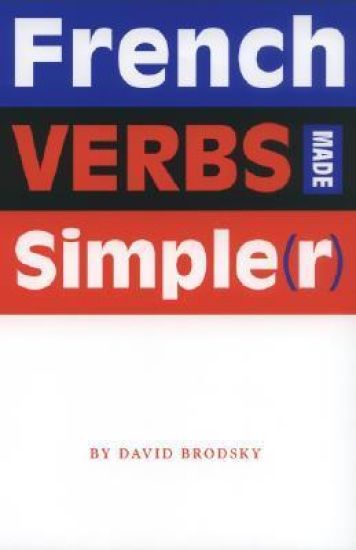
French Verbs Made Simple(r)

French Verbs Made Simple(r)

David Brodsky

University of Texas Press
2006
pokkari
It's time for a new approach to learning French verbs. Unlike popular verb guides that require the rote memorization of hundreds of verb forms, this book clearly explains the rules that govern the conjugation of all classes of French verbs-especially the irregular ones that give second-language learners the most trouble. These straightforward, easy-to-understand rules for conjugating French verbs are effective learning tools for both beginning students and more advanced speakers who want to perfect their usage of French verb forms.French Verbs Made Simple(r) has many helpful features that you won't find in any other verb guide:Clear explanations of all verb tenses and forms.The simple patterns and rules that govern the conjugation of all verbs-including those verbs whose irregularities follow patterns that can be easily learned.A detailed discussion of how each verb form is used, with numerous examples.A full explanation of whether a verb should be conjugated with avoir or Être, and the conditions under which the past participle is variable-two of the thorniest problems for students of French.An extended treatment of the subjunctive that will help you understand why it is used in some situations but not others.Complete conjugations for 57 basic model verbs (along with 27 "variants") and a comprehensive listing of some 6,200 verbs that indicates which of the models each verb follows.Going well beyond any other guide in the clarity and detail of its explanations-as well as the innovative manner in which individual verbs are linked to model conjugations-French Verbs Made Simple(r) is the only guide to French verbs a learner needs.
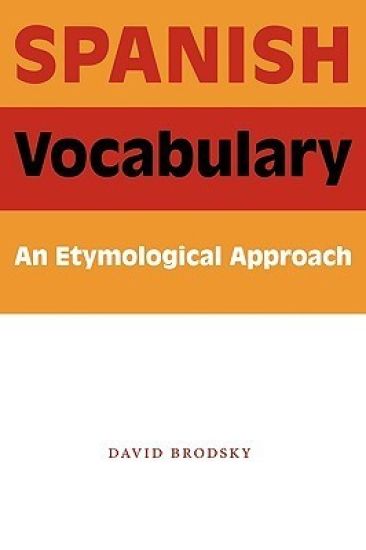
Spanish Vocabulary

Spanish Vocabulary

David Brodsky

University of Texas Press
2008
pokkari
Unlike other vocabulary guides that require the rote memorization of literally thousands of words, this book starts from the premise that using the etymological connections between Spanish and English words-their common derivations from Latin, Greek, and other languages-is the most effective way to acquire and remember vocabulary. This approach is suitable for beginners as well as for advanced students. Teachers of the language will also find much material that can be used to help motivate their students to acquire, and retain, Spanish vocabulary. Spanish Vocabulary is divided into four parts and four annexes: Part I provides background material on the origins of Spanish and begins the process of presenting Spanish vocabulary. Part II presents "classical" Spanish vocabulary-words whose form (in both Spanish and English) is nearly unchanged from Latin and Greek. Part III deals with "popular" Spanish vocabulary, which underwent significant changes in form (and often meaning) during the evolution from Latin to Spanish. A number of linguistic patterns are identified that will help learners recognize and remember new vocabulary. Part IV treats a wide range of themes, including words of Germanic and Arabic origin, numbers, time, food and animals, the family, the body, and politics. Annex A: Principal exceptions to the "Simplified Gender Rule" Annex B: 700 words whose relations, if any, to English words are not immediately obvious Annex C: -cer verbs and related words Annex D: 4,500 additional words, either individually or in groups, with English correspondences
A Bride without a Blessing

A Bride without a Blessing

David Brodsky

Mohr Siebeck
2006
sidottu
David Brodsky uses form and source criticism to date Massekhet Kallah and the first two chapters of Kallah Rabbati - which form a commentary on Massekhet Kallah - to the mid-amoraic period (circa late third and early fifth centuries CE respectively), and to locate their redaction in Babylonia. This makes these two sources the only known rabbinic texts whose final redaction took place in Babylonia during the amoraic period, and establishes them as the closest extant relatives of the Babylonian Talmud. Parallels between these two sources and the Babylonian Talmud elucidate the nature of oral transmission and of the redactional processes of Babylonian rabbinic material during this critical period, and, thereby, of the Babylonian Talmud itself. In addition, the author deciphers Massekhet Kallah's peculiar asceticism: a concern with men's inappropriate use of or interactions with their wives, charity, vows, and even with the group's own transmitted traditions. Massekhet Kallah fears the physical and at times cosmic effects of such inappropriate behavior. Brodsky finds that these items were all deemed consecrated, removed from the realm of normal interaction. To have mundane interaction with them was a powerful and dangerous act. Brodsky explores the fascinating gender and theological implications of this unique asceticism.