Kirjojen hintavertailu. Mukana 11 945 049 kirjaa ja 12 kauppaa.

Kirjahaku

Etsi kirjoja tekijän nimen, kirjan nimen tai ISBN:n perusteella.

11 kirjaa tekijältä David Bromwich

How Words Make Things Happen

How Words Make Things Happen

David Bromwich

Oxford University Press
2019
sidottu
Sooner or later, our words take on meanings other than we intended. How Words Make Things Happen suggests that the conventional idea of persuasive rhetoric (which assumes a speaker's control of calculated effects) and the modern idea of literary autonomy (which assumes that 'poetry makes nothing happen') together have produced a misleading account of the relations between words and human action. Words do make things happen. But they cannot be counted on to produce the result they intend. This volume studies examples from a range of speakers and writers and offers close readings of their words. Chapter 1 considers the theory of speech-acts propounded by J.L. Austin. 'Speakers Who Convince Themselves' is the subject of chapter 2, which interprets two soliloquies by Shakespeare's characters and two by Milton's Satan. The oratory of Burke and Lincoln come in for extended treatment in chapter 3, while chapter 4 looks at the rival tendencies of moral suasion and aestheticism in the poetry of Yeats and Auden. The final chapter, a cause of controversy when first published in the London Review of Books, supports a policy of unrestricted free speech against contemporary proposals of censorship. Since we cannot know what our own words are going to do, we have no standing to justify the banishment of one set of words in favour of another.
Disowned by Memory

Disowned by Memory

David Bromwich

University of Chicago Press
2000
nidottu
Although we know him as one of the greatest English poets, William Wordsworth might not have become a poet at all without the experience of personal and historical catastrophe in his youth. In Disowned by Memory, David Bromwich connects the accidents of Wordsworth's life with the originality of his writing, showing how the poet's strong sympathy with the political idealism of the age and with the lives of the outcast and the dispossessed formed the deepest motive of his writings of the 1790s."This very Wordsworthian combination of apparently low subjects with extraordinary 'high argument' makes for very rewarding, though often challenging reading."—Kenneth R. Johnston, Washington Times"Wordsworth emerges from this short and finely written book as even stranger than we had thought, and even more urgently our contemporary."—Grevel Lindop, Times Literary Supplement"[Bromwich's] critical interpretations of the poetry itself offer readers unusual insights into Wordworth's life and work."—Library Journal"An added benefit of this book is that it restores our faith that criticism can actually speak to our needs. Bromwich is a rigorous critic, but he is a general one whose insights are broadly applicable. It's an intellectual pleasure to rise to his complexities."—Vijay Seshadri, New York Times Book Review
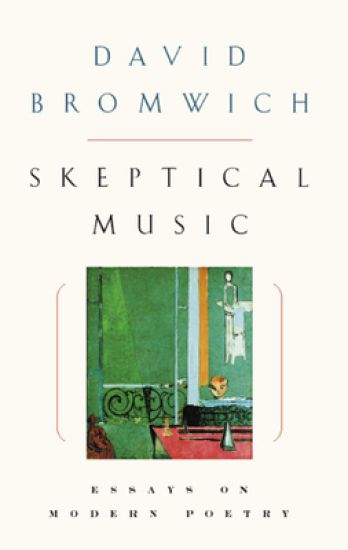
Skeptical Music

Skeptical Music

David Bromwich

University of Chicago Press
2001
sidottu
The poems that are written about, in the essays found in this book, all stake a definitive claim for the modernist style and its intent to capture an audience beyond the present moment. Bromwich's essays offer readings of individual poets, as well as comparisons between poets and their style. Bromwich looks at the link between author and reader that gives language its subtlety and depth and makes the written word adequate to the reality that poetry captures. He also explores the moral and aesthetic considerations of poems, and argues that the excitement that poems draw on is at once primitive and irriducible. There is a look at the relationship between T.S. Eliot and Hart Crane and their work. Another essay takes a revealing look at W.H. Auden and traces the process by which the voice of a generation changed from prophet to domestic ironist. The essays attempt to make the reader think about what poetry is, and why it is still important.
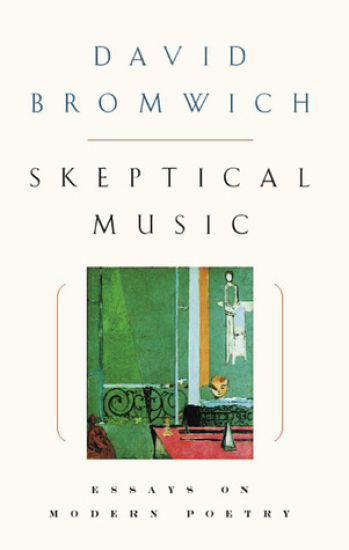
Skeptical Music

Skeptical Music

David Bromwich

University of Chicago Press
2001
nidottu
The poems that are written about, in the essays found in this book, all stake a definitive claim for the modernist style and its intent to capture an audience beyond the present moment. Bromwich's essays offer readings of individual poets, as well as comparisons between poets and their style. Bromwich looks at the link between author and reader that gives language its subtlety and depth and makes the written word adequate to the reality that poetry captures. He also explores the moral and aesthetic considerations of poems, and argues that the excitement that poems draw on is at once primitive and irriducible. There is a look at the relationship between T.S. Eliot and Hart Crane and their work. Another essay takes a revealing look at W.H. Auden and traces the process by which the voice of a generation changed from prophet to domestic ironist. The essays attempt to make the reader think about what poetry is, and why it is still important.
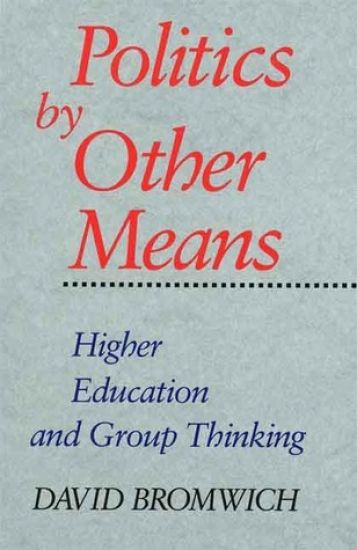
Politics by Other Means

Politics by Other Means

David Bromwich

Yale University Press
1994
pokkari
Liberal education has been under siege in recent years. Far-right ideologues in journalism and government have pressed for a uniform curriculum that focuses on the achievements of Western culture. Partisans of the academic left, who hold our culture responsible for the evils of society, have attempted to redress imbalances by fostering multiculturalism in education. In this eloquent and passionate book a distinguished scholar criticizes these positions and calls for a return to the tradition of independent thinking that he contends has been betrayed by both right and left. Under the guise of educational reform, says David Bromwich, these groups are in fact engaging in politics by other means.Bromwich argues that rivals in the debate over education have one thing in common: they believe in the all-importance of culture. Each assumes that culture confers identity, decides the terms of every moral choice, and gives a meaning to life. Both sides therefore see education as a means to indoctrinate students in specific cultural and political dogmas. By contrast, Bromwich contends that genuine education is concerned less with culture than with critical thinking and independence of mind. This view of education is not a middle way among the political demands of the moment, says Bromwich. Its earlier advocates include Mill and Wollstonecraft, and its roots can be traced to such secular moralists as Burke and Hume.Bromwich attacks the anti-democratic and intolerant premises of both right and left—premises that often appear in the conservative guise of "preserving the tradition" on the one hand, or the radical guise of "opening up the tradition" on the other. He discusses the new academic "fundamentalists" and the politically correct speech codes they have devised to enforce a doctrine of intellectual conformity; educational policy as articulated by conservative apologists George Will and William Bennett; the narrow logic of institutional radicalism; the association between personal reflection and social morality; and the discipline of literary study, where the symptoms of cultural conflict have appeared most visibly. Written with the wisdom and conviction of a dedicated teacher, this book is a persuasive plea to recover a true liberal tradition in academia and government—through independent thinking, self-knowledge, and tolerance of other points of view.
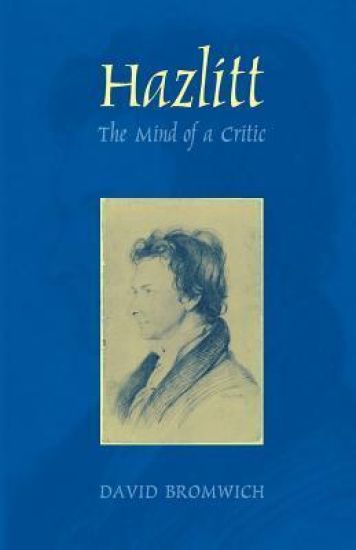
Hazlitt

Hazlitt

David Bromwich

Yale University Press
2000
pokkari
Essayist, lecturer, and radical pamphleteer, William Hazlitt (1778-1830) was the greatest of English critics and a master of the art of prose. This book is a superb appreciation of the man and his works, at once a revaluation of the aesthetics of Romanticism and a sustained intellectual portrait. Nominated for the National Book Critics Circle Award in criticism when it was first published in 1983, it is now reissued with a new preface and bibliography by the author.“Few literary figures in recent decades have seen their reputations rise as securely as Hazlitt’s. Now it will soar. David Bromwich’s book is the most persuasive and ambitious exploration of Hazlitt’s genius hitherto attempted.”—Michael Foot, New Republic“Hazlitt: the Mind of a Critic is an intellectual biography in the best sense of the word, and intellectual biography is the type of writing that shows Hazlitt in his truest light.”—Kenneth R. Johnston, Indiana University“Bromwich’s volume was first published in 1983, and its achievement has never been questioned. All Romanticists recognize that this is one of the great critical works in our field to appear in the post-war era. It aspires to (and achieves) a classical simplicity and elegance.”—Duncan Wu, University of Glasgow
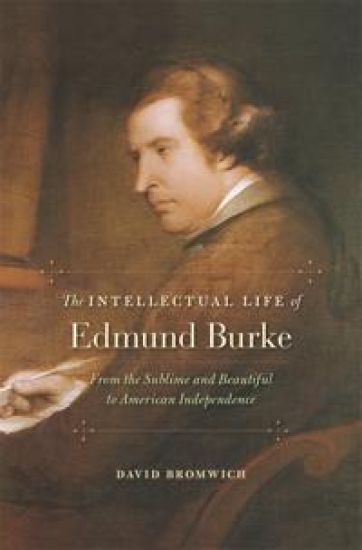
The Intellectual Life of Edmund Burke

The Intellectual Life of Edmund Burke

David Bromwich

The Belknap Press
2014
sidottu
David Bromwich’s portrait of statesman Edmund Burke (1730–1797) is the first biography to attend to the complexity of Burke’s thought as it emerges in both the major writings and private correspondence. The public and private writings cannot be easily dissociated, nor should they be. For Burke—a thinker, writer, and politician—the principles of politics were merely those of morality enlarged. Bromwich reads Burke’s career as an imperfect attempt to organize an honorable life in the dense medium he knew politics to be.This intellectual biography examines the first three decades of Burke’s professional life. His protest against the cruelties of English society and his criticism of all unchecked power laid the groundwork for his later attacks on abuses of government in India, Ireland, and France. Bromwich allows us to see the youthful skeptic, wary of a social contract based on “nature”; the theorist of love and fear in relation to “the sublime and beautiful”; the advocate of civil liberty, even in the face of civil disorder; the architect of economic reform; and the agitator for peace with America. However multiple and various Burke’s campaigns, a single-mindedness of commitment always drove him.Burke is commonly seen as the father of modern conservatism. Bromwich reveals the matter to be far more subtle and interesting. Burke was a defender of the rights of disfranchised minorities and an opponent of militarism. His politics diverge from those of any modern party, but all parties would be wiser for acquaintance with his writing and thoughts.
Moral Imagination

Moral Imagination

David Bromwich

Princeton University Press
2014
sidottu
Spanning many historical and literary contexts, Moral Imagination brings together a dozen recent essays by one of America's premier cultural critics. David Bromwich explores the importance of imagination and sympathy to suggest how these faculties may illuminate the motives of human action and the reality of justice. These wide-ranging essays address thinkers and topics from Gandhi and Martin Luther King on nonviolent resistance, to the dangers of identity politics, to the psychology of the heroes of classic American literature. Bromwich demonstrates that moral imagination allows us to judge the right and wrong of actions apart from any benefit to ourselves, and he argues that this ability is an innate individual strength, rather than a socially conditioned habit. Political topics addressed here include Edmund Burke and Richard Price's efforts to define patriotism in the first year of the French Revolution, Abraham Lincoln's principled work of persuasion against slavery in the 1850s, the erosion of privacy in America under the influence of social media, and the use of euphemism to shade and anesthetize reactions to the global war on terror. Throughout, Bromwich considers the relationship between language and power, and the insights language may offer into the corruptions of power. Moral Imagination captures the singular voice of one of the most forceful thinkers working in America today.
Moral Imagination

Moral Imagination

David Bromwich

Princeton University Press
2016
pokkari
Spanning many historical and literary contexts, Moral Imagination brings together a dozen recent essays by one of America's premier cultural critics. David Bromwich explores the importance of imagination and sympathy to suggest how these faculties may illuminate the motives of human action and the reality of justice. These wide-ranging essays address thinkers and topics from Gandhi and Martin Luther King on nonviolent resistance, to the dangers of identity politics, to the psychology of the heroes of classic American literature. Bromwich demonstrates that moral imagination allows us to judge the right and wrong of actions apart from any benefit to ourselves, and he argues that this ability is an innate individual strength, rather than a socially conditioned habit. Political topics addressed here include Edmund Burke and Richard Price's efforts to define patriotism in the first year of the French Revolution, Abraham Lincoln's principled work of persuasion against slavery in the 1850s, the erosion of privacy in America under the influence of social media, and the use of euphemism to shade and anesthetize reactions to the global war on terror. Throughout, Bromwich considers the relationship between language and power, and the insights language may offer into the corruptions of power. Moral Imagination captures the singular voice of one of the most forceful thinkers working in America today.
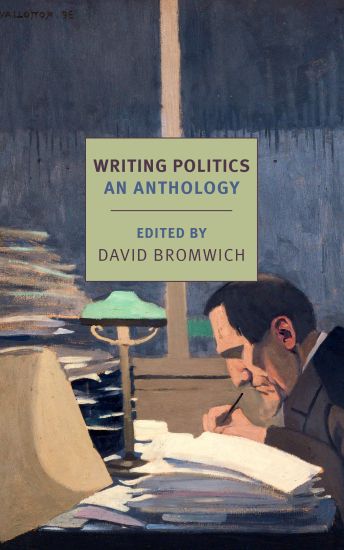
Writing Politics

Writing Politics

David Bromwich

The New York Review of Books, Inc
2020
nidottu
An original anthology exploring the tradition of the political essay--including works by Hannah Arendt, Martin Luther King Jr., Norman Mailer, George Orwell, and Jean-Paul Sartre--edited by the brilliant David Bromwich. David Bromwich is one of the most clear-headed, learned, well-informed, cogent, and uncompromising political writers of our day, a man who is firmly but never dogmatically on the left whose work appears regularly in The New York Review of Books and The London Review of Books. He is also one of our finest intellectual historians and literary critics and the author of an intellectual biography of Edmund Burke that has received glowing reviews. Bromwich's new gathering of political essays dates back to the beginning of the modern political world the better to illuminate some of the central political debates that continue to shape our world but also to bring out some of the finest writing that political passion has given rise to. This is a book not just about political power but about the power of the word. Essays by Edmund Burke, George Orwell, Jean-Paul Sartre, Norman Mailer, and Elizabeth Hardwick are included, along with a wide-ranging introduction by Bromwich.
American Breakdown

American Breakdown

David Bromwich

Verso Books
2019
sidottu
American Breakdown is the brilliant political diary of one of America's leading essayists, David Bromwich, whose work has drawn wide appreciation for its incisive portraits and accurate prognosis. From his analysis of the Cheney-Bush co-presidency, in which foreign policy was reduced to permanent war, and Barack Obama's practice of reconciliation without truth, Bromwich chronicles the emergence of Donald Trump-the demagogue of a culture of corruption from which all traces of political interest and candour have dropped away. An unsparing account of the degradation of American democracy, the book leads off with a new introduction on the prospects for change during the new Democratic Congress.