Kirjojen hintavertailu. Mukana 11 342 296 kirjaa ja 12 kauppaa.

Kirjahaku

Etsi kirjoja tekijän nimen, kirjan nimen tai ISBN:n perusteella.

6 kirjaa tekijältä David C. Cassidy

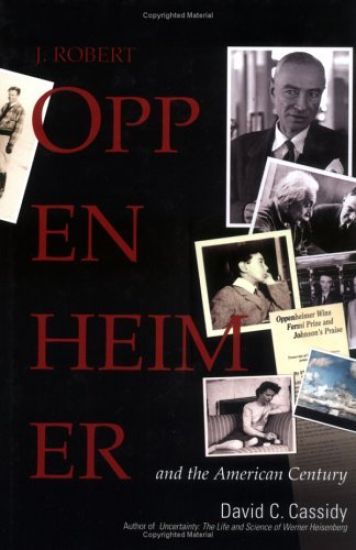
J. Robert Oppenheimer

J. Robert Oppenheimer

David C. Cassidy

Pi Pr
2004
sidottu
How did a gentle liberal humanist become responsible for the creation of the first real weapon of mass destruction? How could a brilliant mind like his virtually found "scientific militarism" and then let it destroy him? Cassidy opens up a life story that is emblematic of the transformation of America over the last three generations.
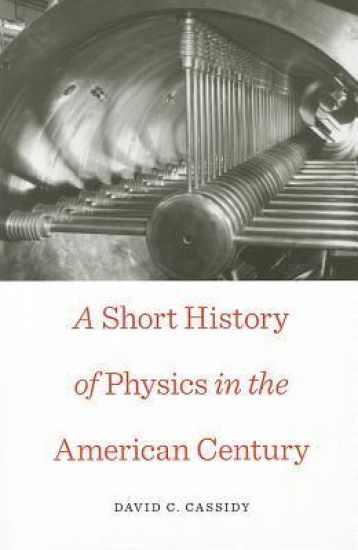
A Short History of Physics in the American Century

A Short History of Physics in the American Century

David C. Cassidy

Harvard University Press
2013
nidottu
As the twentieth century drew to a close, computers, the Internet, and nanotechnology were central to modern American life. Yet the advances in physics underlying these applications are poorly understood and widely underappreciated by U.S. citizens today. In this concise overview, David C. Cassidy sharpens our perspective on modern physics by viewing this foundational science through the lens of America's engagement with the political events of a tumultuous century.American physics first stirred in the 1890s-around the time x-rays and radioactivity were discovered in Germany-with the founding of graduate schools on the German model. Yet American research lagged behind the great European laboratories until highly effective domestic policies, together with the exodus of physicists from fascist countries, brought the nation into the first ranks of world research in the 1930s. The creation of the atomic bomb and radar during World War II ensured lavish government support for particle physics, along with computation, solid-state physics, and military communication. These advances facilitated space exploration and led to the global expansion of the Internet.Well into the 1960s, physicists bolstered the United States' international status, and the nation repaid the favor through massive outlays of federal, military, and philanthropic funding. But gradually America relinquished its postwar commitment to scientific leadership, and the nation found itself struggling to maintain a competitive edge in science education and research. Today, American physicists, relying primarily on industrial funding, must compete with smaller, scrappier nations intent on writing their own brief history of physics in the twenty-first century.
J. Robert Oppenheimer and the American Century

J. Robert Oppenheimer and the American Century

David C. Cassidy

Johns Hopkins University Press
2009
pokkari
David C. Cassidy's celebrated biography is more than the life story of J. Robert Oppenheimer, the brilliant physicist who served as scientific director for the Manhattan Project. It also tells the hidden story of the political and social forces that shaped the world in the 20th century, when the rise of American science contributed mightily to the country's emergence as a dominant power in world affairs. Cassidy explores that strong relationship in the captivating story of the rise and fall of one of America's greatest scientists. As head of the Manhattan Project, Oppenheimer led the country's successful effort to build the first atom bomb during World War II. In 1954 the government-with the United States embroiled in the Cold War-stripped him of his security clearance amid allegations that he consorted with communists. In rich detail Cassidy places this personal story of public disgrace within the larger narrative of the rise of science in America.
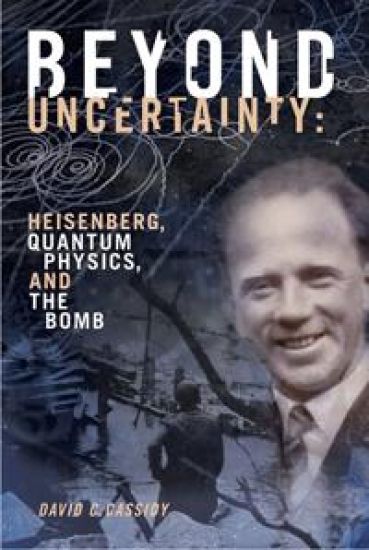
Beyond Uncertainty

Beyond Uncertainty

David C. Cassidy

Bellevue Literary Press
2010
pokkari
"A fascinating, well-documented biography." --New York Times Book Review "A monumental effort." --New York Review of Books "An excellent piece of science writing...Cassidy does not so much exculpate Heisenberg as explain him, with a transparency that makes this biography a pleasure to read." --Los Angeles Times "Cassidy has written the definitive biography of a great and tragic physicist." --Richard Rhodes, author of the Pulitzer Prize--winning The Making of the Atomic Bomb Since the fall of the Soviet Union, long-suppressed information has emerged on Werner Heisenberg's role in the Nazi atomic bomb project. In Beyond Uncertainty, Cassidy interprets this and other previously unknown material within the context of his vast research and tackles the vexing questions of a scientist's personal responsibility and guilt when serving an abhorrent military regime. David C. Cassidy is the author of Beyond Uncertainty: Heisenberg, Quantum Physics, and the Bomb; A Short History of Physics in the American Century; J. Robert Oppenheimer and the American Century; and Einstein and Our World. He is the recipient of the Abraham Pais Prize for History of Physics from the American Physical Society, the Science Writing Award from the American Institute of Physics, the Pfizer Award from the History of Science Society, and an honorary doctorate from Purdue University. Dr. Cassidy is Professor of Natural Sciences at Hofstra University and resides in Bay Shore, New York.
Farm Hall and the German Atomic Project of World War II

Farm Hall and the German Atomic Project of World War II

David C. Cassidy

Springer International Publishing AG
2017
sidottu
This gripping book brings back to life the events surrounding the internment of ten German Nuclear Scientists immediately after World War II. It is also an "eye-witness" account of the dawning of the nuclear age, with the dialogue and narrative spanning the period before, during and after atomic bombs were dropped on Japan at the end of the war. This pivotal historical episode is conveyed, along with the emotions as well as the facts, through drama, historical narrative, and photographs of the captive German nuclear scientists - who included Werner Heisenberg, Otto Hahn, and Max von Laue. The unique story that unfolds in the play is based on secretly recorded transcripts of the scientists’ actual conversations at Farm Hall, together with related documents and photographs.
Farm Hall and the German Atomic Project of World War II

Farm Hall and the German Atomic Project of World War II

David C. Cassidy

Springer International Publishing AG
2018
nidottu
This gripping book brings back to life the events surrounding the internment of ten German Nuclear Scientists immediately after World War II. It is also an "eye-witness" account of the dawning of the nuclear age, with the dialogue and narrative spanning the period before, during and after atomic bombs were dropped on Japan at the end of the war. This pivotal historical episode is conveyed, along with the emotions as well as the facts, through drama, historical narrative, and photographs of the captive German nuclear scientists - who included Werner Heisenberg, Otto Hahn, and Max von Laue. The unique story that unfolds in the play is based on secretly recorded transcripts of the scientists’ actual conversations at Farm Hall, together with related documents and photographs.