Kirjojen hintavertailu. Mukana 11 342 296 kirjaa ja 12 kauppaa.

Kirjahaku

Etsi kirjoja tekijän nimen, kirjan nimen tai ISBN:n perusteella.

4 kirjaa tekijältä David C. Hendrickson

Republic in Peril

Republic in Peril

David C. Hendrickson

Oxford University Press Inc
2017
sidottu
It has become a staple among critics of American foreign policy to refer to the United States's approach as "liberal imperialism." By this they mean that America's globalist agenda and its willingness to use force in theaters across the globe derives from its desire to evangelize the gospel of liberalism and thereby extend the reach of a US-dominated democratic capitalist order. These critics point to the presidency of Woodrow Wilson and trace how this agenda evolved over the next century. The dominance of liberal ideology, they argue, is so all-encompassing that virtually all of the main variants within the modern US foreign policy tradition, from anti-communism to neoliberalism to neoconservatism, fit under liberalism's umbrella. In Republic in Peril, the eminent foreign policy scholar David C. Hendrickson turns this thesis on its head. A trenchant critic of America's quest for global dominance, Hendrickson argues not only that liberalism is not the culprit, but is in fact where we should turn because it offers a powerful critique of both militarized interventionism and the US quest for full-spectrum global dominance. Covering all of the major episodes of the past century, he shows how the US has fully abandoned a tradition of republican liberalism that dates back to the Founders. The republican liberal tradition, which dominated US foreign policy for over a century, mandated non-intervention and the promotion of peace. This "golden rule" policy toward other nations served America well, he contends, and many of the pathologies that plague US foreign policy now--particularly its disastrous approach to the Middle East--can be traced to the desertion of the republican liberal tradition. He therefore advocates returning to the more collegial form of internationalism ("iso-internationalism") that preceded Wilsonianism. Combining both a rich historical overview of modern American foreign policy with a forceful indictment of the illiberal straitjacket in which US has bound itself, Republic in Peril provides a genuinely original defense of liberalism in the service of peaceful non-intervention--a position that contemporary critics of aggressive liberalism are sure to find surprising.
Peace Pact

Peace Pact

David C. Hendrickson

University Press of Kansas
2003
nidottu
That New England might invade Virginia is inconceivable today. But interstate rivalries and the possibility of intersectional war loomed large in the thinking of the Framers who convened in Philadelphia in 1787 to put on paper the ideas that would bind the federal union together. At the end of the Constitutional Convention, Benjamin Franklin rejoiced that the document would "astonish our enemies, who are waiting to hear with confidence . . . that our States are on the point of separation, only to meet hereafter for the purpose of cutting one another's throats." Usually dismissed as hyperbole, this and similar remarks by other Founders help us to understand the core concerns that shaped their conception of the Union. By reexamining the creation of the federal system of the United States from a perspective that yokes diplomacy with constitutionalism, Hendrickson's study, according to Karl Walling, "introduces a new way to think about what is familiar to us."This ground breaking book, then, takes a fresh look at the formative years of American constitutionalism and diplomacy. It tells the story of how thirteen colonies became independent states and found themselves grappling with the classic problems of international cooperation, and it explores the intellectual milieu within which that problem was considered. The founding generation, Hendrickson argues, developed a sophisticated science of international politics relevant both to the construction of their own union and to the foreign relations of "the several states in the union of the empire." The centrality of this discourse, he contends, must severely qualify conventional depictions of early American political thought as simply "liberal" or "republican."Hendrickson also takes issue with conventional accounts of early American foreign policy as "unilateralist" or "isolationist" and insists that the founding generation belonged to and made distinguished contributions to the constitutional tradition in diplomacy, the antecedent of twentieth-century internationalism. He describes an American system of states riven by deep sectional animosities and powerful loyalties to colonies and states (often themselves described as "nations") and explains why in such a milieu the creation of a durable union often appeared to be a quixotic enterprise. The book culminates in a consideration of the making of the federal Constitution, here styled as a peace pact or experiment in international cooperation.Peace Pact is an important book that promises to revolutionize our understanding of the era of revolution and constitution-making. Written in a lucid and accessible style, the book is an excellent introduction to the American founding and its larger significance in American and world history.
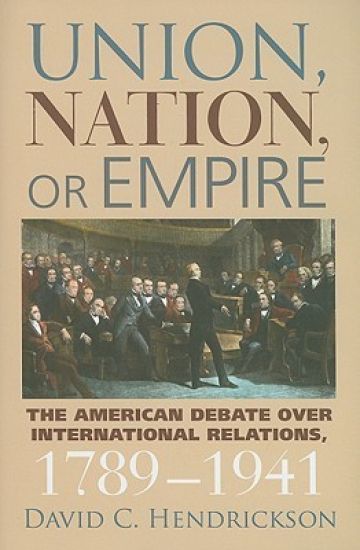
Union, Nation, or Empire

Union, Nation, or Empire

David C. Hendrickson

University Press of Kansas
2009
sidottu
Most overviews of American history depict an isolationist country finally dragged kicking and screaming onto the world stage by the attack on Pearl Harbor. David Hendrickson shows that Americans instead conducted often-raucous debates over international relations in the long epoch customarily seen as isolationist - debates that form the ideological origins of today's foreign policy arguments. ""Union, Nation, or Empire"" is a sequel to Hendrickson's acclaimed ""Peace Pact"", in which he identified a 'unionist paradigm' that defined America's political understanding in 1787. His new book examines how that paradigm was transformed under the impact of the great wars that followed. Skillfully drawn portraits of American statesmen, from Hamilton and Jefferson to Wilson and the two Roosevelts, Hendrickson reveals 'union, nation, and empire' as fundamental categories of political discourse that have shaped our engagement with the world since 1776. Hendrickson argues that the ongoing debate over union, nation, and empire in American history encompasses and illuminates the great questions of international relations - such as whether democracies are as prone to war as monarchies, whether trade promotes peace, or whether empire is compatible with free institutions. Setting these debates in the context of historical events, from the birth of our federal government to America's entry into World War II, he shows the significance of the federal union in our history and demonstrates that internationalism has deep roots in America's past. His assessment of the unionist tradition, in counterpoint to rival ideologies of nationalism and imperialism, includes new insights into the causes of the Civil War and shows how after that conflict the building blocks of the original paradigm were reconstructed to shape the internationalist persuasion in the twentieth century. Deftly combining intellectual, constitutional, and diplomatic history, this gracefully written work revives the compelling rhetoric of yesterday's statesmen to offer readers a lucid narrative of American international thought. It challenges accepted interpretations of our role in the world as it restores the federal union to its proper place in the understanding of American statecraft.
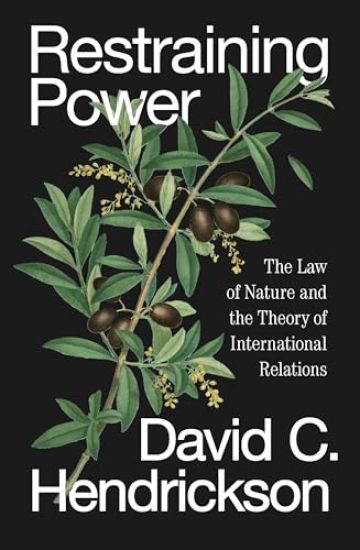
Restraining Power

Restraining Power

David C. Hendrickson

Verso Books
2026
nidottu
For centuries, thinkers grappled with a fundamental question: how can sovereign states coexist without destroying each other? Restraining Power recovers a forgotten tradition that offered an answer-the "law of nature and nations" built on reciprocity, justice, and good faith. David C. Hendrickson excavates this vital framework for restraining state violence and shows why it matters now more than ever. All states, Hendrickson argues, have an interest in observing these principles, but few states have violated them more than the United States. He shows that in crossing these principles, US foreign policy has entered a destabilizing shadow world in which force and fraud seem normal.