*Introduces the operational amplifier early, and uses it as a basic element throughout the book.*Provides numerous exercises and examples throughout.*Written in a clear, precise style that has been highly praised throughout many editions.
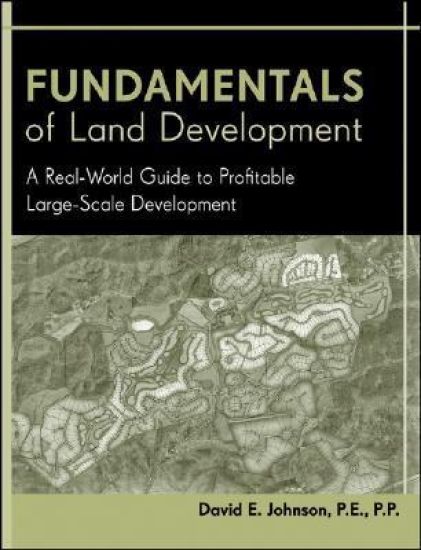
Properly planned and visualized, large-scale developments can be successfully constructed, whether as master planned communities, planned unit developments, or new towns. Fundamentals of Land Development provides an in-depth approach to the design, planning, and development of large land areas into comprehensively designed communities. This book provides in-depth discussions of the full range of development tasks involved in any large development project, from site and land use selection, market analysis, preparing the land use plan and impact statements, to getting approval from the municipality and community, permitting and approval, scheduling and cost management, and the basics of engineering systems and design. Developers and other stake-holders will find guidance on such issues as: • How real-world development is driven by profits, and how team members can maximize profits while developing creatively and responsibly • Site selection and acquisition • Entering the growing business of retirement (active adult) community development Illustrated with real-world case studies drawn from the authors own experience, Fundamentals of Land Development is a practical manual for developers looking to improve the profitability of their projects and gain a better understanding of what all team members undertake in a project of this size and complexity.
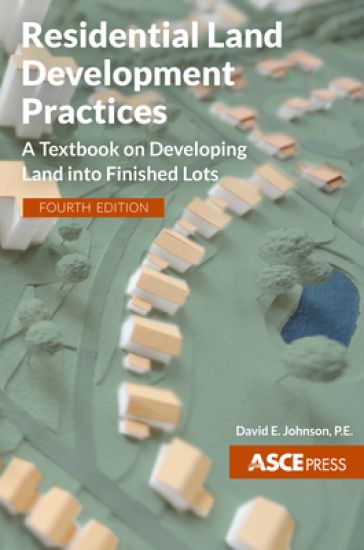
The development of raw land into buildable lots can be filled with opportunities as well as pitfalls. In Residential Land Development Practices, Fourth Edition, Johnson draws on more than 40 years of experience as an engineer, consultant, and lecturer to prepare an easy-to-use guide to the basic concepts of land planning, subdivision design, and residential standards.This edition has been updated with five new chapters reflecting the social and economic changes in the last ten years. The new material includes sustainable land development concepts; the municipal government's changing landscape; the developer, consultant, regulator relationship; due diligence practices; and land development as part of the engineering curriculum.Added to the core topics of bidding, financing, marketing, project management, and field operations, this new edition provides a comprehensive guide for land development beginners or seasoned professionals to better understand the complexities of the residential land development business.
The U.S. Army entered World War II unprepared. In addition, lacking Germany's blitzkrieg approach of coordinated armor and air power, the army was organized to fight two wars: one on the ground and one in the air. Previous commentators have blamed Congressional funding and public apathy for the army's unprepared state. David E. Johnson believes instead that the principal causes were internal: army culture and bureaucracy, and their combined impact on the development of weapons and doctrine. Johnson examines the U.S. Army's innovations for both armor and aviation between the world wars, arguing that the tank became a captive of the conservative infantry and cavalry branches, while the airplane's development was channeled by air power insurgents bent on creating an independent air force. He maintains that as a consequence, the tank's potential was hindered by the traditional arms, while air power advocates focused mainly on proving the decisiveness of strategic bombing, neglecting the mission of tactical support for ground troops. Minimal interaction between ground and air officers resulted in insufficient cooperation between armored forces and air forces. Fast Tanks and Heavy Bombers makes a major contribution to a new understanding of both the creation of the modern U.S. Army and the Army's performance in World War II. The book also provides important insights for future military innovation.
The U.S. Army entered World War II unprepared. In addition, lacking Germany's blitzkrieg approach of coordinated armor and air power, the army was organized to fight two wars: one on the ground and one in the air. Previous commentators have blamed Congressional funding and public apathy for the army's unprepared state. David E. Johnson believes instead that the principal causes were internal: army culture and bureaucracy, and their combined impact on the development of weapons and doctrine. Johnson examines the U.S. Army's innovations for both armor and aviation between the world wars, arguing that the tank became a captive of the conservative infantry and cavalry branches, while the airplane's development was channeled by air power insurgents bent on creating an independent air force. He maintains that as a consequence, the tank's potential was hindered by the traditional arms, while air power advocates focused mainly on proving the decisiveness of strategic bombing, neglecting the mission of tactical support for ground troops. Minimal interaction between ground and air officers resulted in insufficient cooperation between armored forces and air forces. Fast Tanks and Heavy Bombers makes a major contribution to a new understanding of both the creation of the modern U.S. Army and the Army's performance in World War II. The book also provides important insights for future military innovation.
Situates Borges at the limit of philosophy and literature.Kant's Dog provides fresh insight into Borges's preoccupation with the contradiction of the time that passes and the identity that endures. By developing the implicit logic of the Borgesian archive, which is most often figured as the universal demand for and necessary impossibility of translation, Kant's Dog is able to spell out Borges's responses to the philosophical problems that most concerned him, those of the constitution of time, eternity, and identity; the determination of original and copy; the legitimacy of authority; experience; the nature of language and the possibility of a decision; and the name of God. Kant's Dog offers original interpretations of several of Borges's best known and most important stories and of the works of key figures in the history of philosophy, including Aristotle, Saint Paul, Maimonides, Hume, Locke, Kant, Heidegger, and Derrida. This study outlines Borges's curious relationship to literature and philosophy and, through a reconsideration of the relation between necessity and accident, opens the question of the constitution of philosophy and literature. The afterword develops the logic of translation toward the secret at the heart of every culture in order to posit a Borgesian challenge to anthropology and cultural studies.
Reclaiming the notion of literature as an institution essential for reflecting on the violence of culture, history, and politics, Violence and Naming exposes the tension between the irreducible, constitutive violence of language and the reducible, empirical violation of others. Focusing on an array of literary artifacts, from works by journalists such as Elena Poniatowska and Sergio GonzÁlez RodrÍguez to the Zapatista communiquÉs to Roberto BolaÑo's The Savage Detectives and 2666, this examination demonstrates that Mexican culture takes place as a struggle over naming-with severe implications for the rights and lives of women and indigenous persons.Through rereadings of the Conquest of Mexico, the northern Mexican feminicide, the Zapatista uprising in Chiapas, the disappearance of the forty-three students at Iguala in 2014, and the 1999 abortion-rights scandal centering on “Paulina,” which revealed the tenuousness of women’s constitutionally protected reproductive rights in Mexico, Violence and Naming asks how societies can respond to violence without violating the other. This essential question is relevant not only to contemporary Mexico but to all struggles for democracy that promise equality but instead perpetuate incessant cycles of repression.