Kirjojen hintavertailu. Mukana 11 244 527 kirjaa ja 12 kauppaa.

Kirjahaku

Etsi kirjoja tekijän nimen, kirjan nimen tai ISBN:n perusteella.

6 kirjaa tekijältä David E. Lewis

The Wolff-Kishner Reduction and Related Reactions

The Wolff-Kishner Reduction and Related Reactions

David E. Lewis

Elsevier Science Publishing Co Inc
2019
nidottu
The Wolff-Kishner Reduction and Related Reactions: Discovery and Development offers a detailed discussion of this reaction, its discoverers, and its development since its discovery. Derivative name reactions—including the Wharton and Shapiro reactions—are also discussed. The book is illustrated with examples from literature and corresponding references to the primary literature to aid further reading. It provides a comprehensive review of the century of chemistry that allows the reader to follow the development of this important synthetic reaction. In addition, it provides biographical details on the chemists who discovered and developed the reaction, thus adding a human dimension to the discussion.

Addition, Elimination and Substitution: Markovnikov, Hofmann, Zaitsev and Walden
Addition, Elimination and Substitution: Markovnikov, Hofmann, Zaitsev and Walden: Discovery and Development discusses foundational reactions in organic chemistry and their major protagonists, contributions to synthesis, and history. Hofmann, Zaitsev, and Markovnikov are introduced, along with their major discoveries and contributions to organic chemistry. The history of controversies around Markovnikov’s Rule are addressed. The book introduces Walden’s original demonstration of configuration inversion, then discusses bimolecular elimination reactions, regioselective addition reactions, regiospecific alkene synthesis, and the development of modern reactions with configuration inversion. With its unique perspective, focus, and comprehensive coverage, this book belongs on the shelf of every organic chemist.
Advanced Organic Chemistry

Advanced Organic Chemistry

David E. Lewis

Oxford University Press
2015
nidottu
Written by a master teacher, Advanced Organic Chemistry presents a clear, concise, and complete overview of the subject that is ideal for both advanced undergraduate and graduate courses. In contrast with many other books, this volume is a true textbook, not a reference book. FEATURES * Uses a unique method of categorizing organic reactions that is based on reactivity principles rather than mechanism or functional group, enabling students to see reactivity patterns in superficially widely disparate systems * Emphasizes fundamental physical organic concepts that reinforce themes, giving students the foundation to understand both mechanisms and synthesis * Covers asymmetric methodologies, a topic that is now ubiquitous in the current literature * Numerous in-chapter worked problems and end-of-chapter additional exercises allow students to apply concepts as they learn them * More than 2500 references to the primary literature in the body of the book(along with another 750 references in the problems) encourage students to become familiar with real scholarship as they master the concepts * Brief historical vignettes about relevant chemists reinforce a historical and humanizing approach to learning science
The Politics of Presidential Appointments

The Politics of Presidential Appointments

David E. Lewis

Princeton University Press
2008
pokkari
In the wake of Hurricane Katrina, many questioned whether the large number of political appointees in the Federal Emergency Management Agency contributed to the agency's poor handling of the catastrophe, ultimately costing hundreds of lives and causing immeasurable pain and suffering. The Politics of Presidential Appointments examines in depth how and why presidents use political appointees and how their choices impact government performance--for better or worse. One way presidents can influence the permanent bureaucracy is by filling key posts with people who are sympathetic to their policy goals. But if the president's appointees lack competence and an agency fails in its mission--as with Katrina--the president is accused of employing his friends and allies to the detriment of the public. Through case studies and cutting-edge analysis, David Lewis takes a fascinating look at presidential appointments dating back to the 1960s to learn which jobs went to appointees, which agencies were more likely to have appointees, how the use of appointees varied by administration, and how it affected agency performance. He argues that presidents politicize even when it hurts performance--and often with support from Congress--because they need agencies to be responsive to presidential direction. He shows how agency missions and personnel--and whether they line up with the president's vision--determine which agencies presidents target with appointees, and he sheds new light on the important role patronage plays in appointment decisions.
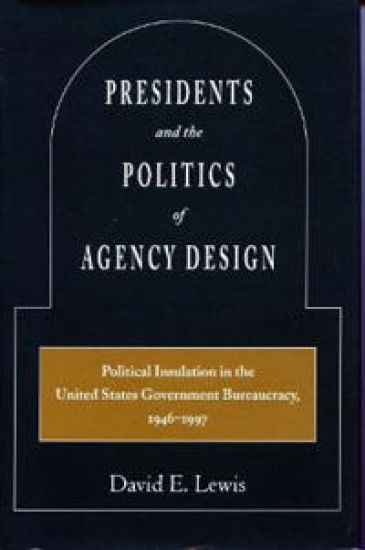
Presidents and the Politics of Agency Design

Presidents and the Politics of Agency Design

David E. Lewis

Stanford University Press
2003
sidottu
The administrative state is the nexus of American policy making in the postwar period. The vague and sometimes conflicting policy mandates of Congress, the president, and courts are translated into real public policy in the bureaucracy. As the role of the national government has expanded, the national legislature and executive have increasingly delegated authority to administrative agencies to make fundamental policy decisions. How this administrative state is designed, its coherence, its responsiveness, and its efficacy determine, in Robert Dahl's phrase, "who gets what, when, and how." This study of agency design, thus, has implications for the study of politics in many areas. The structure of bureaucracies can determine the degree to which political actors can change the direction of agency policy. Politicians frequently attempt to lock their policy preferences into place through insulating structures that are mandated by statute or executive decree. This insulation of public bureaucracies such as the National Transportation Safety Board, the Federal Election Commission, and the National Nuclear Security Administration, is essential to understanding both administrative policy outputs and executive-legislative politics in the United States. This book explains why, when, and how political actors create administrative agencies in such a way as to insulate them from political control, particularly presidential control.
Presidents and the Politics of Agency Design

Presidents and the Politics of Agency Design

David E. Lewis

Stanford University Press
2004
pokkari
The administrative state is the nexus of American policy making in the postwar period. The vague and sometimes conflicting policy mandates of Congress, the president, and courts are translated into real public policy in the bureaucracy. As the role of the national government has expanded, the national legislature and executive have increasingly delegated authority to administrative agencies to make fundamental policy decisions. How this administrative state is designed, its coherence, its responsiveness, and its efficacy determine, in Robert Dahl's phrase, "who gets what, when, and how." This study of agency design, thus, has implications for the study of politics in many areas. The structure of bureaucracies can determine the degree to which political actors can change the direction of agency policy. Politicians frequently attempt to lock their policy preferences into place through insulating structures that are mandated by statute or executive decree. This insulation of public bureaucracies such as the National Transportation Safety Board, the Federal Election Commission, and the National Nuclear Security Administration, is essential to understanding both administrative policy outputs and executive-legislative politics in the United States. This book explains why, when, and how political actors create administrative agencies in such a way as to insulate them from political control, particularly presidential control.