Kirjojen hintavertailu. Mukana 11 244 527 kirjaa ja 12 kauppaa.

Kirjahaku

Etsi kirjoja tekijän nimen, kirjan nimen tai ISBN:n perusteella.

6 kirjaa tekijältä David E. Rowe

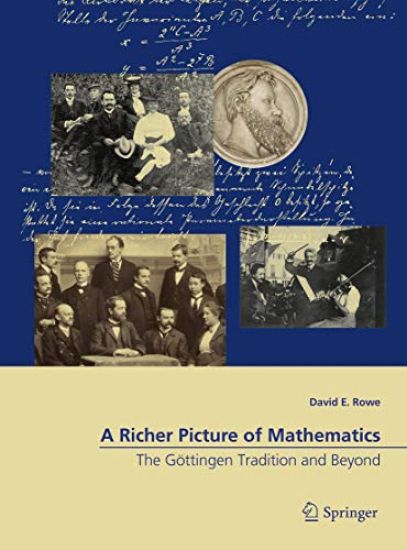
A Richer Picture of Mathematics

A Richer Picture of Mathematics

David E. Rowe

Springer Nature Switzerland AG
2018
nidottu
Historian David E. Rowe captures the rich tapestry of mathematical creativity in this collection of essays from the “Years Ago” column of The Mathematical Intelligencer. With topics ranging from ancient Greek mathematics to modern relativistic cosmology, this collection conveys the impetus and spirit of Rowe’s various and many-faceted contributions to the history of mathematics. Centered on the Göttingen mathematical tradition, these stories illuminate important facets of mathematical activity often overlooked in other accounts. Six sections place the essays in chronological and thematic order, beginning with new introductions that contextualize each section. The essays that follow recount episodes relating to the section’s overall theme. All of the essays in this collection, with the exception of two, appeared over the course of more than 30 years in The Mathematical Intelligencer. Based largely on archival and primary sources, these vignettes offer unusual insights into behind-the-scenes events. Taken together, they aim to show how Göttingen managed to attract an extraordinary array of talented individuals, several of whom contributed to the development of a new mathematical culture during the first decades of the twentieth century.
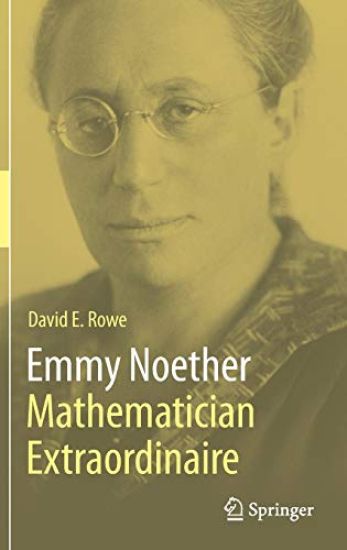
Emmy Noether – Mathematician Extraordinaire

Emmy Noether – Mathematician Extraordinaire

David E. Rowe

Springer Nature Switzerland AG
2021
sidottu
Although she was famous as the "mother of modern algebra," Emmy Noether’s life and work have never been the subject of an authoritative scientific biography. Emmy Noether – Mathematician Extraordinaire represents the most comprehensive study of this singularly important mathematician to date. Focusing on key turning points, it aims to provide an overall interpretation of Noether’s intellectual development while offering a new assessment of her role in transforming the mathematics of the twentieth century.Hermann Weyl, her colleague before both fled to the United States in 1933, fully recognized that Noether’s dynamic school was the very heart and soul of the famous Göttingen community. Beyond her immediate circle of students, Emmy Noether’s lectures and seminars drew talented mathematicians from all over the world. Four of the most important were B.L. van der Waerden, Pavel Alexandrov, Helmut Hasse, and Olga Taussky. Noether’s classic papers on ideal theory inspiredvan der Waerden to recast his research in algebraic geometry. Her lectures on group theory motivated Alexandrov to develop links between point set topology and combinatorial methods. Noether’s vision for a new approach to algebraic number theory gave Hasse the impetus to pursue a line of research that led to the Brauer–Hasse–Noether Theorem, whereas her abstract style clashed with Taussky’s approach to classical class field theory during a difficult time when both were trying to find their footing in a foreign country.Although similar to Proving It Her Way: Emmy Noether, a Life in Mathematics, this lengthier study addresses mathematically minded readers. Thus, it presents a detailed analysis of Emmy Noether’s work with Hilbert and Klein on mathematical problems connected with Einstein’s theory of relativity. These efforts culminated with her famous paper "Invariant Variational Problems," published one year before she joined the Göttingen faculty in 1919.
Emmy Noether – Mathematician Extraordinaire

Emmy Noether – Mathematician Extraordinaire

David E. Rowe

Springer Nature Switzerland AG
2022
nidottu
Although she was famous as the "mother of modern algebra," Emmy Noether’s life and work have never been the subject of an authoritative scientific biography. Emmy Noether – Mathematician Extraordinaire represents the most comprehensive study of this singularly important mathematician to date. Focusing on key turning points, it aims to provide an overall interpretation of Noether’s intellectual development while offering a new assessment of her role in transforming the mathematics of the twentieth century.Hermann Weyl, her colleague before both fled to the United States in 1933, fully recognized that Noether’s dynamic school was the very heart and soul of the famous Göttingen community. Beyond her immediate circle of students, Emmy Noether’s lectures and seminars drew talented mathematicians from all over the world. Four of the most important were B.L. van der Waerden, Pavel Alexandrov, Helmut Hasse, and Olga Taussky. Noether’s classic papers on ideal theory inspiredvan der Waerden to recast his research in algebraic geometry. Her lectures on group theory motivated Alexandrov to develop links between point set topology and combinatorial methods. Noether’s vision for a new approach to algebraic number theory gave Hasse the impetus to pursue a line of research that led to the Brauer–Hasse–Noether Theorem, whereas her abstract style clashed with Taussky’s approach to classical class field theory during a difficult time when both were trying to find their footing in a foreign country.Although similar to Proving It Her Way: Emmy Noether, a Life in Mathematics, this lengthier study addresses mathematically minded readers. Thus, it presents a detailed analysis of Emmy Noether’s work with Hilbert and Klein on mathematical problems connected with Einstein’s theory of relativity. These efforts culminated with her famous paper "Invariant Variational Problems," published one year before she joined the Göttingen faculty in 1919.
Felix Klein

Felix Klein

David E. Rowe

BIRKHAUSER VERLAG AG
2025
sidottu
This book presents a historical account of Felix Klein's "Comparative Reflections on Recent Research in Geometry" (1872), better known as his "Erlangen Program.” Originally conceived and written when Klein was collaborating with Sophus Lie, this bold essay initially made little impression on contemporary researchers. Decades later, however, it eventually became a famous classic. Eminent mathematicians hailed Klein’s main message – the role of invariants of transformation groups in geometry – as presaging major developments in mathematics and physics. The first part of this book focuses on the prehistory surrounding Klein’s “Erlangen Program,” stressing the motivations that led Klein to write it. The core of the book (Part II) then presents a new translation of Klein's original text, followed by detailed textual analysis aimed at guiding the reader through its rather terse and opaque prose. Part III deals with its complicated reception history, treated in four periods spanning the years from 1872 to 1930. This culminated during Klein’s lifetime with his efforts to promote the "Erlangen Program” as a framework for interpreting Einstein’s theory of relativity. After his death in 1925, the viability of this framework became a contentious issue among leading differential geometers. Part IV looks back on the transformations in mathematics that led to a modernized interpretation of Klein’s message. The book also explores in depth how the growing fame of the “Erlangen Program” undermined Klein’s friendship with Sophus Lie, leading to a dramatic public break between them in 1893. Beyond the "Erlangen Program” itself, this book deals with many of Felix Klein’s other works. As an introduction to a largely forgotten world of ideas, this study will appeal not only to experts but also to graduate students and all those with a serious interest in the history of modern mathematics.
A Richer Picture of Mathematics

A Richer Picture of Mathematics

David E. Rowe

Springer International Publishing AG
2018
sidottu
Historian David E. Rowe captures the rich tapestry of mathematical creativity in this collection of essays from the “Years Ago” column of The Mathematical Intelligencer. With topics ranging from ancient Greek mathematics to modern relativistic cosmology, this collection conveys the impetus and spirit of Rowe’s various and many-faceted contributions to the history of mathematics. Centered on the Göttingen mathematical tradition, these stories illuminate important facets of mathematical activity often overlooked in other accounts. Six sections place the essays in chronological and thematic order, beginning with new introductions that contextualize each section. The essays that follow recount episodes relating to the section’s overall theme. All of the essays in this collection, with the exception of two, appeared over the course of more than 30 years in The Mathematical Intelligencer. Based largely on archival and primary sources, these vignettes offer unusual insights into behind-the-scenes events. Taken together, they aim to show how Göttingen managed to attract an extraordinary array of talented individuals, several of whom contributed to the development of a new mathematical culture during the first decades of the twentieth century.
Otto Blumenthal: Ausgewählte Briefe und Schriften I

Otto Blumenthal: Ausgewählte Briefe und Schriften I

David E. Rowe

Springer Fachmedien Wiesbaden
2018
sidottu
Dieser Band bietet einen Einblick in das frühe Leben und Wirken Otto Blumenthals. Zusammen mit einer ausführlichen Biographie, die sich auf die Jahre 1897-1918 konzentriert, vermittelt eine Vielzahl an Schriften und Briefen ein lebhaftes Bild des Mathematikers und seiner Zeitgenossen. Prägend waren insbesondere seine tiefe Freundschaft mit dem Astronomen Karl Schwarzschild, welche bis auf ihre Schulzeit in Frankfurt zurückging, sowie Blumenthals Zeit in Göttingen, aus der sich seine lebenslangen freundschaftlichen Verbindungen zu David Hilbert, Felix Klein und Arnold Sommerfeld entwickelten. Aspekte wie seine spätere Arbeit an der Technischen Hochschule in Aachen, sein mathematisches Schaffen und auch sein Privatleben werden im vorliegenden Werk ebenso berücksichtigt. Besondere Beachtung findet aber auch Blumenthals Tätigkeit in der Redaktion der Mathematischen Annalen, eine Tätigkeit, die ihm zwar viel Freude bereitete, aber nicht immer unproblematisch war und seine Schwierigkeiten in der Nachkriegszeit schon früh vorausahnen ließ.Dieser erste Band wird durch einen zweiten ergänzt, der die Jahre 1919-1944 umfasst.