Kirjojen hintavertailu. Mukana 11 244 527 kirjaa ja 12 kauppaa.

Kirjahaku

Etsi kirjoja tekijän nimen, kirjan nimen tai ISBN:n perusteella.

2 kirjaa tekijältä David F. Hendry

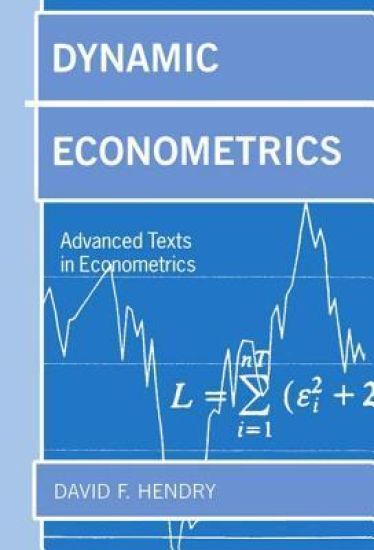
Dynamic Econometrics

Dynamic Econometrics

David F. Hendry

Oxford University Press
1995
nidottu
This book confronts the practical problems of modelling aggregate time series data, in a systematic and intergrated framework. The main problem in econometric modelling of time series is discovering sustainable and interpretable relationships between observed economic variables. The primary aim of this book is to develop an operational econometric approach which allows constructive modelling. Professor Hendry deals with methodological issues (model discovery, data mining, and progressive research strategies); with major tools for modelling (recursive methods, encompassing, super exogeneity, invariance tests); and with practical problems (collinearity, heteroscedasticity, and measurement errors). He also includes an extensive study of US money demand. The book is self-contained, with the technical background covered in appendices. It is thus suitable for first year graduate students, and includes solved examples and exercises to facilitate its use in teaching.
Econometrics: Alchemy or Science?

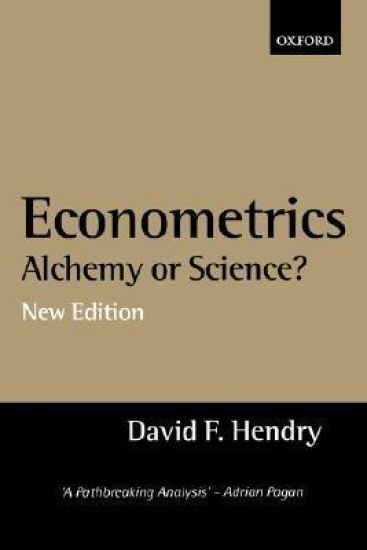
Econometrics: Alchemy or Science?

David F. Hendry

Oxford University Press
2000
nidottu
"Econometrics: Alchemy or Science?" analyses the effectiveness and validity of applying econometric methods to economic time series. The methodological dispute is long-standing, and no claim can be made for a single valid method, but recent results on the theory and practice of model selection bid fair to resolve many of the contentious issues. The book presents criticisms and evaluations of competing approaches, based on theoretical economic and econometric analyses, empirical applications, and Monte Carlo simulations, which interact to determine best practice. It explains the evolution of an approach to econometric modelling founded in careful statistical analyses of the available data, using economic theory to guide the general model specification. From a strong foundation in the theory of reduction, via a range of applied and simulation studies, it demonstrates that general-to-specific procedures have excellent properties. The book is divided into four Parts: Routes and Route Maps; Empirical Modelling Strategies; Formalization; and Retrospect and Prospect. A short preamble to each chapter sketches the salient themes, links to earlier and later developments, and the lessons learnt or missed at the time. A sequence of detailed empirical studies of consumers' expenditure and money demand illustrate most facets of the approach. Material new to this revised edition describes recent major advances in computer-automated model selection, embodied in the powerful new software program PcGets, which establish the operational success of the modelling strategy.