Kirjojen hintavertailu. Mukana 11 342 296 kirjaa ja 12 kauppaa.

Kirjahaku

Etsi kirjoja tekijän nimen, kirjan nimen tai ISBN:n perusteella.

7 kirjaa tekijältä David F. Labaree

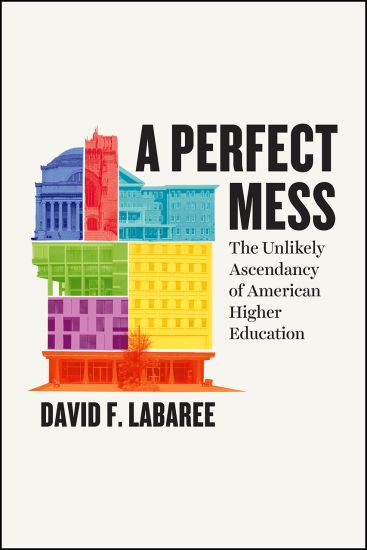
A Perfect Mess

A Perfect Mess

David F. Labaree

University of Chicago Press
2019
nidottu
Read the news about America’s colleges and universities—rising student debt, affirmative action debates, and conflicts between faculty and administrators—and it’s clear that higher education in this country is a total mess. But as David F. Labaree reminds us in this book, it’s always been that way. And that’s exactly why it has become the most successful and sought-after source of learning in the world. Detailing American higher education’s unusual struggle for survival in a free market that never guaranteed its place in society—a fact that seemed to doom it in its early days in the nineteenth century—he tells a lively story of the entrepreneurial spirit that drove American higher education to become the best. And the best it is: today America’s universities and colleges produce the most scholarship, earn the most Nobel prizes, hold the largest endowments, and attract the most esteemed students and scholars from around the world. But this was not an inevitability. Weakly funded by the state, American schools in their early years had to rely on student tuition and alumni donations in order to survive. This gave them tremendous autonomy to seek out sources of financial support and pursue unconventional opportunities to ensure their success. As Labaree shows, by striving as much as possible to meet social needs and fulfill individual ambitions, they developed a broad base of political and financial support that, grounded by large undergraduate programs, allowed for the most cutting-edge research and advanced graduate study ever conducted. As a result, American higher education eventually managed to combine a unique mix of the populist, the practical, and the elite in a single complex system. The answers to today’s problems in higher education are not easy, but as this book shows, they shouldn’t be: no single person or institution can determine higher education’s future. It is something that faculty, administrators, and students—adapting to society’s needs—will determine together, just as they have always done.

The Making of an American High School

The Making of an American High School

David F. Labaree

Yale University Press
1992
pokkari
How have the educational goals of American public high schools changed over time? What can the experiences of one secondary school tell us about the problems they all face today? This book provides an analytical history of the origins and development of Central High School, the first high school in Philadelphia and a model for many subsequent institutions. Using Central as a case study, David F. Labaree argues that the American public high school can be viewed as the product of both democratic politics and capitalist markets: although it was originally intended to produce informed citizens for the new republic, the high school, with its meritocratic emphasis, instead became a vehicle for conferring status on the select group that was educated there. The struggle between these two goals—one leading to political equality and the other reinforcing economic inequality—has characterized its history ever since, says Labaree. According to Labaree, Central was founded as a selective middle-class school with broad moral and political aims. However, the school’s success in providing advantages for its graduates led, during the 1880s, to growing public demand for secondary education. The resulting rapid expansion of Centrals’ enrollment and the establishment of other public high schools eventually undermined the selectivity that had made its credentials so valuable and enabled it to flourish. This in turn spurred the school to protect its credentials by introducing tracking, with a new dual curriculum for college-bound and non college-bound students. Labaree contends that this compromise between access and exclusivity does not work: it fails to serve the public interest because of the attenuation of the school’s democratic goals, and it fails to serve private interests because of the declining value of the credentials it bestows. In order to achieve its original democratic goals, he argues, the public high school must abandon its longstanding links to the market.
How to Succeed in School Without Really Learning

How to Succeed in School Without Really Learning

David F. Labaree

Yale University Press
1999
pokkari
Getting ahead and getting an education are inseparable in the minds of most Americans. David Labaree argues, however, that the connection between schooling and social mobility may be doing more harm than good, for the pursuit of educational credentials has come to take precedence over the acquisition of knowledge. Labaree examines the competing intellectual and ideological traditions that have fought for dominance in our public schools from the nineteenth century to the present. He claims that by thinking of education primarily as the route to individual advancement, we are defining it as a private good—a means of gaining a competitive advantage over other people. He endorses an alternative vision, one that sees education as a public good, providing society with benefits that can be collectively shared—for example, by producing citizens who are politically responsible and workers who are economically productive. He points out that when education is seen primarily as a private consumer good, a number of consequences follow. Formal characteristics of schooling—grades, credits, and degrees—come to assume greater weight than substantive characteristics, such as actually learning something. Grading becomes more important for its social consequences than for its pedagogical uses. For these and other reasons, the pursuit of certification and degrees takes precedence over the goals of learning, and the private benefits of schooling take precedence over its democratic and civic functions.
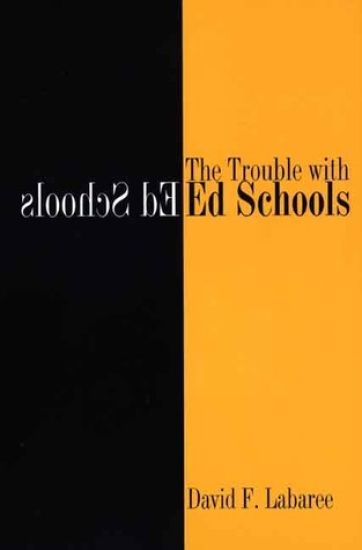
The Trouble with Ed Schools

The Trouble with Ed Schools

David F. Labaree

Yale University Press
2006
pokkari
American schools of education get little respect. They are portrayed as intellectual wastelands, as impractical and irrelevant, as the root cause of bad teaching and inadequate learning. In this book a sociologist and historian of education examines the historical developments and contemporary factors that have resulted in the unenviable status of ed schools, offering valuable insights into the problems of these beleaguered institutions. David F. Labaree explains how the poor reputation of the ed school has had important repercussions, shaping the quality of its programs, its recruitment, and the public response to the knowledge it offers. He notes the special problems faced by ed schools as they prepare teachers and produce research and researchers. And he looks at the consequences of the ed school’s attachment to educational progressivism. Throughout these discussions, Labaree maintains an ambivalent position about education schools—admiring their dedication and critiquing their mediocrity, their romantic rhetoric, and their compliant attitudes.
Education, Markets, and the Public Good
David F. Labaree has spent the last twenty years researching, thinking and writing about some of the key and enduring issues in the history of education and education policy and politics. Here, he brings together twelve of his key writings in one place. Starting with a specially written introduction, 'Getting It Wrong', which gives an ironic overview of how the ideas in his work have evolved over time and throws light on the process of scholarly production, the chapters cover such topics as:the structure of the educational system conflicting purposes of educationthe core problems of practice in teaching and teacher education barriers to curriculum reform. An ideal resource for anyone wanting to know more about the development of schools and schooling and David Labaree's contribution to these important fields.
Education, Markets, and the Public Good
David F. Labaree has spent the last twenty years researching, thinking and writing about some of the key and enduring issues in the history of education and education policy and politics. Here, he brings together twelve of his key writings in one place. Starting with a specially written introduction, 'Getting It Wrong', which gives an ironic overview of how the ideas in his work have evolved over time and throws light on the process of scholarly production, the chapters cover such topics as:the structure of the educational system conflicting purposes of educationthe core problems of practice in teaching and teacher education barriers to curriculum reform. An ideal resource for anyone wanting to know more about the development of schools and schooling and David Labaree's contribution to these important fields.
Someone Has to Fail

Someone Has to Fail

David F. Labaree

Harvard University Press
2012
nidottu
What do we really want from schools? Only everything, in all its contradictions. Most of all, we want access and opportunity for all children—but all possible advantages for our own. So argues historian David Labaree in this provocative look at the way “this archetype of dysfunction works so well at what we want it to do even as it evades what we explicitly ask it to do.” Ever since the common school movement of the nineteenth century, mass schooling has been seen as an essential solution to great social problems. Yet as wave after wave of reform movements have shown, schools are extremely difficult to change. Labaree shows how the very organization of the locally controlled, administratively limited school system makes reform difficult. At the same time, he argues, the choices of educational consumers have always overwhelmed top-down efforts at school reform. Individual families seek to use schools for their own purposes—to pursue social opportunity, if they need it, and to preserve social advantage, if they have it. In principle, we want the best for all children. In practice, we want the best for our own.Provocative, unflinching, wry, Someone Has to Fail looks at the way that unintended consequences of consumer choices have created an extraordinarily resilient educational system, perpetually expanding, perpetually unequal, constantly being reformed, and never changing much.