Kirjojen hintavertailu. Mukana 11 627 067 kirjaa ja 12 kauppaa.

Kirjahaku

Etsi kirjoja tekijän nimen, kirjan nimen tai ISBN:n perusteella.

8 kirjaa tekijältä David G. Haglund

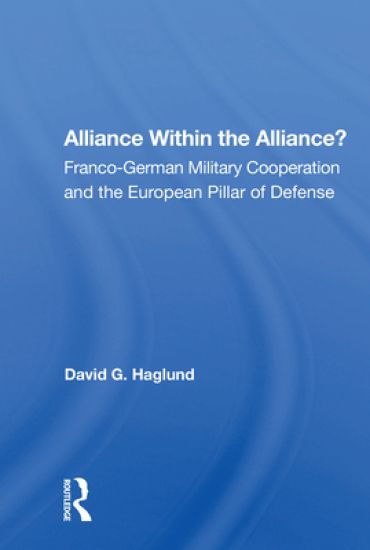
Alliance Within The Alliance?

Alliance Within The Alliance?

David G. Haglund

Routledge
2019
sidottu
This book is about the Franco-German military cooperation. It discusses the ending of the Cold War, the likelihood of a continuation and deepening of security cooperation between France and Germany and the impact this might have upon the transformation of the Atlantic Alliance.
From Euphoria to Hysteria

From Euphoria to Hysteria

David G. Haglund

Routledge
2020
sidottu
This book provides a detailed overview of the debate about the institutional context of Western European security after the Cold War. It discusses various aspects of contemporary European security 'architecture' and explores various aspects of the new transatlantic and European threat environment.
Alliance Within The Alliance?

Alliance Within The Alliance?

David G. Haglund

Routledge
2020
nidottu
This book is about the Franco-German military cooperation. It discusses the ending of the Cold War, the likelihood of a continuation and deepening of security cooperation between France and Germany and the impact this might have upon the transformation of the Atlantic Alliance.
From Euphoria To Hysteria

From Euphoria To Hysteria

David G. Haglund

Routledge
2022
nidottu
This book provides a detailed overview of the debate about the institutional context of Western European security after the Cold War. It discusses various aspects of contemporary European security 'architecture' and explores various aspects of the new transatlantic and European threat environment.
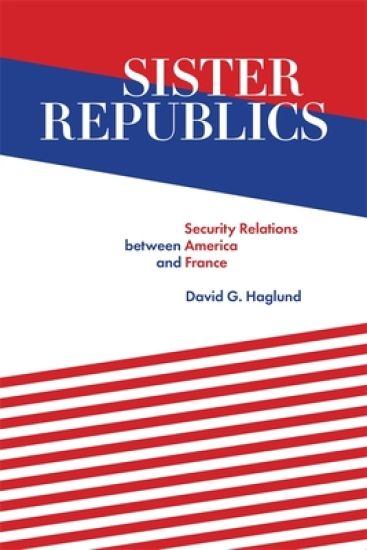
Sister Republics

Sister Republics

David G. Haglund

LOUISIANA STATE UNIVERSITY PRESS
2023
sidottu
David G. Haglund's Sister Republics tells the story of the unique relationship between the United States and its first ally, France. Historians and political scientists have characterized interactions between the two countries in the spheres of security and defense policy in radically different ways: either the two comport themselves in a highly cooperative fashion, befitting their status as old allies and steadfast friends, or they act as bitter rivals, revealing their alliance to be at best dysfunctional and at worst destructive. Haglund uses a fresh approach to reconcile these divergent positions, examining the Franco-American bond through the prism of strategic culture. In doing so, he reveals the cultural factors that have contributed to the suboptimal relationship between the two nations.
Ethnic Diasporas and the Canada-United States Security Community
Ethnic Diasporas and the Canada-United States Security Community focuses on three diasporas and their impact on North American security relations, the Irish and Germans, which were mainly in the US, and the Muslim diaspora, which is based in both countries. The book begins by examining the evolution of North America from a zone of war to a zone of peace (i.e., a security community), starting with the debate over the nature and meaning of the Canada-US border. It then assesses the role of ethnic diasporas in North American security, looking as to whether ethnic interest groups have been gaining influence over the shaping of the US foreign policy. This debate is also valid in Canada, especially given the practice of federal political parties of catering to blocs of ethnic voters. The second section of the book focuses on three case studies. The first examines the impact of the Irish Americans on the quality of security relations between the US and the UK, and therefore between the former and Canada. The second looks at an even larger diaspora, the German Americans, whose political agenda by the start of twentieth century attempted to discourage Anglo-American entente and eventual alliance. The final case concentrates on the debates around the North American Muslim diaspora in the past two decades, a time when policy attention turned toward the greater Middle East, which in many ways constitute the “kin community” of this politically active diaspora. This comparative assessment of the three cases provides contextualization for today’s discussion of homegrown terrorism and its implication for bilateral security cooperation in North America.
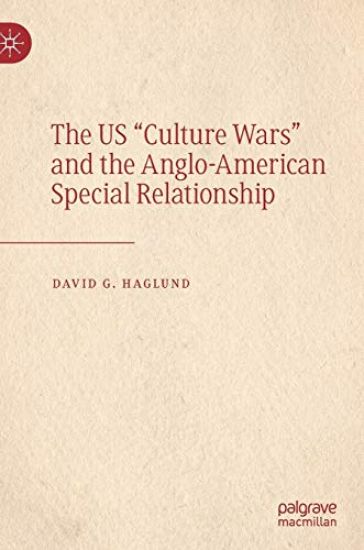
The US "Culture Wars" and the Anglo-American Special Relationship

The US "Culture Wars" and the Anglo-American Special Relationship

David G. Haglund

Springer Nature Switzerland AG
2019
sidottu
This book discusses “culture” and the origins of the Anglo-American special relationship (the AASR). The bitter dispute between ethnic groups in the US from 1914–17—a period of time characterized as the “culture wars”—laid the groundwork both for US intervention in the European balance of power in 1917 and for the creation of what would eventually become a lasting Anglo-American alliance. Specifically, the vigorous assault on English “civilization” launched by two large ethnic groups in America (the Irish-Americans and the German-Americans) had the unintended effect of causing America’s demographic majority at the time (the English-descended Americans) to regard the prospect of an Anglo-American alliance in an entirely new manner. The author contemplates why the Anglo-American “great rapprochement” of 1898 failed to generate the desired “Anglo-Saxon” alliance in Britain, and in so doing features theoretically informed inquiries into debates surrounding both the origins of the war in 1914 and the origins of the American intervention decision nearly three years later.
The US "Culture Wars" and the Anglo-American Special Relationship

The US "Culture Wars" and the Anglo-American Special Relationship

David G. Haglund

Springer Nature Switzerland AG
2020
nidottu
This book discusses “culture” and the origins of the Anglo-American special relationship (the AASR). The bitter dispute between ethnic groups in the US from 1914–17—a period of time characterized as the “culture wars”—laid the groundwork both for US intervention in the European balance of power in 1917 and for the creation of what would eventually become a lasting Anglo-American alliance. Specifically, the vigorous assault on English “civilization” launched by two large ethnic groups in America (the Irish-Americans and the German-Americans) had the unintended effect of causing America’s demographic majority at the time (the English-descended Americans) to regard the prospect of an Anglo-American alliance in an entirely new manner. The author contemplates why the Anglo-American “great rapprochement” of 1898 failed to generate the desired “Anglo-Saxon” alliance in Britain, and in so doing features theoretically informed inquiries into debates surrounding both the origins of the war in 1914 and the origins of the American intervention decision nearly three years later.