Kirjojen hintavertailu. Mukana 11 717 486 kirjaa ja 12 kauppaa.

Kirjahaku

Etsi kirjoja tekijän nimen, kirjan nimen tai ISBN:n perusteella.

4 kirjaa tekijältä David G. Hull

Optimal Control Theory for Applications

Optimal Control Theory for Applications

David G. Hull

Springer-Verlag New York Inc.
2003
sidottu
Mechanical engineering, an engineering discipline born of the needs of the in­ dustrial revolution, is once again asked to do its substantial share in the call for industrial renewal. The general call is urgent as we face profound issues of productivity and competitiveness that require engineering solutions, among others. The Mechanical Engineering Series is a series featuring graduate texts and research monographs intended to address the need for information in con­ temporary areas of mechanical engineering. The series is conceived as a comprehensive one that covers a broad range of concentrations important to mechanical engineering graduate education and research. We are fortunate to have a distinguished roster of consulting editors, each an expert in one of the areas of concentration. The names of the consulting editors are listed on page ii of this volume. The areas of concentration are applied mathematics, biomechanics, computational mechanics, dynamic systems and control, energetics, mechanics of materials, processing, thermal science, and tribology. Austin, Texas Frederick F. Ling Preface Optimization is an area of mathematics that is concerned with finding the "best" points, curves, surfaces, and so on. "Best" is determined by minimizing some measure of performance subject to equality and inequality constraints. Points are constrained by algebraic equations; curves are constrained by or­ dinary differential equations and algebraic equations; surfaces are constrained by partial differential equations, ordinary differential equations, and algebraic equations.
Optimal Control Theory for Applications

Optimal Control Theory for Applications

David G. Hull

Springer-Verlag New York Inc.
2010
nidottu
Mechanical engineering, an engineering discipline born of the needs of the in­ dustrial revolution, is once again asked to do its substantial share in the call for industrial renewal. The general call is urgent as we face profound issues of productivity and competitiveness that require engineering solutions, among others. The Mechanical Engineering Series is a series featuring graduate texts and research monographs intended to address the need for information in con­ temporary areas of mechanical engineering. The series is conceived as a comprehensive one that covers a broad range of concentrations important to mechanical engineering graduate education and research. We are fortunate to have a distinguished roster of consulting editors, each an expert in one of the areas of concentration. The names of the consulting editors are listed on page ii of this volume. The areas of concentration are applied mathematics, biomechanics, computational mechanics, dynamic systems and control, energetics, mechanics of materials, processing, thermal science, and tribology. Austin, Texas Frederick F. Ling Preface Optimization is an area of mathematics that is concerned with finding the "best" points, curves, surfaces, and so on. "Best" is determined by minimizing some measure of performance subject to equality and inequality constraints. Points are constrained by algebraic equations; curves are constrained by or­ dinary differential equations and algebraic equations; surfaces are constrained by partial differential equations, ordinary differential equations, and algebraic equations.
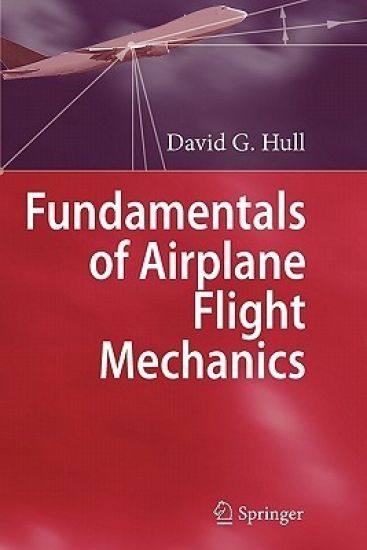
Fundamentals of Airplane Flight Mechanics

Fundamentals of Airplane Flight Mechanics

David G. Hull

Springer-Verlag Berlin and Heidelberg GmbH Co. K
2007
sidottu
Flight mechanics is the application of Newton's laws to the study of vehicle trajectories (performance), stability, and aerodynamic control. This text is concerned with the derivation of analytical solutions of airplane flight mechanics problems associated with flight in a vertical plane. Algorithms are presented for calculating lift, drag, pitching moment, and stability derivatives. Flight mechanics is a discipline. As such, it has equations of motion, acceptable approximations, and solution techniques for the approximate equations of motion. Once an analytical solution has been obtained, numbers are calculated in order to compare the answer with the assumptions used to derive it and to acquaint students with the sizes of the numbers. A subsonic business jet is used for these calculations.
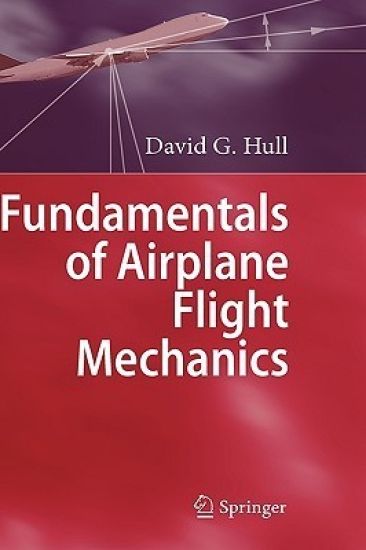
Fundamentals of Airplane Flight Mechanics

Fundamentals of Airplane Flight Mechanics

David G. Hull

Springer-Verlag Berlin and Heidelberg GmbH Co. K
2010
nidottu
Flight mechanics is the application of Newton's laws to the study of vehicle trajectories (performance), stability, and aerodynamic control. This text is concerned with the derivation of analytical solutions of airplane flight mechanics problems associated with flight in a vertical plane. Algorithms are presented for calculating lift, drag, pitching moment, and stability derivatives. Flight mechanics is a discipline. As such, it has equations of motion, acceptable approximations, and solution techniques for the approximate equations of motion. Once an analytical solution has been obtained, numbers are calculated in order to compare the answer with the assumptions used to derive it and to acquaint students with the sizes of the numbers. A subsonic business jet is used for these calculations.