Kirjojen hintavertailu. Mukana 11 417 157 kirjaa ja 12 kauppaa.

Kirjahaku

Etsi kirjoja tekijän nimen, kirjan nimen tai ISBN:n perusteella.

5 kirjaa tekijältä David H. Bayley

Changing the Guard

Changing the Guard

David H. Bayley

Oxford University Press Inc
2005
sidottu
Every day the American government, the United Nations, and other international institutions send people into non-English speaking, war-torn, and often minimally democratic countries struggling to cope with rising crime and disorder under a new regime. These assistance missions attempt to promote democratic law enforcement in devastated countries. But do these missions really facilitate the creation of effective policing? Renowned criminologist David H. Bayley here examines the prospects for the reform of police forces overseas as a means of encouraging the development of democratic governments. In doing so, he assesses obstacles for promoting democratic policing in a state-of-the-art review of all efforts to promote democratic reform since 1991. Changing the Guard offers an inside look at the achievements and limits of current American foreign assistance, outlining the nature and scope of the police assistance program and the agencies that provide it. Bayley concludes with recommendations for how police assistance could be improved in volatile countries across the world. This book is required reading as an instruction manual for building democratic policing overseas.
Police Use of Force

Police Use of Force

David H. Bayley

Praeger Publishers Inc
2010
sidottu
A team of expert contributors provides an in-depth exploration of police use of force, firearms, and less-than-lethal weapons from a dozen countries across five continents. Police Use of Force: A Global Perspective is a fascinating, international exploration of police use of force, firearms, and less-than-lethal weapons in nations around the world. The book is comprised of three sections: the first focuses on the use of force generally, the second explores firearms and deadly force, and the final section considers less-than-lethal weapons, including pepper spray, TASERs, and other emerging technologies currently on the horizon. The essays gathered here will provide readers with an understanding of the vast differences in how police use force in various countries, as well as why police use force differently under different forms of government. Topics covered include use-of-force definitions, training procedures, policy issues, abuse of police authority, use of force during interrogations, and the use of firearms by armed and unarmed police forces. Finally, there is an essay focusing on how shooting and killing a suspect impacts an officer in the months and years that follow.
Forces of Order

Forces of Order

David H. Bayley

University of California Press
1991
pokkari
In sharp contrast to the United States, Japan has one of the lowest crime rates in the world and practically no police brutality or corruption. Urban congestion is often blamed for the soaring crime rate in the United States and the waning public confidence in the American police force, yet Japan's population per square mile is almost thirty times that of ours. In "Forces of Order", originally published in 1976 and now thoroughly revised and expanded, David Bayley examines the reasons behind Japan's phenomenal success when it comes to public order. The Japanese police force is the world's most developed model of 'community policing'. To study it, Bayley conducted hundreds of interviews with police officers in Japan and spent many hours observing them on patrol, mostly at night. Making explicit comparisons between Japan and the United States, he analyzes Japan's record in policing and crime, the life of patrol officers, police relations with the community, police discipline and responsibility, the police as an institution, victimless crime, and deviance and authority in Japanese culture. The essential lesson of the book is that the incidence of crime as well as the nature of police practices is rooted in long-standing traditions that are profoundly related to fundamental matters of morality, culture, and historical experience. Bayley shows that the key differences between Japan and the United States do not stem from the economic or political structures of the two countries, but from the characteristic way in which people are expected to relate to one another and the sorts of social institutions that shape and reinforce those expectations.
Police and Political Development in India

Police and Political Development in India

David H. Bayley

Princeton University Press
2015
pokkari
As a pervasive and relatively modernized element of Indian society, the police are potentially a powerful vanguard in the establishment of a stable democratic process and a major factor in public attitudes toward the government. Professor Bayley's book, based upon 3,600 interviews during two extended periods of research in India, explores in depth the formative role police play in the maintenance and development of the Indian political system. As a first study of police and political development in a relatively non-modernized country, this book will be a guide for the exploration of a topic critical in the political life of many nations, both developed and underdeveloped. Originally published in 1969. The Princeton Legacy Library uses the latest print-on-demand technology to again make available previously out-of-print books from the distinguished backlist of Princeton University Press. These editions preserve the original texts of these important books while presenting them in durable paperback and hardcover editions. The goal of the Princeton Legacy Library is to vastly increase access to the rich scholarly heritage found in the thousands of books published by Princeton University Press since its founding in 1905.
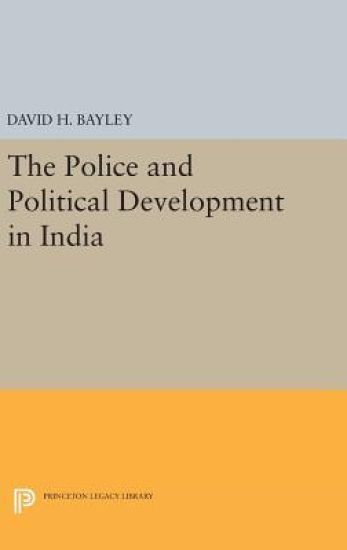
Police and Political Development in India

Police and Political Development in India

David H. Bayley

Princeton University Press
2016
sidottu
As a pervasive and relatively modernized element of Indian society, the police are potentially a powerful vanguard in the establishment of a stable democratic process and a major factor in public attitudes toward the government. Professor Bayley's book, based upon 3,600 interviews during two extended periods of research in India, explores in depth the formative role police play in the maintenance and development of the Indian political system. As a first study of police and political development in a relatively non-modernized country, this book will be a guide for the exploration of a topic critical in the political life of many nations, both developed and underdeveloped. Originally published in 1969. The Princeton Legacy Library uses the latest print-on-demand technology to again make available previously out-of-print books from the distinguished backlist of Princeton University Press. These editions preserve the original texts of these important books while presenting them in durable paperback and hardcover editions. The goal of the Princeton Legacy Library is to vastly increase access to the rich scholarly heritage found in the thousands of books published by Princeton University Press since its founding in 1905.