Kirjojen hintavertailu. Mukana 12 423 762 kirjaa ja 12 kauppaa.

Kirjahaku

Etsi kirjoja tekijän nimen, kirjan nimen tai ISBN:n perusteella.

4 kirjaa tekijältä David H. DeVorkin

From the Laboratory to the Moon

From the Laboratory to the Moon

David H. Devorkin

MIT PRESS LTD
2025
nidottu
The reserved genius and celebrated Black scientist, who built the first astronomical observatory on the moon and worked to inspire underserved students to pursue science and engineering.In April 1972, as George Carruthers closely monitored the operation from the Manned Spacecraft Center in Houston, astronauts conducting the Apollo 16 mission positioned a gold-plated far ultraviolet electrographic camera on the moon. The camera, Carruthers's invention, was the first astronomical observatory on the lunar surface, where it stands to this day. While Carruthers's achievements earned many accolades, including the President's Medal for Technology and Invention, surprisingly little is known about this remarkable man. In From the Laboratory to the Moon, David DeVorkin explores Carruthers's life and work, for the first time telling the full story of how a deeply reserved African American farm boy rose to become one of our most celebrated aerospace scientists.DeVorkin follows Carruthers from his childhood in Ohio and then Chicago to his career at the US Naval Research Laboratory in Washington, DC. In the highly competitive world of space science in the 1960s and 1970s, Carruthers's genius for experimentation and exploration transcended the racial stereotyping and discrimination of his day, and he achieved world-class recognition for his studies of the Earth and deep space. A leading expert in the history of astronomy and space science, DeVorkin gives a deft account of these achievements and of how Carruthers used the fame they brought him, along with his notoriety as a Black man in science, to become a tireless advocate for underserved young people in science and engineering.

Science With A Vengeance

Science With A Vengeance

David H. DeVorkin

Springer-Verlag New York Inc.
1993
nidottu
The exploration of the upper atmosphere was given a jump start in the United States by German V-2 rockets - Hitler's "vengeance weapon" - captured at the end of World War II. The science performed with these missiles was largely determined by the missile itself, such as learning more about the medium through which a ballistic missile travels. Groups rapidly formed within the military and military-funded university laboratories to build instruments to investigate the Earth's upper atmosphere and ionosphere, the nature of cosmic radiation, and the ultraviolet spectrum of the Sun. Few, if any, members of these research groups had prior experience or demonstrated interests in atmospheric, cosmic-ray, or solar physics. Although scientific agendas were at first centered on what could be done with missiles and how to make ballistic missile systems work, reports on techniques and results were widely publicized as the research groups and their patrons sought scientific legitimacy and learned how to make their science an integral part of the national security state. The process by which these groups gained scientific and institutional authority was far from straightforward and offers useful insight both for the historian and for the scientist concerned with how specialties born within the military services became part of post-war American science.
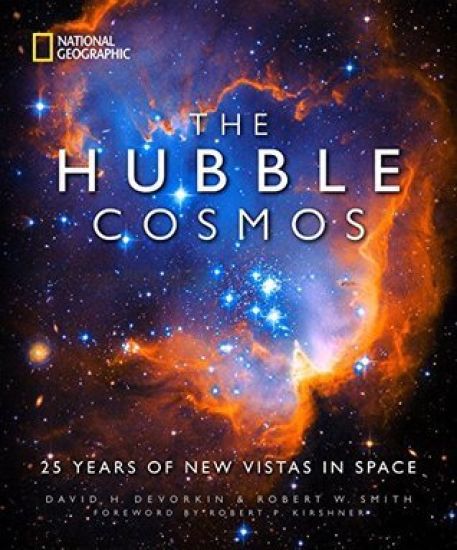
The Hubble Cosmos

The Hubble Cosmos

David H. Devorkin; Robert W. Smith

National Geographic Society
2015
sidottu
In this astronomically spectacular, large-format photographic retrospective, National Geographic celebrates the impact of the Hubble Space Telescope in its 25th anniversary year. Highlighting the most eye-popping images, significant discoveries, and many ways that this telescope's visions have revolutionized our understanding of the universe, this book wil appeal to space aficionados and photography buffs alike. The Hubble Telescope has now gazed into deep space for 25 years, imaging galaxies, nebulas, and supernovas for a new picture of the universe and our place in it. In honor of its 25th anniversary, space historians David DeVorkin and Robert Smith team up again to tell the stories of 25 iconic moments in the illustrious telescope's career, illustrated with breathtaking, never-before-seen images. Here are the major challenges and triumphs, the key scientific findings, the brilliant scientists behind the scenes, and the public's love affair with a space telescope.