Kirjojen hintavertailu. Mukana 11 363 173 kirjaa ja 12 kauppaa.

Kirjahaku

Etsi kirjoja tekijän nimen, kirjan nimen tai ISBN:n perusteella.

13 kirjaa tekijältä David Hackett Fischer

Historians' Fallacie: Toward a Logic of Historical Thought
"If one laughs when David Hackett Fischer sits down to play, one will stay to cheer. His book must be read three times: the first in anger, the srcond in laughter, the third in respect....The wisdom is expressed with a certin ruthlessness. Scarcly a major historian escapes unscathed. Ten thousand members of the AmericanHistorical Association will rush to the index and breathe a little easier to find their names absent.
Growing Old in America

Growing Old in America

David Hackett Fischer

Oxford University Press Inc
1978
nidottu
A history of aging in America surveys and compares actualities and attitudes in the eighteenth, nineteenth, and twentieth centuries and suggests practical improvements on the current inadequate system of pensions, social security, medicare, and other programs
The Great Wave

The Great Wave

David Hackett Fischer

Oxford University Press Inc
1997
sidottu
David Hackett Fischer, one of our most prominent historians, has garnered a reputation for making history come alive - even stories as familiar as Paul Revere's ride, or as complicated as the assimilation of British culture in North America. Now, in The Great Wave, Fischer has done it again, marshalling an astonishing array of historical facts in lucid and compelling prose to outline a history of prices - `the history of change', as Fischer puts it - covering the dazzling sweep of Western history from the medieval glory of Chartres to the modern day. Going far beyond the economic data, Fischer writes a powerful history of the people of the Western world: the economic patterns they lived in, and the politics, culture, and society that they created as a result. As he did in Albion's Seed and Paul Revere's Ride, two of the most talked-about history books in recent years, Fischer combines extensive research and meticulous scholarship with wonderfully evocative writing to create a book for scholars and general readers alike. Records of prices are more abundant than any other quantifiable data, and span the entire range of history, from tables of medieval grain prices to the overabundance of modern statistics. Fischer studies this wealth of data, creating a narrative that encompasses all of Western culture. He describes four waves of price revolutions, each beginning in a period of equilibrium: the High Middle Ages, the Renaissance, the Enlightenment, and finally the Victorian Age. Each revolution is marked by continuing inflation, a widening gap between rich and poor, increasing instability, and finally a crisis at the crest of the wave that is characterized by demographic contraction, social and political upheaval, and economic collapse. The most violent of these climaxes was the catastrophic fourteenth century, in which war, famine, and the Black Death devastated the continent - the only time in Europe's history that the population actually declined. Fischer also brilliantly illuminates how these long economic waves are closely intertwined with social and political events, affecting the very mindset of the people caught in them. The long periods of equilibrium are marked by cultural and intellectual movements - such as the Renaissance, the Enlightenment, and the Victorian Age - based on a belief in order and harmony and in the triumph of progress and reason. By contrast, the years of price revolution created a melancholy culture of despair. Fischer suggests that we are living now in the last stages of a price revolution that has been building since the turn of the century. The destabilizing price surges and declines and the diminished expectations the United States has suffered in recent years - and the famines and wars of other areas of the globe - are typical of the crest of a price revolution. He does not attempt to predict what will happen, noting that `uncertainty about the future is an inexorable fact of our condition'. Rather, he ends with a brilliant analysis of where we might go from here and what our choices are now. This book is essential reading for anyone concerned about the state of the world today.
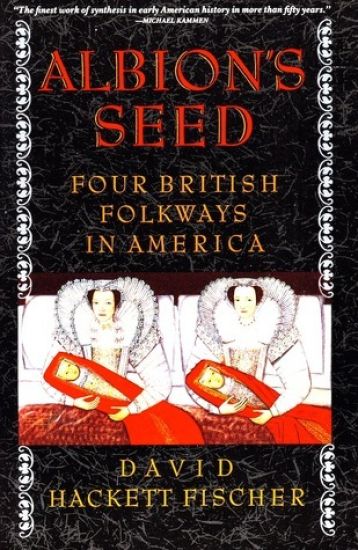
Albion's Seed

Albion's Seed

David Hackett Fischer

Oxford University Press Inc
1992
nidottu
Eighty percent of Americans have no British ancestors. According to David Hackett Fischer, however, their day-to-day lives are profoundly influenced by folkways transplanted from Britain to the New World with the first settlers. Residual, yet persistent, aspects of these 17th Century folkways are indentifiable, Fischer argues, in areas as divers as politics, education, and attitudes towards gender, sexuality, age, and child-raising. Making use of both traditional and revisionist scholarship, this ground-breaking work documents how each successive wave of early emigration--Puritans to the North-East; Royalist aristocrats to the South; the Friends to the Delaware Valley; Irish and North Britons to the American backcountry--contributed to, and continue to affect, ingrained cultural differences between various regions in the United States.
Paul Revere's Ride

Paul Revere's Ride

David Hackett Fischer

Oxford University Press Inc
1995
nidottu
This widely acclaimed and meticulously researched book is the first serious study of Paul Revere's famous ride. Fischer's exciting narrative offers new insight into the coming of the American Revolution.
Liberty and Freedom

Liberty and Freedom

David Hackett Fischer

Oxford University Press Inc
2004
sidottu
Liberty and freedom: Americans agree that these values are fundamental to our nation, but what do they mean? How have their meanings changed through time? In this new volume of cultural history, David Hackett Fischer shows how these varying ideas form an intertwined strand that runs through the core of American life. Fischer examines liberty and freedom not as philosophical or political abstractions, but as folkways and popular beliefs deeply embedded in American culture. Tocqueville called them "habits of the heart." From the earliest colonies, Americans have shared ideals of liberty and freedom, but with very different meanings. Like DNA these ideas have transformed and recombined in each generation. The book arose from Fischer's discovery that the words themselves had differing origins: the Latinate "liberty" implied separation and independence. The root meaning of "freedom" (akin to "friend") connoted attachment: the rights of belonging in a community of freepeople. The tension between the two senses has been a source of conflict and creativity throughout American history. Liberty & Freedom studies the folk history of those ideas through more than 400 visions, images, and symbols. It begins with the American Revolution, and explores the meaning of New England's Liberty Tree, Pennsylvania's Liberty Bells, Carolina's Liberty Crescent, and "Don't Tread on Me" rattlesnakes. In the new republic, the search for a common American symbol gave new meaning to Yankee Doodle, Uncle Sam, Miss Liberty, and many other icons. In the Civil War, Americans divided over liberty and freedom. Afterward, new universal visions were invented by people who had formerly been excluded from a free society--African Americans, American Indians, and immigrants. The twentieth century saw liberty and freedom tested by enemies and contested at home, yet it brought the greatest outpouring of new visions, from Franklin Roosevelt's Four Freedoms to Martin Luther King's "dream" to Janis Joplin's "nothin' left to lose." Illustrated in full color with a rich variety of images, Liberty and Freedom is, literally, an eye-opening work of history--stimulating, large-spirited, and ultimately, inspiring.
Washington's Crossing

Washington's Crossing

David Hackett Fischer

Oxford University Press Inc
2004
sidottu
Six months after Independence, the American Revolution was all but lost. A powerful British force had routed the Americans at New York, occupied three colonies, and advanced within sight of Philadelphia. George Washington lost 90 percent of his army, and was driven across the Delaware River. Panic and despair spread through the states. As the author recounts in this riveting history, many Americans refused to let the Revolution die. In mid-December, the people of occupied New Jersey began to rise against British and German troops. They created an opportunity for George Washington. On Christmas night, as a howling nor'easter struck the Delaware Valley, Washington led his men across the river and attacked the exhausted Hessian garrison at Trenton, killing or capturing nearly a thousand men. A second battle of Trenton followed a week later. The Americans repelled an attack by Lord Cornwallis, but were nearly trapped. They escaped in the night, marched behind the enemy, and defeated a British brigade at Princeton. Badly shaken, the British retreated to an enclave near the coast. For twelve weeks the Americans kept the initiative in small attacks that took a large toll of Howe's army, and wrecked his strategy. American spirits soared. A new three-year army was recruited, a continental executive was organized, and the states created permanent republican governments. European leaders were quick to take notice. Fischer's richly textured narrative reveals the role of contingency in these events. We see how the campaign developed in a web of hard choices by many actors on both sides. While British and German forces remained rigid and hierarchical, Americans invented an open and flexible system that was fundamental to their success. At the same time, Washington and his army developed an American way of war, and also a war-ethic that John Adams called "the policy of humanity." Their conduct of the War for Independence gave new meaning to the Revolution, in a pivotal moment for American history.
Washington's Crossing

Washington's Crossing

David Hackett Fischer

Oxford University Press Inc
2006
nidottu
A leading American historian provides a colorful and dramatic account of a pivotal moment in American history--the Christmas night crossing of the Delaware River to mount a sneak attack on British and Hessian troops at Trenton, New Jersey--an event that marked a turning point in America's battle for independence. Winner of the Pulitzer Prize. Reprint.
Fairness and Freedom

Fairness and Freedom

David Hackett Fischer

Oxford University Press Inc
2012
sidottu
Fairness and Freedom compares the history of two open societies - New Zealand and the United States - with much in common. Both have democratic polities, mixed-enterprise economies, individuated societies, pluralist cultures, and a deep concern for human rights and the rule of law. But all of these elements take different forms, because constellations of value are far apart. The dream of living free is America's Polaris; fairness and natural justice are New Zealand's Southern Cross. Fischer asks why these similar countries went different ways. Both were founded by English-speaking colonists, but at different times and with disparate purposes. They lived in the first and second British Empires, which operated in very different ways. Indians and Maori were important agents of change, but to different ends. On the American frontier and in New Zealand's Bush, material possibilities and moral choices were not the same. Fischer takes the same comparative approach to parallel processes of nation-building and immigration, women's rights and racial wrongs, reform causes and conservative responses, war-fighting and peace-making, and global engagement in our own time--with similar results. On another level, this book expands Fischer's past work on liberty and freedom. It is the first book to be published on the history of fairness. And it also poses new questions in the old tradition of history and moral philosophy. Is it possible to be both fair and free? In a vast array of evidence, Fischer finds that the strengths of these great values are needed to correct their weaknesses. As many societies seek to become more open - never twice in the same way, an understanding of our differences is the only path to peace.
Champlain's Dream

Champlain's Dream

David Hackett Fischer

SIMON SCHUSTER
2009
nidottu
Winner of the Pritzker Literature Award for Lifetime Achievement in Military Writing In this sweeping, enthralling biography, acclaimed historian David Hackett Fischer brings to life the remarkable Samuel de Champlain--soldier, spy, master mariner, explorer, cartographer, artist, and Father of New France. Born on France's Atlantic coast, Champlain grew to manhood in a country riven by religious warfare. The historical record is unclear on whether Champlain was baptized Protestant or Catholic, but he fought in France's religious wars for the man who would become Henri IV, one of France's greatest kings, and like Henri, he was religiously tolerant in an age of murderous sectarianism. Champlain was also a brilliant navigator. He went to sea as a boy and over time acquired the skills that allowed him to make twenty-seven Atlantic crossings without losing a ship. But we remember Champlain mainly as a great explorer. On foot and by ship and canoe, he traveled through what are now six Canadian provinces and five American states. Over more than thirty years he founded, colonized, and administered French settlements in North America. Sailing frequently between France and Canada, he maneuvered through court intrigue in Paris and negotiated among more than a dozen Indian nations in North America to establish New France. Champlain had early support from Henri IV and later Louis XIII, but the Queen Regent Marie de Medici and Cardinal Richelieu opposed his efforts. Despite much resistance and many defeats, Champlain, by his astonishing dedication and stamina, finally established France's New World colony. He tried constantly to maintain peace among Indian nations that were sometimes at war with one another, but when he had to, he took up arms and forcefully imposed a new balance of power, proving himself a formidable strategist and warrior. Throughout his three decades in North America, Champlain remained committed to a remarkable vision, a Grand Design for France's colony. He encouraged intermarriage among the French colonists and the natives, and he insisted on tolerance for Protestants. He was a visionary leader, especially when compared to his English and Spanish contemporaries--a man who dreamed of humanity and peace in a world of cruelty and violence. This superb biography, the first in decades, is as dramatic and exciting as the life it portrays. Deeply researched, it is illustrated throughout with many contemporary images and maps, including several drawn by Champlain himself.