Kirjojen hintavertailu. Mukana 11 699 587 kirjaa ja 12 kauppaa.

Kirjahaku

Etsi kirjoja tekijän nimen, kirjan nimen tai ISBN:n perusteella.

5 kirjaa tekijältä David Halliburton

The Color of the Sky

The Color of the Sky

David Halliburton

Cambridge University Press
2008
pokkari
David Halliburton's book is a richly textured study of the complete writings of Stephen Crane, including Maggie: A Girl of the Streets, The Red Badge of Courage, and the less well-known fiction, newswriting, and poetry. Offering close readings of the works within a broad framework, Halliburton sets out to explore the imaginative world Crane created in his total oeuvre of fiction, poetry and reportage. Comparative and interdisciplinary methods, combined with insights from historians such as Toynbee and Hofsteader, enable Halliburton to shed light on a number of issues. These include Crane's interest in musicality, the importance of his poetry and journalism to his other writings, the phenomenology of his social structures, his mastery of prosody, and the relation of his writings to the ideas of thinkers such as William James, Santayana, Weber and Sartre. This ambitious and comprehensive book sets a standard by which to measure all future interpretations of Crane.
The Color of the Sky

The Color of the Sky

David Halliburton

Cambridge University Press
1989
sidottu
David Halliburton's book is a richly textured study of the complete writings of Stephen Crane, including Maggie: A Girl of the Streets, The Red Badge of Courage, and the less well known fiction, newswriting, and poetry. Offering close readings of the works within a broad framework, Halliburton sets out to explore the imaginative world Crane created in his total oeuvre of fiction, poetry, and reportage. Comparative and interdisciplinary methods, combined with insights from historians such as Toynbee and Hofsteader, enable Halliburton to shed light on a number of previously overlooked issues. These include Crane's interest in musicality, the importance of his poetry and journalism to his other writings, the phenomenology of his social structures, his mastery of prosody, and the relation of his writings to the ideas of thinkers such as William James, Santayana, Weber, and Sartre. This ambitious and comprehensive book sets a standard by which to measure all future interpretations of Crane.
Edgar Allan Poe

Edgar Allan Poe

David Halliburton

Princeton University Press
2015
pokkari
By attempting to suspend moral, ideological, or psychological assumptions, a phenomenological interpretation of literature hopes to reach "the things themselves," the essential phenomena of being, space, and time, as they are constituted, by consciousness, in words. Although there has been a tradition of phenomenological criticism in Europe for the last twenty years, David Halliburton is the first to write a general study of an American author from this particular point of view. The book begins with a methodological chapter that sets out the assumptions and procedures of the approach. This is followed by analyses of Poe's major works, exploring such special problems as Poe's treatment of the material world, including technology; the interrelation of body and consciousness; poetic voice; attitudes toward women; and the will to affirmation, plenitude, and unity. The center of interest is neither Poe's biography nor environment but always the meaning of Poe's words. Because these works are shaped by a single imagination and because they are experienced in time, as a process, each work has its own "way of going." The aim of the interpretation is to find this way and go along with it; to live each work dynamically, as it "happens," while tracing its interaction with other works. Originally published in 1973. The Princeton Legacy Library uses the latest print-on-demand technology to again make available previously out-of-print books from the distinguished backlist of Princeton University Press. These editions preserve the original texts of these important books while presenting them in durable paperback and hardcover editions. The goal of the Princeton Legacy Library is to vastly increase access to the rich scholarly heritage found in the thousands of books published by Princeton University Press since its founding in 1905.
Edgar Allan Poe

Edgar Allan Poe

David Halliburton

Princeton University Press
2016
sidottu
By attempting to suspend moral, ideological, or psychological assumptions, a phenomenological interpretation of literature hopes to reach "the things themselves," the essential phenomena of being, space, and time, as they are constituted, by consciousness, in words. Although there has been a tradition of phenomenological criticism in Europe for the last twenty years, David Halliburton is the first to write a general study of an American author from this particular point of view. The book begins with a methodological chapter that sets out the assumptions and procedures of the approach. This is followed by analyses of Poe's major works, exploring such special problems as Poe's treatment of the material world, including technology; the interrelation of body and consciousness; poetic voice; attitudes toward women; and the will to affirmation, plenitude, and unity. The center of interest is neither Poe's biography nor environment but always the meaning of Poe's words. Because these works are shaped by a single imagination and because they are experienced in time, as a process, each work has its own "way of going." The aim of the interpretation is to find this way and go along with it; to live each work dynamically, as it "happens," while tracing its interaction with other works. Originally published in 1973. The Princeton Legacy Library uses the latest print-on-demand technology to again make available previously out-of-print books from the distinguished backlist of Princeton University Press. These editions preserve the original texts of these important books while presenting them in durable paperback and hardcover editions. The goal of the Princeton Legacy Library is to vastly increase access to the rich scholarly heritage found in the thousands of books published by Princeton University Press since its founding in 1905.
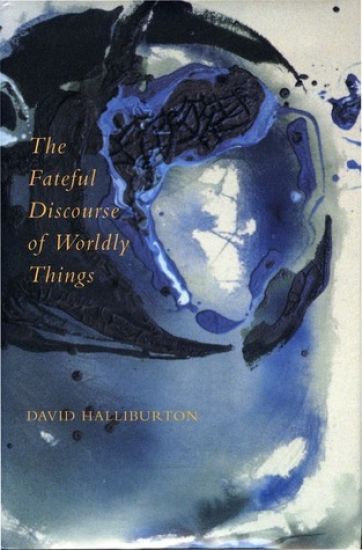
The Fateful Discourse of Worldly Things

The Fateful Discourse of Worldly Things

David Halliburton

Stanford University Press
1997
sidottu
This broad interdisciplinary and comparative study of the ways in which we discursively "make" the world and its things aims to go beyond the "poetic thinking" of Heidegger toward a more pragmatic way of interpreting concrete social, cultural, and political experience. The book outlines three constitutive functions of world-making. Endowing signifies the direct provision of the "wherewithal" that must come into being if anything else is to come into being. Enabling develops or facilitates what is endowed; it is a kind of education in being-in-the-world. Entitling embraces the realm of justice and decision; it concerns what is right for human beings to have and do and be. Placing these functions in contemporary contexts, the book offers as an alternative some perspectives of American pragmatism (Dewey, Peirce, James, Mead, Buchler) and Continental philosophy (Arendt, Merleau-Ponty, Heidegger, Husserl, Barthes, Gramsci). The book closely examines the thinking of Hobbes, Descartes, Vico, Calderón, and Jefferson and several literary figures and thinkers (Yeats, Emerson, Hopkins, Baudelaire, Pascal, Rilke, Frost, Brecht). Throughout, the book investigates and questions the tradition of possessive individualism interpreted by modern scholars, notably Pocock. The book is in five parts. Part I argues a need to move beyond deconstructing toward reconstructing. Part II considers the interactions of endowing, enabling, and entitling. In Part III, the author explores the ways in which discourse works in the Cartesian discourse of reason, and the phenomenon of Manifest Destiny as rendered by Frost. The focus of Part IV is incorporating, which builds on Merleau-Ponty's concept of flesh, or the process by which the body acts and becomes fully worldly. Part V addresses the phenomena of experience in a variety of modes, including the role of story and natality, experimental theater, the epistolary novel, and representations of the heroic Lucretia. A postscript, exploring the "conclusion" with which scholarly books typically end, offers a perspectivist reading of the final text, Emerson's "Experience."