Kirjojen hintavertailu. Mukana 11 357 360 kirjaa ja 12 kauppaa.

Kirjahaku

Etsi kirjoja tekijän nimen, kirjan nimen tai ISBN:n perusteella.

21 kirjaa tekijältä David Hinton

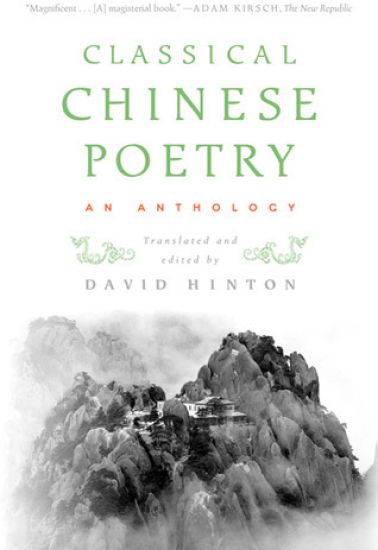
Classical Chinese Poetry

Classical Chinese Poetry

David Hinton

Farrar, Straus Giroux Inc
2010
nidottu
With this groundbreaking collection, translated and edited by the renowned poet and translator David Hinton, a new generation will be introduced to the work that riveted Ezra Pound and transformed modern poetry. The Chinese poetic tradition is the largest and longest continuous tradition in world literature, and this rich and far-reaching anthology of nearly five hundred poems provides a comprehensive account of its first three millennia (1500 BCE-1200 CE), the period during which virtually all of its landmark developments took place. Unlike earlier anthologies of Chinese poetry, Hinton's book focuses on a relatively small number of poets, providing selections that are large enough to recreate each one as a fully realized and unique voice. From the classic, deeply poetic texts of Chinese philosophy to intensely personal lyrics, from love poems to startling and strange perspectives on the natural world, Hinton has collected an entire world of beauty and insight. And in his eye-opening translations, these ancient poems feel remarkably fresh and contemporary.Without ever reaching for anachronistic effects or colloquialisms, Hinton presents a literary tradition both radically new and entirely resonant.

Hunger Mountain

Hunger Mountain

David Hinton

Shambhala Publications Inc
2012
pokkari
Learning to see with the eyes of the ancient Chinese sages can change your view of the universe, as David Hinton demonstrates. He takes us on a series of walks up Hunger Mountain, a wilderness area near his home in Vermont. What he sees and describes about these outings is informed by the cosmos-view he's imbibed from his many years of translating Chinese poetry: a way of looking at nature, and our place in it, and a particular way of regarding the relationship between ourselves and the universe. It's a view that informs all the great Chinese poetry and art. It's found in Taoism and Chinese expressions of Buddhism, but it predates them by millennia, going back probably to the Paleolithic Age--and it's found in the structures of the Chinese language itself, and in the evolution of the system of writing. Each chapter takes its name and theme from a character of the Chinese alphabet, whose history and development Hinton examines. They originate as primitive marks, very literally expressing the simplest of ideas, from which they grow and develop through time to express concepts of great subtlety. The poets and artists understood this and kept their focus on the emptiness that gives birth to all things as they used language and images that sprang from that emptiness. We learn about this as David walks up and around Hunger Mountain, making observations about the landscape, his place in it, and the underlying geological reality, telling stories of the great poets as he goes. It's the profoundest kind of nature writing, and it's an exceptionally accessible entree to an ancient Chinese view of the universe.
Existence

Existence

David Hinton

Shambhala Publications Inc
2016
pokkari
The mystery of existence and our place in that mystery--as expressed in a single Chinese landscape painting: a new work of meditative philosophy by the renowned translator of the Chinese classics and author of Hunger Mountain. Join David Hinton, the premier modern translator of the Chinese classics, as he stands before a single landscape painting, discovering in it the wondrous story of existence--and as part of that story, the magical nature of consciousness. What he coaxes from the image is nothing less than a revelation: the dynamic interweaving of mind and Cosmos, and the glorious dance of Absence and Presence that is the secret of that Cosmos. The painting called Peaceful-Distance Pavilion by Shih-t'ao (1642-1707) is, like other paintings in that genre, mostly space: one tiny figure, accompanied by an attendant, looks out over a vast landscape of mountains and clouds. But start looking into that space and, with the right guidance, what you end up seeing is profound. David Hinton is the perfect guide. He uses his knowledge of Chinese philosophy, poetry, art, language, and writing system to illuminate this painting's message, which is ultimately the story of the glorious dance between nothing and everything, between emptiness and existence. It's an enthralling journey that can change the way you look at the world, a journey for which David is a wise and eloquent guide.
No-Gate Gateway

No-Gate Gateway

David Hinton

Shambhala Publications Inc
2018
nidottu
A new translation of one of the great koan collections--by the premier translator of the Chinese classics--that reveals it to be a literary and philosophical masterwork beyond its association with Chan/Zen. A monk asked: "A dog too has Buddha-nature, no?" And with the master's enigmatic one-word response begins the great No-Gate Gateway (Wu-Men Kuan), ancient China's classic foray into the inexpressible nature of mind and reality. For nearly eight hundred years, this text (also known by its Japanese name, Mumonkan) has been the most widely used koan collection in Zen Buddhism--and with its comic storytelling and wild poetry, it is also a remarkably compelling literary masterwork. In his radical new translation, David Hinton places this classic for the first time in the philosophical framework of its native China, in doing so revealing a new way of understanding Zen--in which generic "Zen perplexity" is transformed into a more approachable and earthy mystery. With the poetic abilities he has honed in his many translations, Hinton brilliantly conveys the book's literary power, making it an irresistible reading experience capable of surprising readers into a sudden awakening that is beyond logic and explanation.
The Wilds of Poetry

The Wilds of Poetry

David Hinton

Shambhala Publications Inc
2017
pokkari
An exploration of the emerging Western consciousness of how deeply we belong to the wild Cosmos, as seen through the lineage of modern America's great avant-garde poets --a thrilling journey with today's premier translator of the Chinese classics. Henry David Thoreau, in The Maine Woods, describes a moment on Mount Ktaadin when all explanations and assumptions fell away for him and he was confronted with the wonderful, inexplicable thusness of things. David Hinton takes that moment as the starting point for his account of a rewilding of consciousness in the West: a dawning awareness of our essential oneness with the world around us. Because there was no Western vocabulary for this perception, it fell to poets to make the first efforts at articulation, and those efforts were largely driven by Taoist and Ch'an (Zen) Buddhist ideas imported from ancient China. Hinton chronicles this rewilding through the lineage of avant-garde poetry in twentieth-century America--from Walt Whitman, Ezra Pound and Robinson Jeffers to Gary Snyder, W. S. Merwin, and beyond--including generous selections of poems that together form a compelling anthology of ecopoetry. In his much-admired translations, Hinton has re-created ancient Chinese rivers-and-mountains poetry as modern American poetry; here, he reenvisions modern American poetry as an extension of that ancient Chinese tradition: an ecopoetry that weaves consciousness into the Cosmos in radical and fundamental ways.
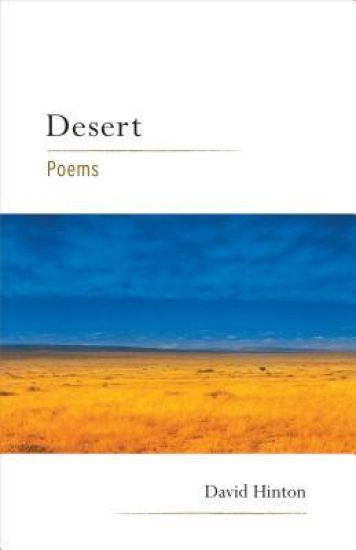
Desert

Desert

David Hinton

Shambhala Publications Inc
2018
nidottu
The first collection of original poetry by the renowned nature writer and highly lauded translator of the Chinese classics. Traveling today I found a river somewhere inside me, wondered how far it wanders there and how much sky it mirrors. All day long, wind and desert light, I followed that river's distances . . . Weaving mind and landscape together in meditations on sky and wind, ridgeline and horizon, existence and self, Desert marks David Hinton's first collection of original poetry in over a decade. Hinton's poetic art has long shined brilliantly through his widely acclaimed Chinese translations--and here speaks for itself in his contemporary voice as he turns his attention to the transcendent landscape of the American West. Updating the philosophical insights of ancient China that Hinton has explored so deeply, these poems bring the wonder and ancient mystery of the desert landscape to light. Hinton demonstrated in The Wilds of Poetry how those ancient Chinese insights shaped the innovative American poetry of our time, and here he extends that tradition in poems that are spare and spacious, as vast and open as the desert itself.
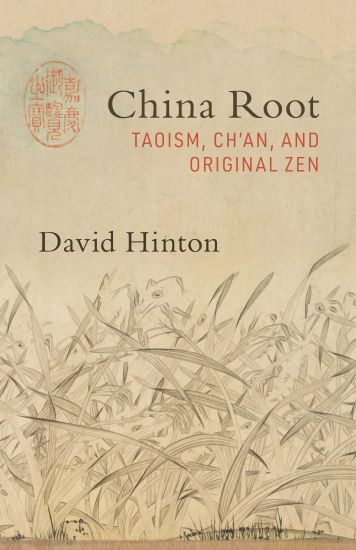
China Root

China Root

David Hinton

Shambhala Publications Inc
2020
nidottu
A beautifully compelling and liberating guide to the original nature of Zen in ancient China by renowned author and translator David Hinton. Buddhism migrated from India to China in the first century C.E., and Ch'an (Japanese: Zen) is generally seen as China's most distinctive and enduring form of Buddhism. In China Root, however, David Hinton shows how Ch'an was in fact a Buddhist-influenced extension of Taoism, China's native system of spiritual philosophy. Unlike Indian Buddhism's abstract sensibility, Ch'an was grounded in an earthy and empirically-based vision. Exploring this vision, Hinton describes Ch'an as a kind of anti-Buddhism. A radical and wild practice aspiring to a deeply ecological liberation: the integration of individual consciousness with landscape and with a Cosmos seen as harmonious and alive. In China Root, Hinton describes this original form of Zen with his trademark clarity and elegance, each chapter exploring in enlightening ways a core Ch'an concept--such as meditation, mind, Buddha, awakening--as it was originally understood and practiced in ancient China. Finally, by examining a range of standard translations in the Appendix, Hinton reveals how this original understanding and practice of Ch'an/Zen is almost entirely missing in contemporary American Zen, because it was lost in Ch'an's migration from China through Japan and on to the West. Whether you practice Zen or not, taking this journey on the wings of Hinton's remarkable insight and powerful writing will transform how you understand yourself and the world.
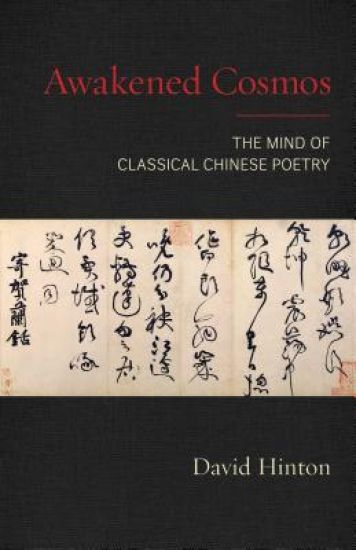
Awakened Cosmos

Awakened Cosmos

David Hinton

Shambhala Publications Inc
2019
nidottu
A deep and radically original exploration of Taoist and Ch'an (Zen) Buddhist wisdom through the lens of the life and work of Tu Fu, widely considered China's greatest classical poet. What is consciousness but the Cosmos awakened to itself? This perspective is fundamental to the Taoist and Ch'an Buddhist worldview that shapes classical Chinese poetry. Tu Fu's writing during the T'ang Dynasty traces his life from periods of relative normalcy to years spent as an impoverished refugee amid the devastation of civil war, revealing Daoist/Ch'an insight informed by a wide range of human experience. Awakened Cosmos is a unique biography, exploring key poems to guide the reader through Tu Fu's dramatic life at the fundamental levels of Daoist/Ch'an wisdom. Each chapter presents a poem in three stages: first, the original Chinese; then, an English translation in Hinton's masterful style; and finally, a lyrical essay that discusses the untranslatable philosophical dimensions of the poem. The result is nothing short of remarkable: a biography of the Cosmos awakened to itself in the form of a majesterial poet from China. Thirty years ago, David Hinton published America's first full-length translation of Tu Fu's work. Awakened Cosmos is published simultaneously with a newly translated and substantially expanded version of that landmark translation: The Selected Poems of Tu Fu: Expanded and Newly Translated (New Directions).
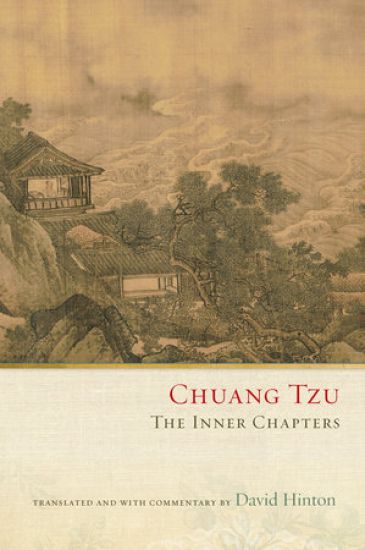
Chuang Tzu

Chuang Tzu

David Hinton

Counterpoint
2014
nidottu
Revered for millennia in the Chinese spiritual tradition, Chuang Tzu stands alongside the Tao Te Ching as a founding classic of Taoism. The Inner Chapters are the only sustained section of this text widely believed to be the work of Chuang Tzu himself, dating to the fourth century B.C.E. Witty and engaging, spiced with the lyricism of poetry, Chuang Tzu's Taoist insights are timely and eternal, profoundly concerned with spiritual ecology. Indeed, the Tao of Chuang Tzu was a wholesale rejection of a human-centered approach. Zen traces its sources back to these Taoist roots  roots at least as deep as those provided by Buddhism.But this is an ancient text that yields a surprisingly modern effect. In bold and startling prose, David Hinton's translation captures the "zany texture and philosophical abandon" of the original. The Inner Chapters' fantastical passages - in which even birds and trees teach us what they know  offer up a wild menagerie of characters, freewheeling play with language, and surreal humor. And interwoven with Chuang Tzu's sharp instruction on the Tao are short-short stories that are often rough and ribald, rich with satire and paradox.On their deepest level, the Inner Chapters are a meditation on the mysteries of knowledge itself. "Chuang Tzu's propositions," the translator's introduction reminds us, "seem to be in constant transformation, for he deploys words and concepts only to free us of words and concepts." Hinton's vital new translation makes this ancient text from the golden age of Chinese philosophy come alive for contemporary readers.
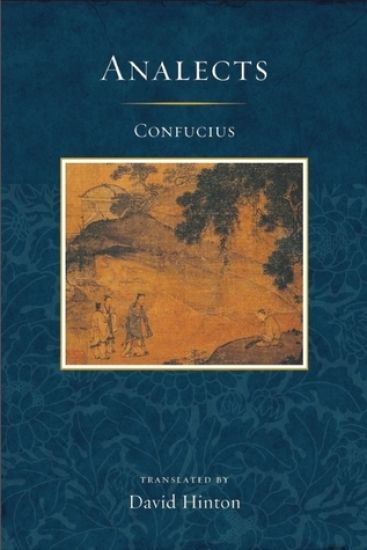
Analects

Analects

David Hinton

Counterpoint
2014
nidottu
While Confucius failed in his lifetime to rescue a crumbling civilization with his teachings, he was to become the most influential sage in human history. His thought, still remarkably current and even innovative after 2500 years, survives here in The Analects  a collection of brief aphoristic sayings that has had a deeper impact on more people's lives over a longer period of time than any other book in human history.Formulated in the ruins of a society that had been founded on untenable spiritualistic concepts of governance, Confucius' philosophy postulated a humanistic social order that has survived as China's social ideal ever since. Beginning with the realization that society is a structure of human relationships, Confucius saw that in a healthy society this structure must be a selfless weave of caring relationships. Those caring relationships are a system of "ritual" that people enact in their daily lives, thus infusing the secular with scared dimensions.Highly regarded for the poetic fluency he brings to his award-winning work, David Hinton is the first twentieth-century translator to render the four central masterworks of ancient Chinese thought: Chuang Tzu, Mencius, The Analects, and Tao te Ching (forthcoming). HIs new versions are not only inviting and immensely readable, but they also apply a much-needed consistency to key terms in these texts, lending structural links and philosophical rigor heretofore unavailable in English. Breathing new life into these originary classics, Hinton's translations will stand as the definitive series for our era.
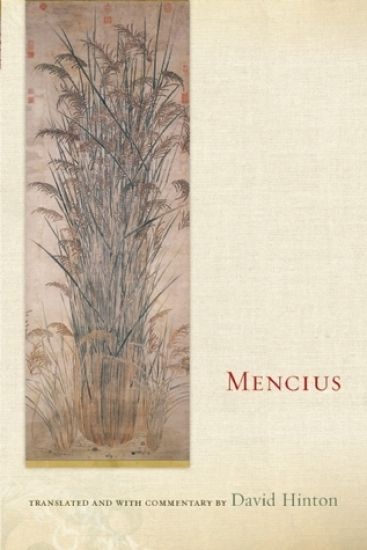
Mencius

Mencius

David Hinton

Counterpoint
2015
nidottu
This ancient text records the teachings of Mencius (4th c. B.C.E.), the second originary sage in the Confucian tradition which has shaped Chinese civilization for over two thousand years. In a culture that makes no distinction between those realms we call the heart and the mind, Mencius was the great thinker of the heart, and it was he who added the profound inner dimensions to the Confucian vision. Given his emphasis on the heart, it isn't surprising that his philosophical method is very literary in nature: story and anecdote full of human drama and poetic turns of thought. Indeed, the text is considered a paragon of literary eloquence and style.Mencius' strikingly contemporary empiricism represented a complete secularization of the spiritualist concepts of governance that had dominated China for over a millenia. He invested the humanist Confucian vision with its inner dimensions by recognizing that the individual is an integral part of a self-generating and harmonious cosmos. He saw all the spiritual depths of that cosmology inside us, and this led to a mystical faith in the inherent nobility of human beings. In his chaotic and war-ravaged times, he was therefore passionate in his defense of the people. Indeed, he advocated a virtual democracy in which a government's legitimacy depended upon the assent of the people. Such is the enduring magic of the Mencian heart full of compassionate and practical concern for the human condition, and yet so empty that it contains the ten thousand transformations of the entire cosmos.
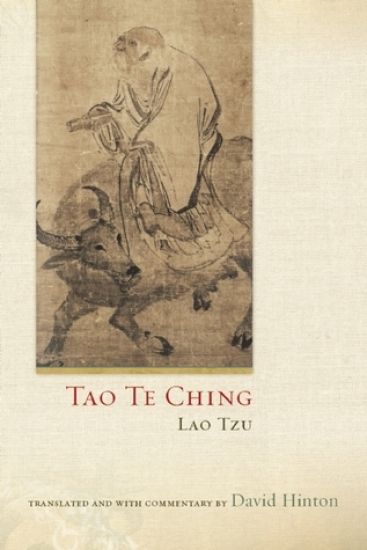
Tao Te Ching

Tao Te Ching

David Hinton

Counterpoint
2015
nidottu
Having masterfully translated a wide range of ancient Chinese poets and philosophers, David Hinton is uniquely qualified to offer the definitive contemporary English version of Lao Tzu's Tao Te Ching. Like all of his translations, Hinton's translation of the Tao Te Ching is mind-opening, presenting startling new dimensions in this widely-influential text. He shows how Lao Tzu's spirituality is structured around the generative life-force, for example, and that this system of thought weaves the human into natural process at the deepest levels of being, thereby revealing the Tao Te Ching as an originary text in deep feminist and ecological thought.Lao Tzu's Tao Te Ching is not only the single most important text ever composed in China, it is probably the most influential spiritual text in human history. In the past, virtually all translations of this text have been produced either by sinologists having little poetic facility in English, or writers having no ability to read the original Chinese. Hinton's fluency in ancient Chinese and his acclaimed poetic ability provide him the essential qualifications. Together, they allow a breathtaking new translation that reveals how remarkably current and even innovative this text is after 2500 years.
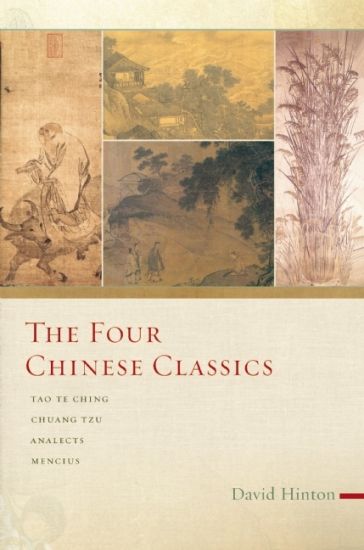
The Four Chinese Classics

The Four Chinese Classics

David Hinton

Counterpoint
2016
nidottu
The books collected in this volume represent the first time since the mid-nineteenth century that the four seminal masterworks of ancient Chinese thought have been translated as a unified series by a single translator. Hinton's award-winning experience translating a wide range of ancient Chinese poets makes these books sing in English as never before. But these new versions are not only inviting and immensely readable, they also apply much-needed consistency to key philosophical terms in these texts, lending structural links and philosophical rigor heretofore unavailable in English. Breathing new life into these originary classics, Hinton's new translations will stand as the definitive texts for our era. Perhaps the most broadly influential spiritual text in human history, Lao Tzu's Tao Te Ching is the source of Taoist philosophy, which eventually developed into Ch'an (Zen) Buddhism. Equally influential in the social sphere, Confucious' Analects is the source of social wisdom in China. The Chuang Tzu is the wild and wacky prose complement to the Tao Te Ching. And with its philosophical story-telling, the Menicius adds depth and complexity to Confucius' vision.
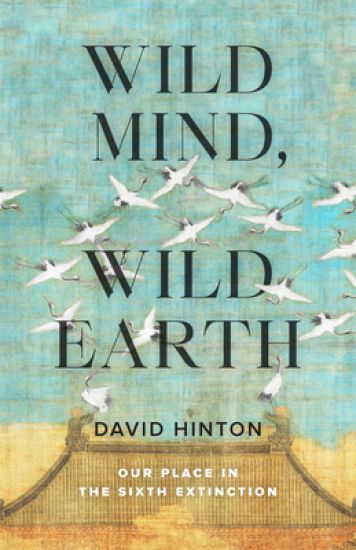
Wild Mind, Wild Earth

Wild Mind, Wild Earth

David Hinton

SHAMBHALA PUBLICATIONS INC
2022
nidottu
Exploring the confluence of ancient Chinese spirituality and modern Western environmental thought, Wild Mind, Wild Earth reveals the unrecognized kinship of mind and nature that must be reanimated if we are to end our destruction of the planet. Earth is embroiled in its sixth major extinction event--this time caused not by asteroids or volcanos, but by us. At bottom, preventing this sixth extinction is a spiritual/philosophical problem, for it is the assumptions defining us and our relation to earth that are driving the devastation. Those assumptions insist on a fundamental separation of human and earth that devalues earth and enables our exploitative relation to it. In Wild Mind, Wild Earth, David Hinton explores modes of seeing and being that could save the planet by reestablishing a deep kinship between human and earth: the insights of primal cultures and the Ch'an (Zen) Buddhism of ancient China. He also shows how these insights have become well-established in the West over the last two hundred years, through the work of poets and philosophers and scientists. This offers marvelous hope and beauty--but like so many of us, Hinton recognizes the sixth extinction is now an inexorable and perhaps unstoppable tragedy. And he reveals how those primal/Zen insights enable us to inhabit even the unfurling catastrophe as a profound kind of liberation. Wild Mind, Wild Earth is a remarkable and revitalizing journey.
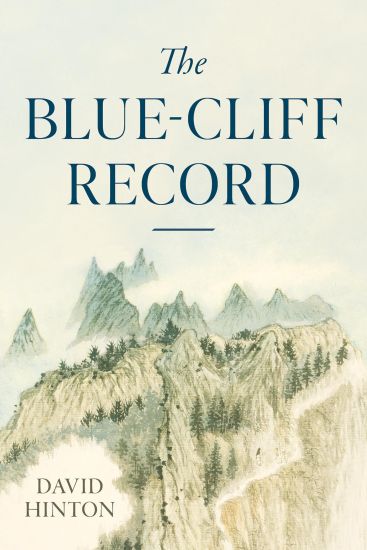
The Blue-Cliff Record

The Blue-Cliff Record

David Hinton

SHAMBHALA PUBLICATIONS INC
2024
nidottu
A once-in-a-generation translation of the definitive Ch'an (Zen) koan collection from preeminent translator David Hinton. The Blue-Cliff Record, a twelfth-century collection of Zen koans, is a treasure of world religious literature. Like any such text, it operates at several levels: it is a remarkable example of classical Chinese literature and poetry, a philosophical text of profound power, and an active practice guide in use by Ch'an and Zen Buddhists all over the world. In this innovative rendering, renowned translator David Hinton pares the Chinese original down to its earliest and most essential version--the sangha-cases (koans) and brief poetic responses (or gathas, meaning a Buddhist "sutra-poem") compiled by the great master Snow-Chute Mountain (Hs eh Tou, 980-1052). In doing so, he brings the reader closer to the Taoist cosmological framework that lays at the foundation of the entire Ch'an tradition--revealing a whole new understanding of this seminal text. In these one hundred classic koans, beginners will discover a strange, funny, and provocative world of quixotic exchanges and penetrating insights, and longtime koan practitioners will find themselves challenged anew by Hinton's masterful translations.
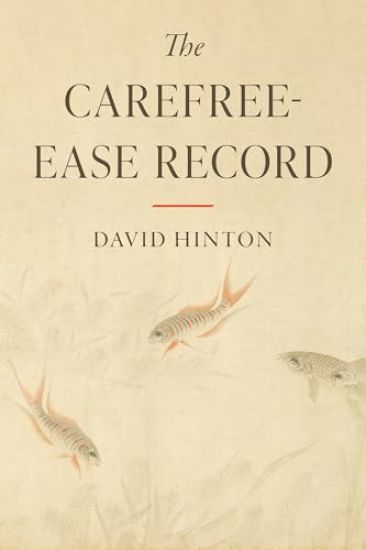
The Carefree-Ease Record

The Carefree-Ease Record

David Hinton

SHAMBHALA PUBLICATIONS INC
2025
nidottu
In this radical new translation of a classic Ch'an (Zen) koan collection, David Hinton illuminates the Taoist dimensions of "carefree-ease," the effortless joy of the enlightened mind in harmony with earth and cosmos. First collected by the Ch'an master Wisdom-Expanse (Hung-Chih) in the twelfth century, this collection of one hundred kung-ans, or koans, is an essential text for students of Ch'an and Zen. These miniature masterpieces of Chinese philosophy and literature offer a unique way of penetrating directly into the essence of Ch'an teaching, and in this new translation, Hinton affords readers an opportunity to experience these koans in English like never before. Paring away the later commentaries that are usually presented with these koans, Hinton lets the original stories stand on their own, revealing themselves as nothing less than poetic expressions of the awakened mind. A far cry from the transcendence of life-and-death that typifies the traditional Buddhist goal of nirvana, this awakening is distinctly earthy and grounded in the rhythms of nature, shaped by the centuries of Taoist tradition that preceded Ch'an. "Carefree ease," writes Hinton, "is to move through life with the profound tranquility of the Cosmos itself as it unfurls through its perennial transformations." Following his translation of No-Gate Gateway (2018) and Blue-Cliff Record (2024), this volume marks the completion of Hinton's project to translate all three of the classic koan collections.
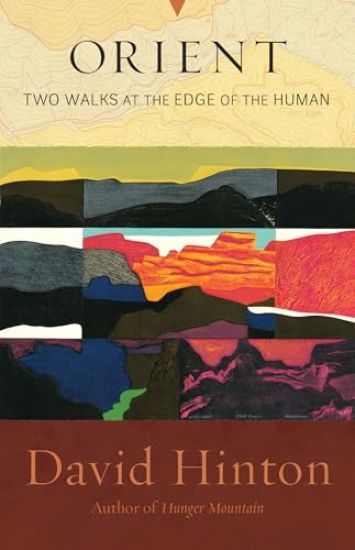
Orient

Orient

David Hinton

SHAMBHALA PUBLICATIONS INC
2025
pokkari
Join renowned author David Hinton on two walks into the wild beauty and archaeological ruins of the desert Southwest--and to the edges of consciousness and Taoist cosmology that he explores on the way. In this poetic odyssey of nature writing that blurs the line between observer and landscape, Hinton's project is nothing less than to map our place in the cosmos and awaken to our interconnectedness with the wild spontaneity of the natural world. Like Henry David Thoreau and other great literary walkers, Hinton joins his profound philosophical worldview--informed by a lifetime of translating the Taoist and Ch'an Buddhist masterpieces of classical Chinese literature--with his keen eye for the slightest of nature's details. As he explores sweeping desert landscapes and the crumbling ruins of the humans who once lived there, Hinton simultaneously investigates the nature of sight and perception, tracing the movements of consciousness and the very roots of language.