Kirjojen hintavertailu. Mukana 12 390 323 kirjaa ja 12 kauppaa.

Kirjahaku

Etsi kirjoja tekijän nimen, kirjan nimen tai ISBN:n perusteella.

23 kirjaa tekijältä David J Fisher

Transient Liquid Phase Bonding

Transient Liquid Phase Bonding

David J Fisher

Materials Research Forum LLC
2019
pokkari
The book presents a complete overview on the topic of Transient Liquid Phase Bonding (TLPB) which has many high-tech applications, ranging from the production and repair of turbine engines in the aerospace industry, to nuclear power plants and the connection of circuit lines in the microelectronics industry. The TLPB process and its specific applications are presented in great detail: Self-Bonding of Pure Materials; Bonding Different Pure Materials; Self-Bonding of Composites; Self-Bonding of Simple Alloys; Self-Bonding of Complex Alloys; Bonding Same-Base Alloys; Bonding Different-Base Alloys; Bonding Ceramics to Ceramics; Bonding Ceramics to Metals. The book references 483 original resources and includes their direct web link for in-depth reading.

Bonding by Self-Propagating Reaction

Bonding by Self-Propagating Reaction

David J Fisher

Materials Research Forum LLC
2019
pokkari
Bonding by Self-Propagating Reaction represents a highly promising approach for the joining of dissimilar materials in such fields as microelectronics, infrared sensors, micro-electro-mechanical systems (MEMS), aerospace and nuclear industries, and surface engineering for chemical, mechanical and microsystems applications.
Topological Semimetals

Topological Semimetals

David J Fisher

Materials Research Forum LLC
2019
pokkari
Topological semimetals are quantum materials that are not only extremely interesting from a theoretical point of view but also have a great potential for technological applications in which superconducting, semiconducting and other semimetal behaviors are involved. Specific applications include quantum computing, fabricating superconducting microstructures, environmental 'harvesting' of energies which would otherwise go to waste immediately as heat, and fabricating topological quantum devices on industrial-scales. The book references 307 original resources and includes their direct web link for in-depth reading.
Mechanochromism

Mechanochromism

David J Fisher

Materials Research Forum LLC
2019
pokkari
The book Mechanochromism references 325 original resources and includes their direct web link for in-depth reading. Keywords: Mechanochromism, Piezochromism, Piezoelectricity, Triboluminescence, Electroluminescence, Thermoluminescence, Photoluminescence, Stress Recording, Wear Monitoring, Fracture Detection, Pressure Monitoring, Incipient Damage Detection, Shock Wave Effects, Mechanoluminescent Polymers, Nanosensors, Spiropyran, Gold Complexes, Copper Complexes, Platinum Complexes, Iridium Complexes, Tetraphenyls, Diketones, Anthracenes, Acetylenes, Azoles, Thiophenes, Polyurethane, Hydrogels, Nitriles, Triphenylamine, Naphthalimide, Pyrenes, Polymers, Phosphonium, Pyridines, Pyrimidines, Phenazine, Cyanostilbene, Diones.
The Inverse Hall-Petch Problem

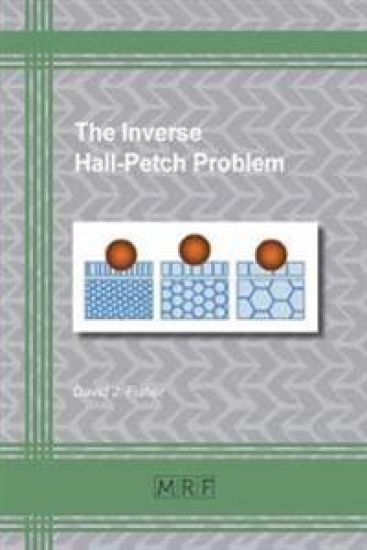
The Inverse Hall-Petch Problem

David J Fisher

Materials Research Forum LLC
2019
pokkari
The book reviews the Hall-Petch law, one of the most useful equations of materials science, and the reverse or inverse Hall-Petch relation, which is particular important for controlling the strength of nanocrystalline materials. Theoretical models, experimental data and practical aspects are discussed, making reference to a total of 396 original resources with their direct web link for in-depth reading.
Heterostructural Interface Modelling

Heterostructural Interface Modelling

David J Fisher

Materials Research Forum LLC
2019
pokkari
The interface structure of joined materials is a key factor in the development of high-tech components. The book reviews recent experimental and theoretical research in the area of modelling new types of joints and predicting the expected properties. Fields covered include lattice theory, semiconductor electronics, solid-state lithium-ion conductor, solid-state devices, filamentary growth of graphite, curved basal sheets of graphite, thermodynamic factors and lattice-matching criteria, minimisation of interface stresses due to misfit, epitaxial deposition, composite design, coincidence site lattice theory, ionic conductivity improvement by interfacial lattice strain, epitaxial thin-film systems, methods and software for identifying compatible material combinations. The book references 302 original resources and includes their direct web link for in-depth reading. Keywords: Interface Modelling, Lattice Theory, Semiconductor Electronics, Lithium-ion Conductor, Graphite Filaments, Graphite Sheets, Interface Stresses, Epitaxial Deposition, Composite Design, Coincidence-Site Lattice Theory, Ionic Conductivity, Interfacial Lattice Strain, Epitaxial Thin Films, Compatible-Material-Combination Software, Lattice-Matching to Silicon, Lattice-Matching to Smiconductors, Lattice-Matching to Sapphire, Lattice-Matching to Ceramics, Lattice-Matching to Metals, Lattice-Matching to Organic Materials.
Additive Manufacturing of Metals

Additive Manufacturing of Metals

David J Fisher

Materials Research Forum LLC
2020
pokkari
Additive manufacturing of metals is an increasingly important process for producing or repairing structural components in the aerospace, medical and dental industries. The book reviews the various techniques that are currently in use and describes the many possible applications. The review is based on 350 original resources and includes their direct web link for in-depth reading. Keywords: Additive Manufacturing, 3-Dimensional Printing, Layered Manufacturing, Titanium Alloys, Nickel Alloys, Iron Alloys, Stainless Steels, Aluminium, Cobalt, Copper, Magnesium, Niobium, Tantal, Tin, Tungsten, Zinc, Porous Metals, Biomedical Materials, Orthopaedic Devices, Dental Implants, Aerospace Components, Laser Melting, Electron-Beam Melting.

Lead Halide Perovskite Solar Cells

Lead Halide Perovskite Solar Cells

David J Fisher

Materials Research Forum LLC
2020
pokkari
Lead halide perovskite materials have a huge potential in solar cell technology. They offer the combined advantages of low-cost preparation and high power-conversion efficiency. The present review focusses on the following topics: Power Conversion Efficiency; Electron Transport, Hole Transport and Interface Layers; Material Preparation; Cesium-Doped Lead-Halide Perovskites; Formamidinium-Doped Lead-Halide Perovskites; Methylammonium Lead-Halide Perovskites; Hysteresis, Stability and Toxicity Problems. The book references 334 original resources and includes their direct web link for in-depth reading. Keywords: Solar Cells, Lead Halide Perovskite Materials, Cesium-Doped Lead-Halide Perovskites, Formamidinium-Doped Lead-Halide Perovskites, Methylammonium Lead-Halide Perovskites, Electron-Transport Layer, Hole-Transport Layer, Interface Layers, Hysteresis Problem, Stability Problem, Toxicity Problem.

Self-Propelled Janus Particles

Self-Propelled Janus Particles

David J Fisher

Materials Research Forum LLC
2021
pokkari
Design and operation of Janus particles have a great potential for applications in fields such as environmental remediation, electronic engineering, bio-imaging, bio-sensing, drug delivery and other biomedical tasks. Current research aims to imitate the molecular motors of biological systems by creating micro- and nano-scale particles which can exploit chemical energy so as to produce directional motion. The assembling of self-propelled particles and their movement can be controlled by using external fields, especially magnetic fields. The book references 332 original resources and includes their direct web link for in-depth reading.Keywords: Janus Particles, Bio-imaging, Bio-sensing, Drug Delivery, Environmental Remediation, Electronic Engineering, Asymmetrical Colloidal Particles, Catalysis-propelled Particles, Nanoscale Engines, Chemical Asymmetry, Self-propulsion, Diffusiophoresis, Electrophoresis, Thermophoresis, Bubble Generation, External Propulsion, Radiation Effects, Electric Field, Magnetic Field, Gravitaxis, Barrier Effects.
Mechanical Properties of MAX Phases

Mechanical Properties of MAX Phases

David J Fisher

Materials Research Forum LLC
2021
pokkari
MAX Phase Materials are uniquely structured carbide and nitride materials which combine the rigidity, oxidation-resistance and high-temperature strength of ceramic materials with such metallic properties as good machinability, thermal-shock resistance, damage-tolerance and good transport properties. Potential applications include microelectronic layers, coatings for electrical contacts, thermal shock-resistant refractories, high-temperature heating elements, neutron-irradiation resistant nuclear applications, thermal barriers, protective aerospace coatings, and bio-compatible materials. The book reviews theoretical and experimental research up to early 2021 and references 185 original resources with their direct web links for in-depth reading.Keywords: MAX Phase Materials, Rigidity, High-Temperature Strength, Machinability, Microelectronic Layers, Electrical Contact Coatings, Thermal-Shock Resistance, Heating Elements, Neutron-Irradiation Resistant Materials, Thermal Barriers, Bio-compatible Materials.
Data-Mining and Intermetallic Property-Prediction

Data-Mining and Intermetallic Property-Prediction

David J Fisher

Materials Research Forum LLC
2022
pokkari
Using a computer-aided data mining approach and available experimental data bases, the author discusses the prediction of the structures and properties of intermetallic alloy compounds. The book references 252 original resources with their direct web links for in-depth reading.Keywords: Data-Mining, Intermetallic Compounds, Structure-Mapping, Clustering Methods, Free Energy, Energy Landscapes of Compounds, Stable Groupings of Atoms, Intermetallic Phases, Crystal Unit Cell Size, Platonic Solids, Symmetries, Stoichiometries, Stability Fields.
The Boron Arsenides

The Boron Arsenides

David J Fisher

Materials Research Forum LLC
2023
pokkari
Boron Arsenide offers very interesting electronic properties, as well as a high thermal conductivity; nearly 10 times higher than that of silicon. It has been hailed as 'the best semiconductor material ever found'. The present book presents a detailed review of this material and its potential applications. The materials covered include Icosahedral Boron Arsenide, Hexagonal Boron Arsenide, Amorphous Boron Arsenide and Cubic Boron Arsenide. The book references 166 original resources with their direct web links for in-depth reading.Keywords: Boron Arsenides, Electron Mobility, Hole Mobility, Band-gap, Monolayers, Defects, Mechanical Properties, Photo-electrodes, Thermal Conductivity, Heat-spreading.
Transparent Metals

Transparent Metals

David J Fisher

Materials Research Forum LLC
2025
pokkari
There is much current interest in transparent metallic materials. These are optical materials based upon photonic band-gap structures which are created by combining films of metals and dielectrics. Transparent materials are used to produce devices having electrically variable optical properties. Such photonic devices exhibit increased speeds of operation, reduced size and increased immunity to temperature changes. The book references 202 original resources with their direct web links for in-depth reading.Keywords: Solar Cells, Optoelectronic Devices, Photonic Band-Gap Structure, Light-Emitting Diodes, Metal-Polymer Hybrid Nanostructure, Ultra-Thin Gold Electrode, Transparent Metal Electrode Materials, Transparent Heaters, Silver Nanowire Electrodes.
Rhenium Disulfide

Rhenium Disulfide

David J Fisher

Materials Research Forum LLC
2018
pokkari
Rhenium disulfide, especially in low-dimensional form, is a subject of lively research into its electronic and optical properties. The field of twodimensional materials such as graphene and its analogues has been growing very rapidly. This class of materials also includes rhenium disulfide and rhenium diselenide, which belong to the transition-metal dichalcogenide family. Due to their reduced crystal symmetry, they exhibit distinct electrical and optical characteristics along certain in-plane crystal directions. The group-VI members such as molybdenum and tungsten are the most typical ones, but group-VII rhenium disulfide has been attracting most attention of late because of its unusual structural, electro-optical and chemical properties; especially an indirect-to-direct band-gap transition which occurs when thinned down from bulk to monolayer. The group-VI transition-metal dichalcogenides have a 1H, 2H, 3R or 1T structure, whereas ReS2 has a distorted 1T structure which imparts an in-plane anisotropy to its physical properties. Few other materials (black phosphorus, ReSe2, TiS3, ZrS3) exhibit such an in-plane structural anisotropy. This makes ReS2 unique among the transition-metal chalcogenides. Atomically thin rhenium disulphide is characterized by weak interlayer coupling and a distorted 1T structure, which leads to the anisotropy in optical and electrical properties. It also possesses structural and vibrational anisotropy, layer-independent electrical and optical properties and metal-free magnetism. In these respects, it differs from group-VI transition-metal dichalcogenides such as MoS2, MoSe2, WS2 and WSe2. It is already being used in solid-state electronics, catalysis, energy storage and energy-harvesting applications.