Kirjojen hintavertailu. Mukana 11 244 527 kirjaa ja 12 kauppaa.

Kirjahaku

Etsi kirjoja tekijän nimen, kirjan nimen tai ISBN:n perusteella.

11 kirjaa tekijältä David J. Hand

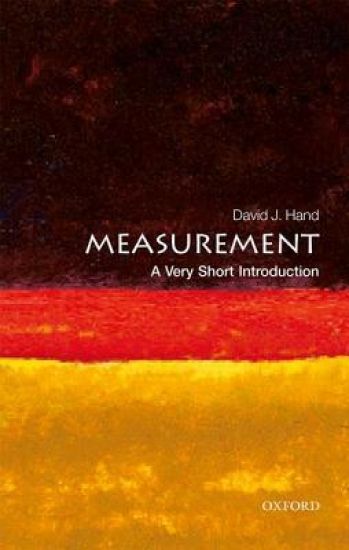
Measurement

Measurement

David J. Hand

Oxford University Press
2016
nidottu
Measurement is a fundamental concept that underpins almost every aspect of the modern world. It is central to the sciences, social sciences, medicine, and economics, but it affects everyday life. We measure everything - from the distance of far-off galaxies to the temperature of the air, levels of risk, political majorities, taxes, blood pressure, IQ, and weight. The history of measurement goes back to the ancient world, and its story has been one of gradual standardization. Today there are different types of measurement, levels of accuracy, and systems of units, applied in different contexts. Measurement involves notions of variability, accuracy, reliability, and error, and challenges such as the measurement of extreme values. In this Very Short Introduction, David Hand explains the common mathematical framework underlying all measurement, the main approaches to measurement, and the challenges involved. Following a brief historical account of measurement, he discusses measurement as used in the physical sciences and engineering, the life sciences and medicine, the social and behavioural sciences, economics, business, and public policy. ABOUT THE SERIES: The Very Short Introductions series from Oxford University Press contains hundreds of titles in almost every subject area. These pocket-sized books are the perfect way to get ahead in a new subject quickly. Our expert authors combine facts, analysis, perspective, new ideas, and enthusiasm to make interesting and challenging topics highly readable.
Statistics

Statistics

David J. Hand

Oxford University Press
2008
nidottu
Modern statistics is very different from the dry and dusty discipline of the popular imagination. In its place is an exciting subject which uses deep theory and powerful software tools to shed light and enable understanding. And it sheds this light on all aspects of our lives, enabling astronomers to explore the origins of the universe, archaeologists to investigate ancient civilisations, governments to understand how to benefit and improve society, and businesses to learn how best to provide goods and services. Aimed at readers with no prior mathematical knowledge, this Very Short Introduction explores and explains how statistics work, and how we can decipher them. ABOUT THE SERIES: The Very Short Introductions series from Oxford University Press contains hundreds of titles in almost every subject area. These pocket-sized books are the perfect way to get ahead in a new subject quickly. Our expert authors combine facts, analysis, perspective, new ideas, and enthusiasm to make interesting and challenging topics highly readable.
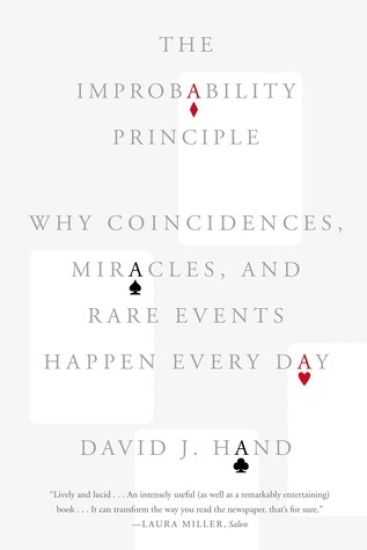
The Improbability Principle: Why Coincidences, Miracles, and Rare Events Happen Every Day
In The Improbability Principle, the renowned statistician David J. Hand argues that extraordinarily rare events are anything but. In fact, they're commonplace. Not only that, we should all expect to experience a miracle roughly once every month. But Hand is no believer in superstitions, prophecies, or the paranormal. His definition of "miracle" is thoroughly rational. No mystical or supernatural explanation is necessary to understand why someone is lucky enough to win the lottery twice, or is destined to be hit by lightning three times and still survive. All we need, Hand argues, is a firm grounding in a powerful set of laws: the laws of inevitability, of truly large numbers, of selection, of the probability lever, and of near enough. Together, these constitute Hand's groundbreaking Improbability Principle. And together, they explain why we should not be so surprised to bump into a friend in a foreign country, or to come across the same unfamiliar word four times in one day. Hand wrestles with seemingly less explicable questions as well: what the Bible and Shakespeare have in common, why financial crashes are par for the course, and why lightning does strike the same place (and the same person) twice. Along the way, he teaches us how to use the Improbability Principle in our own lives--including how to cash in at a casino and how to recognize when a medicine is truly effective. An irresistible adventure into the laws behind "chance" moments and a trusty guide for understanding the world and universe we live in, The Improbability Principle will transform how you think about serendipity and luck, whether it's in the world of business and finance or you're merely sitting in your backyard, tossing a ball into the air and wondering where it will land.
Artificial Intelligence Frontiers in Statistics
This book presents a summary of recent work on the interface between artificial intelligence and statistics. It does this through a series of papers by different authors working in different areas of this interface. These papers are a selected and referenced subset of papers presented at the 3rd Interntional Workshop on Artificial Intelligence and Statistics, Florida, January 1991.
Practical Longitudinal Data Analysis

Practical Longitudinal Data Analysis

David J. Hand

Chapman Hall/CRC
1996
sidottu
This text describes regression-based approaches to analyzing longitudinal and repeated measures data. It emphasizes statistical models, discusses the relationships between different approaches, and uses real data to illustrate practical applications. It uses commercially available software when it exists and illustrates the program code and output. The data appendix provides many real data sets-beyond those used for the examples-which can serve as the basis for exercises.
Measurement Theory and Practice

Measurement Theory and Practice

David J. Hand

John Wiley Sons Inc
2004
sidottu
We live in a world of measurements. Measurements, be they of length, speed, weight, temperature, intelligence, income, endurance, greed, gross domestic product, quality of life, unemployment or skill at a job, are all numerical manifestations of the extent of some underlying attribute. They reflect the reality around us – length and weight provide examples of systems that represent clear physical attributes. At the same time, measurements also define the reality around us – psychometric tests and price inflation constitute both the definitions and the procedures for measuring these concepts. Altogether, measurements are central to our modern world and our view of it. This book explores the nature of measurement, investigating its different kinds, how these kinds should be interpreted, and the legitimacy of their statistical manipulation. The procedures through which numbers are assigned to objects are described, and measurement in psychology, medicine, the physical sciences, and the social sciences are examined in detail. The ideas of measurement are so ubiquitous that we often fail to notice them; they are concealed behind a veil of familiarity. This book lifts the corner of that veil and, in doing so, shows that there are aspects of the familiar world that are occasionally puzzling, sometimes downright extraordinary, and often more intriguing than is generally believed.
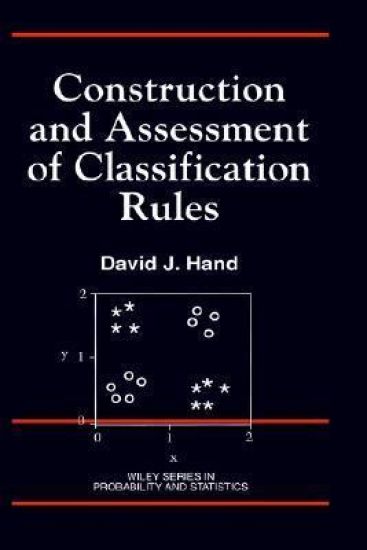
Construction and Assessment of Classification Rules
The author has written an accessible book presenting the central issues and placing particular emphasis on comparison, performance assessment and how to match method to application. He reviews the different approaches and guides researchers (and the huge class of users and potential users) to suitable classes of techniques. He points the way to more detailed study in "further reading" sections in each chapter.
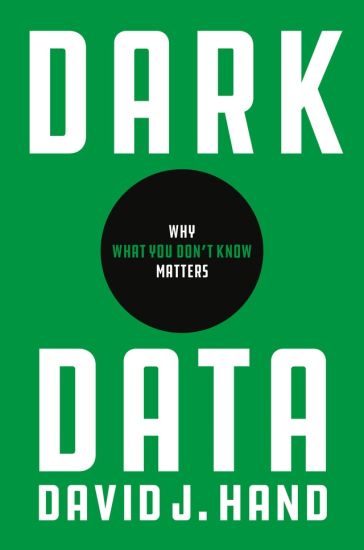
Dark Data

Dark Data

David J. Hand

PRINCETON UNIVERSITY PRESS
2020
sidottu
A practical guide to making good decisions in a world of missing dataIn the era of big data, it is easy to imagine that we have all the information we need to make good decisions. But in fact the data we have are never complete, and may be only the tip of the iceberg. Just as much of the universe is composed of dark matter, invisible to us but nonetheless present, the universe of information is full of dark data that we overlook at our peril. In Dark Data, data expert David Hand takes us on a fascinating and enlightening journey into the world of the data we don't see.Dark Data explores the many ways in which we can be blind to missing data and how that can lead us to conclusions and actions that are mistaken, dangerous, or even disastrous. Examining a wealth of real-life examples, from the Challenger shuttle explosion to complex financial frauds, Hand gives us a practical taxonomy of the types of dark data that exist and the situations in which they can arise, so that we can learn to recognize and control for them. In doing so, he teaches us not only to be alert to the problems presented by the things we don’t know, but also shows how dark data can be used to our advantage, leading to greater understanding and better decisions.Today, we all make decisions using data. Dark Data shows us all how to reduce the risk of making bad ones.
Dark Data

Dark Data

David J. Hand

PRINCETON UNIVERSITY PRESS
2022
pokkari
A practical guide to making good decisions in a world of missing dataIn the era of big data, it is easy to imagine that we have all the information we need to make good decisions. But in fact the data we have are never complete, and may be only the tip of the iceberg. Just as much of the universe is composed of dark matter, invisible to us but nonetheless present, the universe of information is full of dark data that we overlook at our peril. In Dark Data, data expert David Hand takes us on a fascinating and enlightening journey into the world of the data we don't see.Dark Data explores the many ways in which we can be blind to missing data and how that can lead us to conclusions and actions that are mistaken, dangerous, or even disastrous. Examining a wealth of real-life examples, from the Challenger shuttle explosion to complex financial frauds, Hand gives us a practical taxonomy of the types of dark data that exist and the situations in which they can arise, so that we can learn to recognize and control for them. In doing so, he teaches us not only to be alert to the problems presented by the things we don’t know, but also shows how dark data can be used to our advantage, leading to greater understanding and better decisions.Today, we all make decisions using data. Dark Data shows us all how to reduce the risk of making bad ones.
What's The Question?

What's The Question?

David J. Hand

TAYLOR FRANCIS LTD
2026
nidottu
Statistics and data science aim to extract understanding from data and guide decision-making. However, before applying any analytical tools we need absolute clarity about what we want to know or accomplish. Ambiguous objectives inevitably lead to mistaken conclusions and flawed actions. This book investigates the deeper challenges of formulating clear questions and matching analytical methods to those questions—issues that apply as much to elementary statistical tools as to sophisticated techniques. Rather than focusing on standard statistical misuses or data provenance issues, this work examines the critical step of ensuring your analysis actually answers the question you mean to ask. Drawing from collaborative work across finance, medicine, government, manufacturing, defense, and other fields, the book deliberately emphasizes basic and familiar tools so the fundamental issues are accessible to everyone. Following John Tukey's insight about the simplest problems of data analysis, the most detailed discussions centre on averages and comparisons between distributions, though the principles apply with even greater force to advanced methods that fewer people fully understand. Key Features: • Focuses on question formulation rather than computational techniques, addressing the step that precedes all successful data analysis • Emphasizes basic statistical tools (averages, comparisons) to make fundamental challenges visible to all practitioners • Contains 130 text boxes presenting essential ideas in non-technical language, creating a "two-in-one" book accessible to both mathematical and non-mathematical readers • Provides real-world examples drawn from diverse fields including finance, healthcare, government, manufacturing, and defense • Offers a deep-dive analysis of a specific comparison method to illustrate the care required for precise statistical reasoning • Structured progression from general principles through detailed mathematical exploration to practical applications across various analytical scenarios This book serves as an essential guide for statisticians, data scientists, researchers, and anyone who uses data to make decisions. Whether you're a practitioner seeking to improve your analytical approach or a student learning to think critically about statistical questions, this work will help you use data analytical tools more effectively and avoid the costly mistakes that arise from asking the wrong questions of your data.
What's The Question?

What's The Question?

David J. Hand

TAYLOR FRANCIS LTD
2026
sidottu
Statistics and data science aim to extract understanding from data and guide decision-making. However, before applying any analytical tools we need absolute clarity about what we want to know or accomplish. Ambiguous objectives inevitably lead to mistaken conclusions and flawed actions. This book investigates the deeper challenges of formulating clear questions and matching analytical methods to those questions—issues that apply as much to elementary statistical tools as to sophisticated techniques. Rather than focusing on standard statistical misuses or data provenance issues, this work examines the critical step of ensuring your analysis actually answers the question you mean to ask. Drawing from collaborative work across finance, medicine, government, manufacturing, defense, and other fields, the book deliberately emphasizes basic and familiar tools so the fundamental issues are accessible to everyone. Following John Tukey's insight about the simplest problems of data analysis, the most detailed discussions centre on averages and comparisons between distributions, though the principles apply with even greater force to advanced methods that fewer people fully understand. Key Features: • Focuses on question formulation rather than computational techniques, addressing the step that precedes all successful data analysis • Emphasizes basic statistical tools (averages, comparisons) to make fundamental challenges visible to all practitioners • Contains 130 text boxes presenting essential ideas in non-technical language, creating a "two-in-one" book accessible to both mathematical and non-mathematical readers • Provides real-world examples drawn from diverse fields including finance, healthcare, government, manufacturing, and defense • Offers a deep-dive analysis of a specific comparison method to illustrate the care required for precise statistical reasoning • Structured progression from general principles through detailed mathematical exploration to practical applications across various analytical scenarios This book serves as an essential guide for statisticians, data scientists, researchers, and anyone who uses data to make decisions. Whether you're a practitioner seeking to improve your analytical approach or a student learning to think critically about statistical questions, this work will help you use data analytical tools more effectively and avoid the costly mistakes that arise from asking the wrong questions of your data.