Kirjojen hintavertailu. Mukana 12 390 323 kirjaa ja 12 kauppaa.

Kirjahaku

Etsi kirjoja tekijän nimen, kirjan nimen tai ISBN:n perusteella.

5 kirjaa tekijältä David J. Marchette

Computer Intrusion Detection and Network Monitoring

Computer Intrusion Detection and Network Monitoring

David J. Marchette

Springer-Verlag New York Inc.
2001
sidottu
In the fall of 1999, I was asked to teach a course on computer intrusion detection for the Department of Mathematical Sciences of The Johns Hopkins University. That course was the genesis of this book. I had been working in the field for several years at the Naval Surface Warfare Center, in Dahlgren, Virginia, under the auspices of the SHADOW program, with some funding by the Office of Naval Research. In designing the class, I was concerned both with giving an overview of the basic problems in computer security, and with providing information that was of interest to a department of mathematicians. Thus, the focus of the course was to be more on methods for modeling and detecting intrusions rather than one on how to secure one's computer against intrusions. The first task was to find a book from which to teach. I was familiar with several books on the subject, but they were all at either a high level, focusing more on the political and policy aspects of the problem, or were written for security analysts, with little to interest a mathematician. I wanted to cover material that would appeal to the faculty members of the department, some of whom ended up sitting in on the course, as well as providing some interesting problems for students. None of the books on the market at the time had an adequate discussion of mathematical issues related to intrusion detection.
Random Graphs for Statistical Pattern Recognition

Random Graphs for Statistical Pattern Recognition

David J. Marchette

John Wiley Sons Inc
2004
sidottu
A timely convergence of two widely used disciplines Random Graphs for Statistical Pattern Recognition is the first book to address the topic of random graphs as it applies to statistical pattern recognition. Both topics are of vital interest to researchers in various mathematical and statistical fields and have never before been treated together in one book. The use of data random graphs in pattern recognition in clustering and classification is discussed, and the applications for both disciplines are enhanced with new tools for the statistical pattern recognition community. New and interesting applications for random graph users are also introduced. This important addition to statistical literature features: *Information that previously has been available only through scattered journal articles *Practical tools and techniques for a wide range of real-world applications *New perspectives on the relationship between pattern recognition and computational geometry *Numerous experimental problems to encourage practical applications With its comprehensive coverage of two timely fields, enhanced with many references and real-world examples, Random Graphs for Statistical Pattern Recognition is a valuable resource for industry professionals and students alike.
Computer Intrusion Detection and Network Monitoring

Computer Intrusion Detection and Network Monitoring

David J. Marchette

Springer-Verlag New York Inc.
2011
nidottu
In the fall of 1999, I was asked to teach a course on computer intrusion detection for the Department of Mathematical Sciences of The Johns Hopkins University. That course was the genesis of this book. I had been working in the field for several years at the Naval Surface Warfare Center, in Dahlgren, Virginia, under the auspices of the SHADOW program, with some funding by the Office of Naval Research. In designing the class, I was concerned both with giving an overview of the basic problems in computer security, and with providing information that was of interest to a department of mathematicians. Thus, the focus of the course was to be more on methods for modeling and detecting intrusions rather than one on how to secure one's computer against intrusions. The first task was to find a book from which to teach. I was familiar with several books on the subject, but they were all at either a high level, focusing more on the political and policy aspects of the problem, or were written for security analysts, with little to interest a mathematician. I wanted to cover material that would appeal to the faculty members of the department, some of whom ended up sitting in on the course, as well as providing some interesting problems for students. None of the books on the market at the time had an adequate discussion of mathematical issues related to intrusion detection.
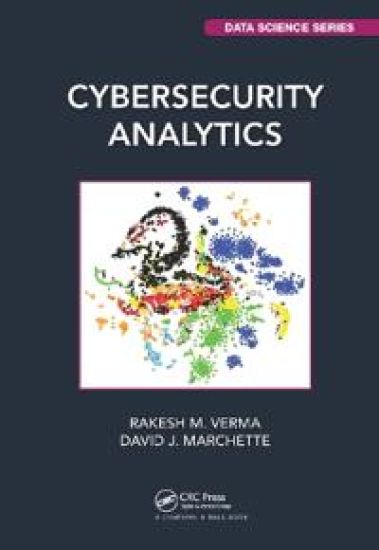
Cybersecurity Analytics

Cybersecurity Analytics

Rakesh M. Verma; David J. Marchette

CRC Press
2019
sidottu
Cybersecurity Analytics is for the cybersecurity student and professional who wants to learn data science techniques critical for tackling cybersecurity challenges, and for the data science student and professional who wants to learn about cybersecurity adaptations. Trying to build a malware detector, a phishing email detector, or just interested in finding patterns in your datasets? This book can let you do it on your own. Numerous examples and datasets links are included so that the reader can "learn by doing." Anyone with a basic college-level calculus course and some probability knowledge can easily understand most of the material. The book includes chapters containing: unsupervised learning, semi-supervised learning, supervised learning, text mining, natural language processing, and more. It also includes background on security, statistics, and linear algebra. The website for the book contains a listing of datasets, updates, and other resources for serious practitioners.
Cybersecurity Analytics

Cybersecurity Analytics

Rakesh M. Verma; David J. Marchette

TAYLOR FRANCIS LTD
2022
nidottu
Cybersecurity Analytics is for the cybersecurity student and professional who wants to learn data science techniques critical for tackling cybersecurity challenges, and for the data science student and professional who wants to learn about cybersecurity adaptations. Trying to build a malware detector, a phishing email detector, or just interested in finding patterns in your datasets? This book can let you do it on your own. Numerous examples and datasets links are included so that the reader can "learn by doing." Anyone with a basic college-level calculus course and some probability knowledge can easily understand most of the material. The book includes chapters containing: unsupervised learning, semi-supervised learning, supervised learning, text mining, natural language processing, and more. It also includes background on security, statistics, and linear algebra. The website for the book contains a listing of datasets, updates, and other resources for serious practitioners.