Kirjojen hintavertailu. Mukana 12 083 983 kirjaa ja 12 kauppaa.

Kirjahaku

Etsi kirjoja tekijän nimen, kirjan nimen tai ISBN:n perusteella.

5 kirjaa tekijältä David J. Shayler

Gemini 5

Gemini 5

David J. Shayler

Springer International Publishing AG
2023
nidottu
This third book of the Gemini mission series focuses on the flight that simulated in Earth orbit the duration of an eight-day Apollo mission to the Moon. After the proof-of-concept test flights Gemini 1, 2 and 3 (as described in GEMINI FLIES!) and the success of the first American EVA as well as the four-day U.S. mission (GEMINI 4), NASA gained the confidence to gradually increase mission time spent in orbit. This is the first known book to focus solely on the Gemini 5 mission and its challenges with equipment failures and difficult living conditions. The mission was targeted to double the endurance of the previous one, and as such was an integral stepping stone for an even more audacious mission four months later. Attempting the eight- and then fourteen-day durations would be an opportunity for America to gain the lead in space exploration over the Soviets. This mission pioneered the duration of a flight to the Moon and back three years before Apollo 8 made that journey, without a lunar landing, for the first time.
Assembling and Supplying the ISS

Assembling and Supplying the ISS

David J. Shayler

Springer International Publishing AG
2017
nidottu
The creation and utilization of the International Space Station (ISS) is a milestone in space exploration. But without the Space Shuttle, it would have remained an impossible dream. Assembling and Supplying the ISS is the story of how, between 1998 and 2011, the Shuttle became the platform which enabled the construction and continued operation of the primary scientific research facility in Earth orbit. Fulfilling an objective it had been designed to complete decades before, 37 Shuttle missions carried the majority of the hardware needed to build the ISS and then acted as a ferry and supply train for early resident crews to the station. Building upon the decades of development and experience described in the companion volume Linking the Space Shuttle and Space Stations: Early Docking Technologies from Concept to Implementation, this book explores • a purpose-built hardware processing facility • challenging spacewalking objectives • extensive robotic operations • undocking a unmanned orbiter The experience and expertise gained through these missions allows space planners to improve space construction skills in advance of even more ambitious plans in the future.
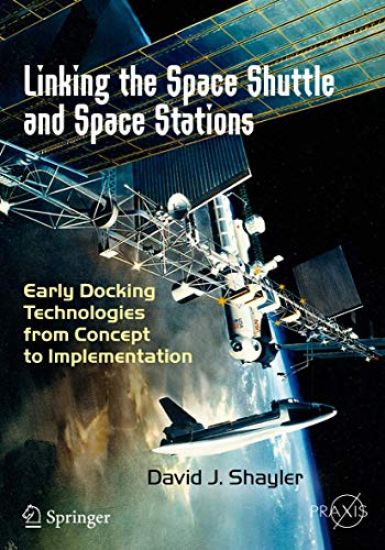
Linking the Space Shuttle and Space Stations

Linking the Space Shuttle and Space Stations

David J. Shayler

Springer International Publishing AG
2017
nidottu
How could the newly authorized space shuttle help in the U.S. quest to build a large research station in Earth orbit? As a means of transporting goods, the shuttle could help supply the parts to the station. But how would the two entitles be physically linked?Docking technologies had to constantly evolve as the designs of the early space stations changed. It was hoped the shuttle would make missions to the Russian Salyut and American Skylab stations, but thesewere postponed until the Mir station became available, while plans for getting a new U. S. space station underway were stalled.In Linking the Space Shuttle and Space Stations, the author delves into the rich history of the Space Shuttle and its connection to these early space stations, culminating in the nine missions to dock the shuttle toMir. By 1998, after nearly three decades of planning and operations, shuttle missions to Mir had resulted in:• A proven system to link up the space shuttle to a space station• Equipment and hands-on experience in handling tons of materials• An infrastructure to support space station assembly and resupplyEach of these played a pivotal role in developing the skills and procedures crucial to the creation of the later, much larger and far more complex International Space Station, as described in the companionvolume Assembling and Supplying the ISS: The Space Shuttle Fulfills Its Mission.
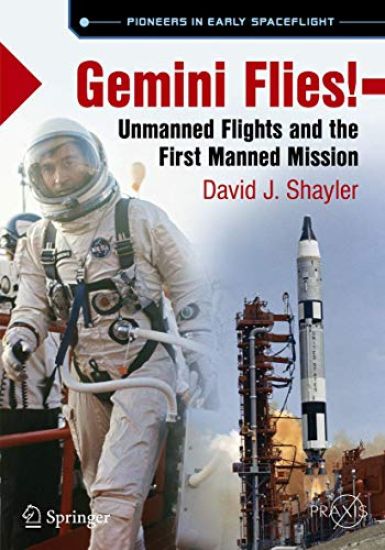
Gemini Flies!

Gemini Flies!

David J. Shayler

Springer International Publishing AG
2018
nidottu
In May 1961, President John F. Kennedy committed the United States to landing a man on the moon before the end of the decade. With just a handful of years to pull it off, NASA authorized the Project Gemini space program, which gathered vital knowledge needed to achieve the nation’s goal. This book introduces the crucial three-step test program employed by the Gemini system, covering: The short unmanned orbital flight of Gemini 1 that tested the compatibility of launch vehicle, spacecraft and ground systems. The unmanned suborbital flight of Gemini 2 to establish the integrity of the reentry system and protective heat shield. The three-orbit manned evaluation flight of Gemini 3, christened ‘Molly Brown’ by her crew. A mission recalled orbit by orbit, using mission transcripts, post-flight reports and the astronauts’ own account of their historic journey.The missions of Project Gemini was the pivotal steppingstone between Project Mercury and the Apollo Program. Following the success of its first two unmanned missions and the exploits of Gus Grissom and John Young on Gemini 3, NASA gained the confidence to plan an even bolder step on its next mission, as described in the next book in this series on Gemini 4.
Gemini 4

Gemini 4

David J. Shayler

Springer International Publishing AG
2019
nidottu
The flight of Gemini 4 in June 1965 was conducted barely four years after the first Americans flew in space. It was a bold step by NASA to accomplish the first American spacewalk and to extend the U.S. flight duration record to four days. This would be double the experience gained from the six Mercury missions combined.This daring mission was the first to be directed from the new Mission Control at the Manned Spacecraft Center near Houston, Texas. It also revealed that: Working outside the spacecraft would require further study.Developing the techniques to rendezvous with another object in space would not be as straightforward as NASA had hoped.Living in a small spacecraft for several days was a challenging but necessary step in the quest for even longer flights.Despite the risks, the gamble that astronauts Jim McDivitt and Ed White undertook paid off. Gemini 4 gave NASA the confidence to attempt an even longer flight the next time. That next mission would simulate the planned eight-day duration of an Apollo lunar voyage. Its story is recounted in the next title in this series: Gemini 5: Eight Days in Space or Bust.