Kirjojen hintavertailu. Mukana 12 083 983 kirjaa ja 12 kauppaa.

Kirjahaku

Etsi kirjoja tekijän nimen, kirjan nimen tai ISBN:n perusteella.

2 kirjaa tekijältä David K. Gosser

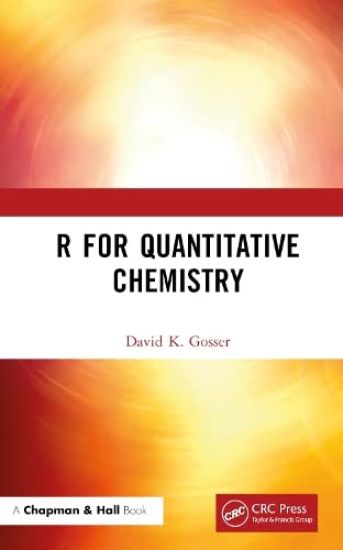
R for Quantitative Chemistry

R for Quantitative Chemistry

David K. Gosser

TAYLOR FRANCIS LTD
2023
sidottu
R for Quantitative Chemistry is an exploration of how the R language can be applied to a wide variety of problems in what is typically termed "Quantitative Chemistry" or sometimes "Analytical Chemistry". Topics include: basic statistics, spectroscopic data, acid base equilibria and titrations, binding curves (of great current interest for biomedical applications), Fourier Transforms, and chemical kinetics and enzyme kinetics. An innovative feature is the discussion (as an alternative to the less stable nls packages) of the simplex adaptation subplex (R package) coupled with Monte Carlo analysis to determine confidence intervals for estimated parameters resulting from least squares optimization. Chemists who are interested in learning R as a research tool as well as Chemists who are teaching Quantitative Chemistry, as well as their students will be interested. This book is useful as most R books approach data analysis from an economic, social, medical, or biological context. Analysis of chemical data draws upon specific numerical models and a different set R programming and packages than is typically discussed in other disciplines. This book will be based upon, in large part, actual experimental data and will include end of chapter questions and projects. Readers are encouraged to email the author at [email protected] and to follow the accompanying blog on Medium "R Programming for Quantitative Chemistry". Key Features: Elements of R programming for Chemists Literature Based Examples Includes Binding Assay Analysis Integrates theory, experiment, and R programming
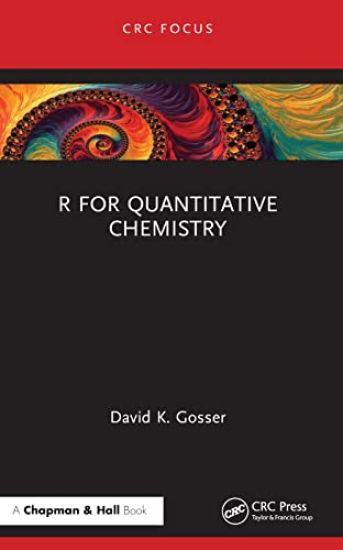
R for Quantitative Chemistry

R for Quantitative Chemistry

David K. Gosser

TAYLOR FRANCIS LTD
2023
nidottu
R for Quantitative Chemistry is an exploration of how the R language can be applied to a wide variety of problems in what is typically termed "Quantitative Chemistry" or sometimes "Analytical Chemistry". Topics include: basic statistics, spectroscopic data, acid base equilibria and titrations, binding curves (of great current interest for biomedical applications), Fourier Transforms, and chemical kinetics and enzyme kinetics. An innovative feature is the discussion (as an alternative to the less stable nls packages) of the simplex adaptation subplex (R package) coupled with Monte Carlo analysis to determine confidence intervals for estimated parameters resulting from least squares optimization. Chemists who are interested in learning R as a research tool as well as Chemists who are teaching Quantitative Chemistry, as well as their students will be interested. This book is useful as most R books approach data analysis from an economic, social, medical, or biological context. Analysis of chemical data draws upon specific numerical models and a different set R programming and packages than is typically discussed in other disciplines. This book will be based upon, in large part, actual experimental data and will include end of chapter questions and projects. Readers are encouraged to email the author at [email protected] and to follow the accompanying blog on Medium "R Programming for Quantitative Chemistry". Key Features: Elements of R programming for Chemists Literature Based Examples Includes Binding Assay Analysis Integrates theory, experiment, and R programming