Kirjojen hintavertailu. Mukana 11 717 486 kirjaa ja 12 kauppaa.

Kirjahaku

Etsi kirjoja tekijän nimen, kirjan nimen tai ISBN:n perusteella.

18 kirjaa tekijältä David Konstan

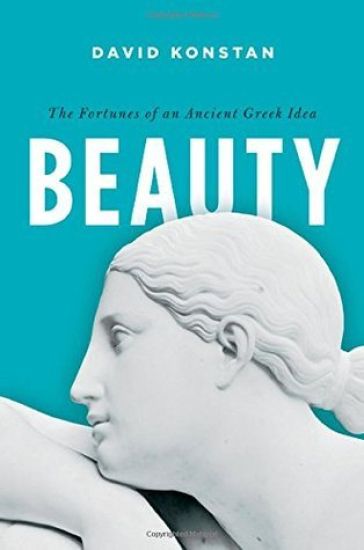
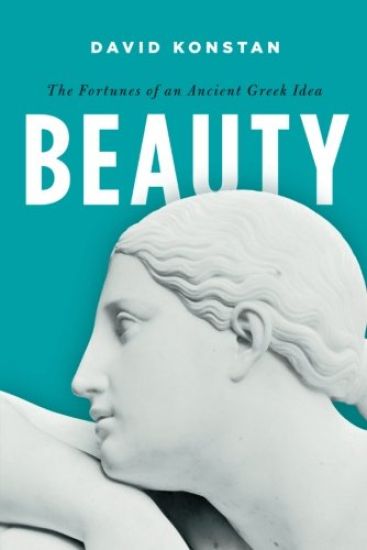
Beauty

Beauty

David Konstan

Oxford University Press Inc
2017
nidottu
Those who study the nature of beauty are at once plagued by a singular issue: what does it mean to say something is beautiful? On the one hand, beauty is associated with erotic attraction; on the other, it is the primary category in aesthetics, and it is widely supposed that the proper response to a work of art is one of disinterested contemplation. At its core, then, beauty is a contested concept, and both sides feel comfortable appealing to the authority of Plato, and via him, to the ancient Greeks generally. So, who is right--if either? Beauty offers an elegant investigation of ancient Greek notions of beauty and, in the process, sheds light on modern aesthetics and how we ought to appreciate the artistic achievements of the classical world itself. The book begins by reexamining the commonly held notion that the ancient Greeks possessed no term that can be unambiguously defined as "beauty" or "beautiful." Author David Konstan discusses a number of Greek approximations before positioning the heretofore unexamined term kállos as the key to bridging the gap between beauty and desire, and tracing its evolution as applied to physical beauty, art, literature, and more. Throughout, the discussion is enlivened with thought-provoking stories taken from Homer, Plato, Xenophon, Plutarch, and others. The book then examines corresponding terms in ancient Latin literature to highlight the survival of Greek ideas in the Latin West. The final chapter will compare the ancient Greek conception of beauty with modern notions of beauty and aesthetics. In particular, the book will focus on the reception of classical Greek art in the Renaissance and how Vasari and his contemporaries borrowed from Plato the sense that the beauty in art was transcendental, but left out the erotic dimension of viewing. A study of the ancient Greek idea of beauty shows that, even if Greece was the inspiration for modern aesthetic ideals, the Greek view of the relationship between beauty and desire was surprisingly consistent--and different from our own. Through this magisterial narrative, it is possible to identify how the Greeks thought of beauty, and what it was that attracted them. Their perceptions still have something important to tell us about art, love, desire--and beauty.
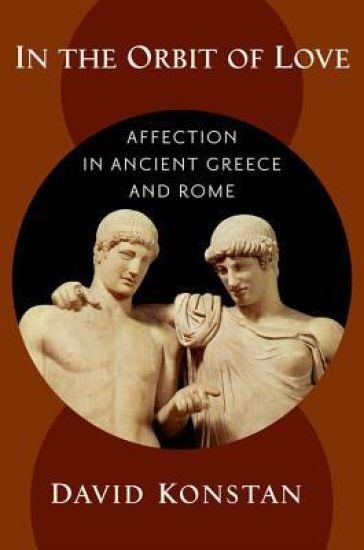
In the Orbit of Love

In the Orbit of Love

David Konstan

Oxford University Press Inc
2018
sidottu
This book is about love in the classical world -- not erotic passion but the kind of love that binds together intimate members of a family and very close friends, but which may also extend to include a wider range of individuals for whom we care deeply. David Konstan begins the book with a discussion of friendship, focusing particularly on the Greek notion that in friendship the identities of two friends all but merge into one. The book then turns to the question of loyalty, and why loyalty seems not to have achieved the status of a virtue in classical thought, before considering love in relation to generosity, favors, and gratitude. There follows a discussion of grief, which is a symptom of the loss of a loved one. The book concludes with an examination of love as the basis of civic solidarity. In each case, love is the gravitational center of the relations under examination. In this, the book departs from the more usual analysis of these affective ties in terms of reciprocity, which in one way or another involves an expectation of return. Seen this way, such relationships seem to have a selfish or at least self-centered dimension, as distinct from truly other-regarding attitudes. While it is true that the ancient sources sometimes describe these relations, including friendship, as forms of mutual obligation, there is also a counter strand that emphasizes genuine altruism, and it is this aspect that the book seeks to bring out. A close look at how love drew into its orbit the various relations examined in this book sheds light not only on some central features of ancient habits of thought but also on our own contemporary notions of love, altruism, and friendship.
Greek Comedy and Ideology

Greek Comedy and Ideology

David Konstan

Oxford University Press Inc
1995
sidottu
The happy endings of comedy resolve conflicts that have their sources in the real world. These conflicts, in turn, leave their mark upon the texts in the form of gaps in the plot and inconsistencies of characterization. Greek Comedy and Ideology analyses how the structure of ancient Greek comedy betrays and responds to cultural tensions in the society of the classical city-state. Individual chapters treat Aristophanic and Menandrean comedies, with a final chapter on Molière.
Beauty

Beauty

David Konstan

Oxford University Press Inc
2015
sidottu
Those who study the nature of beauty are at once plagued by a singular issue: what does it mean to say something is beautiful? On the one hand, beauty is associated with erotic attraction; on the other, it is the primary category in aesthetics, and it is widely supposed that the proper response to a work of art is one of disinterested contemplation. At its core, then, beauty is a contested concept, and both sides feel comfortable appealing to the authority of Plato, and via him, to the ancient Greeks generally. So, who is right--if either? Beauty offers an elegant investigation of ancient Greek notions of beauty and, in the process, sheds light on modern aesthetics and how we ought to appreciate the artistic achievements of the classical world itself. The book begins by reexamining the commonly held notion that the ancient Greeks possessed no term that can be unambiguously defined as "beauty" or "beautiful." Author David Konstan discusses a number of Greek approximations before positioning the heretofore unexamined term kállos as the key to bridging the gap between beauty and desire, and tracing its evolution as applied to physical beauty, art, literature, and more. Throughout, the discussion is enlivened with thought-provoking stories taken from Homer, Plato, Xenophon, Plutarch, and others. The book then examines corresponding terms in ancient Latin literature to highlight the survival of Greek ideas in the Latin West. The final chapter will compare the ancient Greek conception of beauty with modern notions of beauty and aesthetics. In particular, the book will focus on the reception of classical Greek art in the Renaissance and how Vasari and his contemporaries borrowed from Plato the sense that the beauty in art was transcendental, but left out the erotic dimension of viewing. A study of the ancient Greek idea of beauty shows that, even if Greece was the inspiration for modern aesthetic ideals, the Greek view of the relationship between beauty and desire was surprisingly consistent--and different from our own. Through this magisterial narrative, it is possible to identify how the Greeks thought of beauty, and what it was that attracted them. Their perceptions still have something important to tell us about art, love, desire--and beauty.

Before Forgiveness

Before Forgiveness

David Konstan

Cambridge University Press
2010
sidottu
In this book, David Konstan argues that the modern concept of interpersonal forgiveness, in the full sense of the term, did not exist in ancient Greece and Rome. Even more startlingly, it is not fully present in the Hebrew Bible, nor in the New Testament or in the early Jewish and Christian commentaries on the Holy Scriptures. It would still be centuries - many centuries - before the idea of interpersonal forgiveness, with its accompanying ideas of apology, remorse, and a change of heart on the part of the wrongdoer, would emerge. For all its vast importance today in religion, law, politics and psychotherapy, interpersonal forgiveness is a creation of the eighteenth and nineteenth centuries, when the Christian concept of divine forgiveness was fully secularized. Forgiveness was God's province and it took a revolution in thought to bring it to earth and make it a human trait.
Friendship in the Classical World

Friendship in the Classical World

David Konstan

Cambridge University Press
1997
sidottu
This book – the only history of friendship in classical antiquity that exists in English – examines the nature of friendship in Greece and Rome from Homer to the Christian Roman Empire of the fourth century AD. Friendship is conceived of as a voluntary and loving relationship, but there are major shifts in emphasis from the bonding among warriors in epic poetry, to the egalitarian ties characteristic of the Athenian democracy, the status-conscious connections in Rome and the Hellenistic kingdoms, and the commitment to a universal love among Christian writers. Friendship is also examined in relation to erotic love and comradeship, for its role in politics and economic life, in philosophical and religious communities, in connection with patronage and the private counsellors of kings, and in respect to women. Its relation to modern friendship is also fully discussed.
Sexual Symmetry

Sexual Symmetry

David Konstan

Princeton University Press
2014
pokkari
"In the Greek romances," writes David Konstan, "sighs, tears, and suicide attempts are as characteristic of the male as of the female in distress; ruses, disguises, and outright violence in defense of one's chastity are as much the part of the female as of the male." Exploring how erotic love is represented in ancient amatory literature, Konstan points to the symmetry in the passion of the hero and heroine as a unique feature of the Greek novel: they fall mutually in love, they are of approximately the same age and social class, and their reciprocal attachment ends in marriage. He shows how the plots of the novels are perfectly adapted to expressing this symmetry and how, because of their structure, they differ from classical epic, elegy, comedy, tragedy, and other genres, including modern novels ranging from Sidney to Harlequin romances. Using works like Chaereas and Callirhoe and Daphnis and Chloe, Konstan examines such issues as pederasty, the role of eros in both marital and nonmarital love, and the ancient Greek concept of fidelity. He reveals how the novelistic formula of sexual symmetry reverses the pattern of all other ancient genres, where erotic desire appears one-sided and unequal and is often viewed as either a weakness or an aggressive, conquering power. Konstan's approach draws upon theories concerning the nature of sexuality in the ancient world, reflected in the work of Michel Foucault, David Halperin, and John Winkler. Originally published in 1993. The Princeton Legacy Library uses the latest print-on-demand technology to again make available previously out-of-print books from the distinguished backlist of Princeton University Press. These editions preserve the original texts of these important books while presenting them in durable paperback and hardcover editions. The goal of the Princeton Legacy Library is to vastly increase access to the rich scholarly heritage found in the thousands of books published by Princeton University Press since its founding in 1905.
Sexual Symmetry

Sexual Symmetry

David Konstan

Princeton University Press
2016
sidottu
"In the Greek romances," writes David Konstan, "sighs, tears, and suicide attempts are as characteristic of the male as of the female in distress; ruses, disguises, and outright violence in defense of one's chastity are as much the part of the female as of the male." Exploring how erotic love is represented in ancient amatory literature, Konstan points to the symmetry in the passion of the hero and heroine as a unique feature of the Greek novel: they fall mutually in love, they are of approximately the same age and social class, and their reciprocal attachment ends in marriage. He shows how the plots of the novels are perfectly adapted to expressing this symmetry and how, because of their structure, they differ from classical epic, elegy, comedy, tragedy, and other genres, including modern novels ranging from Sidney to Harlequin romances. Using works like Chaereas and Callirhoe and Daphnis and Chloe, Konstan examines such issues as pederasty, the role of eros in both marital and nonmarital love, and the ancient Greek concept of fidelity. He reveals how the novelistic formula of sexual symmetry reverses the pattern of all other ancient genres, where erotic desire appears one-sided and unequal and is often viewed as either a weakness or an aggressive, conquering power. Konstan's approach draws upon theories concerning the nature of sexuality in the ancient world, reflected in the work of Michel Foucault, David Halperin, and John Winkler. Originally published in 1993. The Princeton Legacy Library uses the latest print-on-demand technology to again make available previously out-of-print books from the distinguished backlist of Princeton University Press. These editions preserve the original texts of these important books while presenting them in durable paperback and hardcover editions. The goal of the Princeton Legacy Library is to vastly increase access to the rich scholarly heritage found in the thousands of books published by Princeton University Press since its founding in 1905.
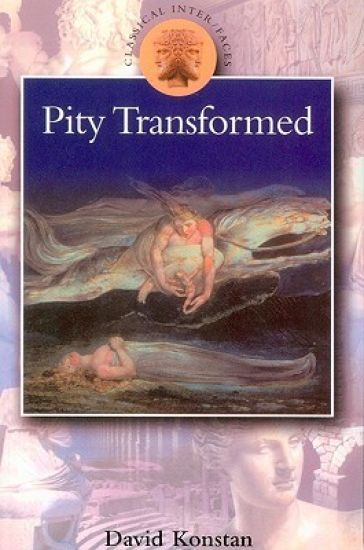
Pity Transformed

Pity Transformed

David Konstan

Gerald Duckworth Co Ltd
2001
sidottu
"Pity Transformed" is an examination of how pity was imagined and expressed in classical antiquity. It pays particular attention to the ways in which the pity of the Greeks and Romans differed from modern ideas. Among the topics investigated in this study are the appeal to pity in courts of law and the connection between pity and desert; the relation between pity and love or intimacy; self-pity; the role of pity in war and its relation to human rights and human dignity; divine pity from paganism to Christianity; and why pity was considered an emotion. This book will lead readers to ponder how the Greeks and Romans were both like and unlike us in this fundamental area of cultural sensibility.
Roman Comedy

Roman Comedy

David Konstan

Cornell University Press
1986
pokkari
This book explores the social institutions, the prevailing social values, and the ideology of the ancient city-state as revealed in Roman Comedy. "The very essence of comedy is social," writes David Konstan, "and in the complex movement of its plots we may be able to discern the lineaments and contradictions of the reigning ideas of an age." David Konstan looks closely at eight plays: Plautus's Aulularia, Asinaria, Captivi, Rudens, Cistellaria, and Truculentus, and Terence's Phormio and Hecyra. Offering new interpretations of each, he develops a "typology of plot forms" by analyzing structural features and patterns of conventional behavior in the plays, and he relates the results of his literary analysis to contemporary social conditions. He argues that the plays address tensions that were potentially disruptive to the ancient city-state, and that they tended to resolve these tensions in ways that affirmed traditional values. Roman Comedy is an innovative and challenging book that will be welcomed by students of classical literature, ancient social history, the history of the theater, and comedy as a genre.
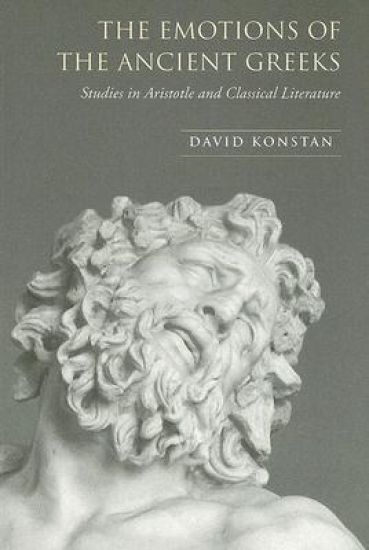
The Emotions of the Ancient Greeks

The Emotions of the Ancient Greeks

David Konstan

University of Toronto Press
2007
pokkari
It is generally assumed that whatever else has changed about the human condition since the dawn of civilization, basic human emotions - love, fear, anger, envy, shame - have remained constant. David Konstan, however, argues that the emotions of the ancient Greeks were in some significant respects different from our own, and that recognizing these differences is important to understanding ancient Greek literature and culture.With The Emotions of the Ancient Greeks, Konstan reexamines the traditional assumption that the Greek terms designating the emotions correspond more or less to those of today. Beneath the similarities, there are striking discrepancies. References to Greek 'anger' or 'love' or 'envy,' for example, commonly neglect the fact that the Greeks themselves did not use these terms, but rather words in their own language, such as orgê and philia and phthonos, which do not translate neatly into our modern emotional vocabulary. Konstan argues that classical representations and analyses of the emotions correspond to a world of intense competition for status, and focused on the attitudes, motives, and actions of others rather than on chance or natural events as the elicitors of emotion. Konstan makes use of Greek emotional concepts to interpret various works of classical literature, including epic, drama, history, and oratory. Moreover, he illustrates how the Greeks' conception of emotions has something to tell us about our own views, whether about the nature of particular emotions or of the category of emotion itself.
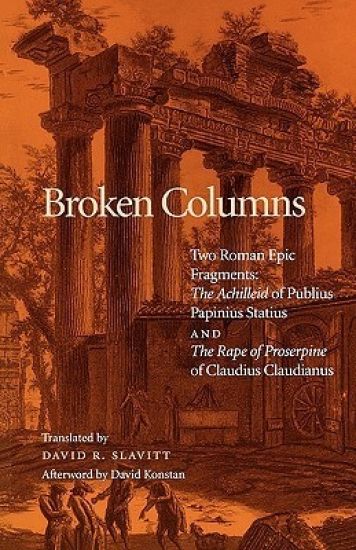
Broken Columns

Broken Columns

David Konstan

University of Pennsylvania Press
1997
pokkari
There is more to classical literature than just the classics. Here David Slavitt expands the canon by presenting vivid, graceful, and amusing translations of two neglected fragmentary works of Latin literature. The first is Publius Papinius Statius's first-century epic Achilleid, an extraordinary fusion of epic and New Comedy sentiments and humor that may represent the earliest literary imagining of the charm of adolescence. It relates the story of the education of Achilles under the centaur Chiron, his adopting the disguise of a girl during his sojourn at the court of Lycomedes in Scyros, his love affair with Deidamia, his detection by Ulysses and Diomedes, and his departure for Troy. The second work is Claudius Claudianus's unfinished fourth-century epic version of the rape of Proserpine. The two works together make a delightful pair. The afterword by David Konstan explores the traditions in which-and against which-Statius and Claudian composed their versions of these well-known stories.
Before Forgiveness

Before Forgiveness

David Konstan

Cambridge University Press
2012
pokkari
In this book, David Konstan argues that the modern concept of interpersonal forgiveness, in the full sense of the term, did not exist in ancient Greece and Rome. Even more startlingly, it is not fully present in the Hebrew Bible, nor in the New Testament or in the early Jewish and Christian commentaries on the Holy Scriptures. It would still be centuries - many centuries - before the idea of interpersonal forgiveness, with its accompanying ideas of apology, remorse, and a change of heart on the part of the wrongdoer, would emerge. For all its vast importance today in religion, law, politics and psychotherapy, interpersonal forgiveness is a creation of the eighteenth and nineteenth centuries, when the Christian concept of divine forgiveness was fully secularized. Forgiveness was God's province and it took a revolution in thought to bring it to earth and make it a human trait.
The Origin of Sin

The Origin of Sin

David Konstan

BLOOMSBURY PUBLISHING PLC
2022
sidottu
Where did the idea of sin arise from? In this meticulously argued book, David Konstan takes a close look at classical Greek and Roman texts, as well as the Bible and early Judaic and Christian writings, and argues that the fundamental idea of "sin" arose in the Hebrew Bible and the New Testament, although this original meaning was obscured in later Jewish and Christian interpretations. Through close philological examination of the words for "sin," in particular the Hebrew hata' and the Greek hamartia, he traces their uses over the centuries in four chapters, and concludes that the common modern definition of sin as a violation of divine law indeed has antecedents in classical Greco-Roman conceptions, but acquired a wholly different sense in the Hebrew Bible and New Testament.
The Origin of Sin

The Origin of Sin

David Konstan

BLOOMSBURY PUBLISHING PLC
2022
nidottu
Where did the idea of sin arise from? In this meticulously argued book, David Konstan takes a close look at classical Greek and Roman texts, as well as the Bible and early Judaic and Christian writings, and argues that the fundamental idea of "sin" arose in the Hebrew Bible and the New Testament, although this original meaning was obscured in later Jewish and Christian interpretations. Through close philological examination of the words for "sin," in particular the Hebrew hata' and the Greek hamartia, he traces their uses over the centuries in four chapters, and concludes that the common modern definition of sin as a violation of divine law indeed has antecedents in classical Greco-Roman conceptions, but acquired a wholly different sense in the Hebrew Bible and New Testament.
Simplicius: On Aristotle Physics 6

Simplicius: On Aristotle Physics 6

David Konstan

Bloomsbury Academic
2014
nidottu
Book Six of Aristotle's Physics, which concerns the continuum, shows Aristotle at his best. It contains his attack on atomism which forced subsequent Greek and Islamic atomists to reshape their views entirely. It also elaborates Zeno's paradoxes of motion and the famous paradoxes of stopping and starting. This is the first translation into any modern language of Simplicius' commentary on Book Six. Simplicius, the greatest ancient authority on Aristotle's Physics whose works have survived to the present, lived in the sixth century A.D. He produced detailed commentaries on several of Aristotle's works. Those on the Physics, which alone come to over 1300 pages in the original Greek, preserve not only a centuries-old tradition of ancient scholarship on Aristotle but also fragments of lost works by other thinkers, including both the Presocratic philosophers and such Aristotalians as Eudemus, Theophrastus and Alexander. The Physics contains some of Aristotle's best and most enduring work, and Simplicius' commentaries are essential to an understanding of it. This volume makes the commentary on Book Six accessible at last to all scholars, whether or not they know classical Greek. It will be indispensible for students of classical philosophy, and especially of Aristotle, as well as for those interested in philosophical thought of late antiquity. It will also be welcomed by students of the history of ideas and philosophers interested in problem mathematics and motion.
A Life Worthy of the Gods

A Life Worthy of the Gods

David Konstan

Parmenides Publishing
2008
nidottu
Epicurus, and his Roman disciple Lucretius, held that the primary cause of human unhappiness was an irrational fear of death. What is more, they believed that a clear understanding of the nature of the world would help to eliminate this fear; for if we recognize that the universe and everything in it is made up of atoms and empty space, we will see that the soul cannot possibly survive the extinction of the body—and no harm to us can occur after we die. This liberating insight is at the core of Epicurean therapy. In this book, Konstan seeks to show how such fears arose, according to the Epicureans, and why they persist even in modern societies. It offers a close examination of the basic principles of Epicurean psychology: showing how a system based on a materialistic world view could provide a coherent account of irrational anxieties and desires, and provide a therapy that would allow human beings to enjoy life to the fullest degree.