Kirjojen hintavertailu. Mukana 12 265 394 kirjaa ja 12 kauppaa.

Kirjahaku

Etsi kirjoja tekijän nimen, kirjan nimen tai ISBN:n perusteella.

7 kirjaa tekijältä David Krell

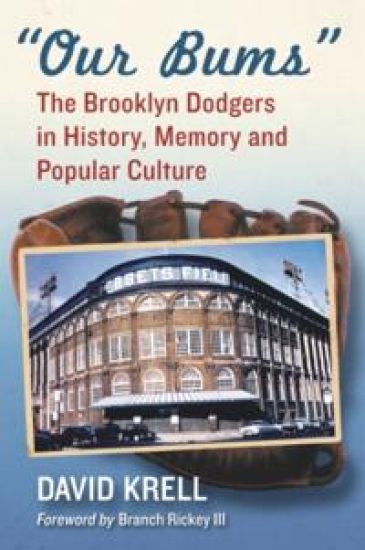
"Our Bums"

"Our Bums"

David Krell

McFarland Co Inc
2015
pokkari
Baseball fans may know the story of the Brooklyn Dodgers, but they don't know the whole story. With a foreword by Branch Barrett Rickey (grandson of Branch Rickey), this book fills the void in Dodgers scholarship, exploring their impact on popular culture and revealing lesser-known details of the team's history. Personal stories are included from the fans who embraced Jackie Robinson, Pee Wee Reese, Carl Erskine, Roy Campanella and other icons of Ebbets Field. Drawing on archival documents, contemporary press accounts and fan interviews, the author brings to life the magic of the Dodgers, chronicling in detail the genesis, glory and demise of the team that changed baseball--and America.
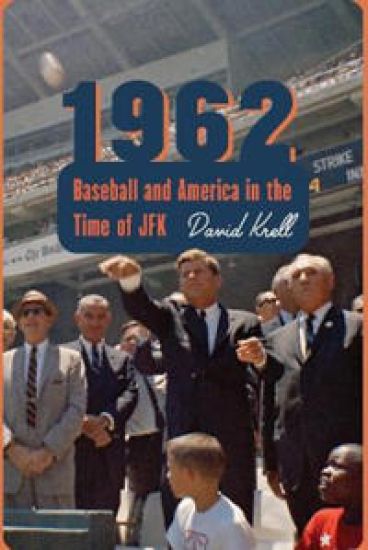
1962

1962

David Krell

University of Nebraska Press
2021
sidottu
In the watershed year of 1962, events and people came together to reshape baseball like never before. The season saw five no-hitters, a rare National League playoff between the Giants and the Dodgers, and a thrilling seven-game World Series where the Yankees, led by Mickey Mantle, won their twentieth title, beating the San Francisco Giants, led by Willie Mays, in their first appearance since leaving New York. Baseball was expanding with the Houston Colt .45s and the New York Mets, who tried to fill the National League void in New York but finished with 120 losses and the worst winning percentage since 1900. Despite their record, the ’62 Mets revived National League baseball in a city thirsty for an alternative to the Yankees. As the team struggled through a disastrous first year, manager Casey Stengel famously asked, “Can’t anybody here play this game?” Earlier that year in Los Angeles, Dodgers owner Walter O’Malley launched Dodger Stadium, a state-of-the-art ballpark in Chavez Ravine and a new icon for the city. For the Dodgers, Sandy Koufax pitched his first of four career no-hitters, Maury Wills set a record for stolen bases in a season, and Don Drysdale won twenty-five games. Beyond baseball, 1962 was also a momentous year in American history: Mary Early became the first Black graduate of the University of Georgia, First Lady Jackie Kennedy revealed the secrets of the White House in a television special, John Glenn became the first astronaut to orbit Earth, and JFK stared down Russia during the Cuban Missile Crisis. Weaving the 1962 baseball season within the social fabric of this era, David Krell delivers a fascinating book as epochal as its subject.
The Fenway Effect

The Fenway Effect

David Krell

University of Nebraska Press
2024
sidottu
To be a part of Red Sox Nation is to be a hopeful romantic who neither betrays loyalty nor surrenders hope in the direst of circumstances. From Bangor to Back Bay, New Englanders endure in baseball matters. And life. The team’s history has intersected with the history of Boston and well beyond it, through the Curse of the Bambino, the military service of Ted Williams during World War II, and the Boston Marathon bombing. The Fenway Effect chronicles these stories and others that have built the incredible saga of the Boston Red Sox. How did Cheers depict the passion of Boston’s sports fans? Why is Narragansett beer so important to New England? What’s the architectural impact of The Teammates-the statue of Bobby Doerr, Johnny Pesky, Ted Williams, and Dom DiMaggio outside Fenway Park? What did the Boston press really think about Red Sox owner Harry Frazee selling Babe Ruth to the Yankees? What was the origin of Fenway Park’s predecessor-Huntington Avenue Grounds? Even Yankees fans will tip their caps to the rich impact of the Red Sox on music, movies, branding, broadcasting, and more. Plus, there’s a chapter focusing on the oral history of Red Sox fans, some of whom share here anecdotes that are funny, insightful, and heartwarming.
1978

1978

David Krell

University of Nebraska Press
2025
sidottu
Americans struggled to find their footing in the late 1970s. The Vietnam War ended with more than fifty-eight thousand American soldiers’ deaths; the public’s trust in politicians plummeted amid the Watergate scandal. As deadly blizzards ripped through the Midwest and Northeast in early 1978 and caused hundreds of millions of dollars in damages, Americans turned to baseball for the welcome distraction and promise of a new season. From spring training to the World Series, 1978 gave baseball fans one of the sport’s greatest seasons, full of legendary moments like the battle between the New York Yankees and the Boston Red Sox for the American League East pennant, Gaylord Perry’s three thousandth strikeout, Tom Seaver’s only career no-hitter, Willie McCovey’s five hundredth home run, and Pete Rose’s marathon forty-four-game hitting streak. The 1978 season played out against a backdrop of disco music, bell-bottom pants, and gas-guzzling cars, while Hollywood answered a desperate longing for a simpler time with nostalgic offerings such as Grease, The Buddy Holly Story, American Hot Wax, Animal House, and Superman. Robin Williams became a household name with a guest appearance on the popular TV show Happy Days, Atlantic City debuted its first casino, and Jill Clayburgh symbolized the emerging independence of women in An Unmarried Woman. In a memorable end to the baseball season, Reggie Jackson and Bucky Dent led the Yankees to their second consecutive World Series over the Dodgers after losing the first two games, then winning four in a row. With a month-by-month approach, David Krell breaks down major events in both baseball and American culture at large in 1978, chronicling in novelistic detail the notable achievements of some of the greatest players of the era, along with some of the national pastime’s quirkiest moments, to capture an extraordinary year in baseball.
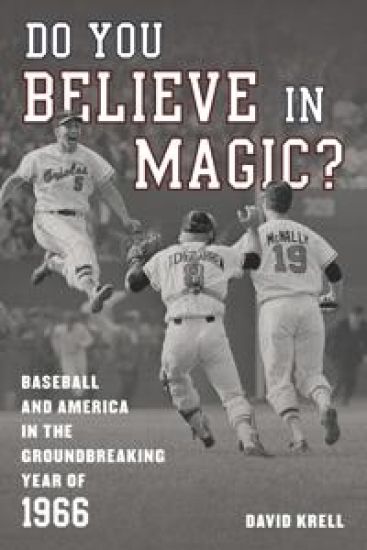
Do You Believe in Magic?

Do You Believe in Magic?

David Krell

ROWMAN LITTLEFIELD
2023
sidottu
1966: Baseball and America in the Space Age brings to life a year of transition in a country on the cusp of radical changes in politics, mores, and popular culture. What was mainstream in 1966 could be considered old-fashioned just a year or two later when the counterculture emerged as an important societal force; by the early 1970s, standards had loosened further when Hollywood producers broke free of the constraint of benign storylines in favor of movies and TV shows with political issues as their foundation.With the baseball season as its narrative arc, 1966 traces the end of one baseball dynasty and the beginning of another while revealing untold stories and offering new perspectives about highly significant events in both baseball and the country’s affairs.The Orioles shocked the baseball world with a World Series sweep; it sparked an American League dynasty and ended the Dodgers’ National League reign that had begun after World War II. But baseball’s significance went beyond box scores to establish equality, fairness, and social justice. In his Hall of Fame induction speech, Ted Williams used his clout to do what few, if any, of his peers had done publicly—call for the induction of players from the Negro Leagues; Emmett Ashford became the first black umpire in Major League Baseball; and Marvin Miller helped form the Major League Baseball Players Union, which changed the status of players from property of owners to free agents with bargaining power. Against a backdrop of NASA’s five successful Gemini missions that set the stage for the Apollo moon landings, 1966 brings this amazing year to life. In addition to baseball and the Space Race, it will uncover massive changes in popular culture. Producer William Dozier brought a satirical version of the comic-book icon Batman to television, igniting a superhero phenomenon. Jacqueline Susann’s controversial novel Valley of the Dolls exposed the dark side of Hollywood with stories about drugs, sex, and mental illness. And Mission: Impossible premiered in 1966, offering great espionage fodder for Cold War audiences after James Bond became a household name in the early 1960s.This book will remind readers of a time when social progress and cultural revolutions made Americans feel that the country’s promise was limitless.