Kirjojen hintavertailu. Mukana 11 476 282 kirjaa ja 12 kauppaa.

Kirjahaku

Etsi kirjoja tekijän nimen, kirjan nimen tai ISBN:n perusteella.

6 kirjaa tekijältä David L. Eng

Racial Castration

Racial Castration

David L. Eng

Duke University Press
2001
sidottu
Racial Castration, the first book to bring together the fields of Asian American studies and psychoanalytic theory, explores the role of sexuality in racial formation and the place of race in sexual identity. David L. Eng examines images-literary, visual, and filmic-that configure past as well as contemporary perceptions of Asian American men as emasculated, homosexualized, or queer.Eng juxtaposes theortical discussions of Freud, Lacan, and Fanon with critical readings of works by Frank Chin, Maxine Hong Kingston, Lonny Kaneko, David Henry Hwang, Louie Chu, David Wong Louie, Ang Lee, and R. Zamora Linmark. While situating these literary and cultural productions in relation to both psychoanalytic theory and historical events of particular significance for Asian Americans, Eng presents a sustained analysis of dreamwork and photography, the mirror stage and the primal scene, and fetishism and hysteria. In the process, he offers startlingly new interpretations of Asian American masculinity in its connections to immigration exclusion, the building of the transcontinental railroad, the wartime internment of Japanese Americans, multiculturalism, and the model minority myth. After demonstrating the many ways in which Asian American males are haunted and constrained by enduring domestic norms of sexuality and race, Eng analyzes the relationship between Asian American male subjectivity and the larger transnational Asian diaspora. Challenging more conventional understandings of diaspora as organized by race, he instead reconceptualizes it in terms of sexuality and queerness.
Racial Castration

Racial Castration

David L. Eng

Duke University Press
2001
pokkari
Racial Castration, the first book to bring together the fields of Asian American studies and psychoanalytic theory, explores the role of sexuality in racial formation and the place of race in sexual identity. David L. Eng examines images-literary, visual, and filmic-that configure past as well as contemporary perceptions of Asian American men as emasculated, homosexualized, or queer.Eng juxtaposes theortical discussions of Freud, Lacan, and Fanon with critical readings of works by Frank Chin, Maxine Hong Kingston, Lonny Kaneko, David Henry Hwang, Louie Chu, David Wong Louie, Ang Lee, and R. Zamora Linmark. While situating these literary and cultural productions in relation to both psychoanalytic theory and historical events of particular significance for Asian Americans, Eng presents a sustained analysis of dreamwork and photography, the mirror stage and the primal scene, and fetishism and hysteria. In the process, he offers startlingly new interpretations of Asian American masculinity in its connections to immigration exclusion, the building of the transcontinental railroad, the wartime internment of Japanese Americans, multiculturalism, and the model minority myth. After demonstrating the many ways in which Asian American males are haunted and constrained by enduring domestic norms of sexuality and race, Eng analyzes the relationship between Asian American male subjectivity and the larger transnational Asian diaspora. Challenging more conventional understandings of diaspora as organized by race, he instead reconceptualizes it in terms of sexuality and queerness.

The Feeling of Kinship

The Feeling of Kinship

David L. Eng

Duke University Press
2010
sidottu
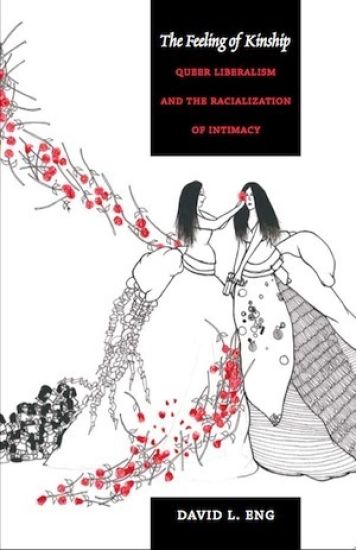
In The Feeling of Kinship, David L. Eng investigates the emergence of “queer liberalism”-the empowerment of certain gays and lesbians in the United States, economically through an increasingly visible and mass-mediated queer consumer lifestyle, and politically through the legal protection of rights to privacy and intimacy. Eng argues that in our “colorblind” age the emergence of queer liberalism is a particular incarnation of liberal freedom and progress, one constituted by both the racialization of intimacy and the forgetting of race. Through a startling reading of Lawrence v. Texas, the landmark legal decision overturning Texas’s antisodomy statute, Eng reveals how the ghosts of miscegenation haunt both Lawrence and the advent of queer liberalism.Eng develops the concept of “queer diasporas” as a critical response to queer liberalism. A methodology drawing attention to new forms of family and kinship, accounts of subjects and subjectivities, and relations of affect and desire, the concept differs from the traditional notions of diaspora, theories of the nation-state, and principles of neoliberal capitalism upon which queer liberalism thrives. Eng analyzes films, documentaries, and literature by Asian and Asian American artists including Wong Kar-wai, Monique Truong, Deann Borshay Liem, and Rea Tajiri, as well as a psychoanalytic case history of a transnational adoptee from Korea. In so doing, he demonstrates how queer Asian migrant labor, transnational adoption from Asia, and the political and psychic legacies of Japanese internment underwrite narratives of racial forgetting and queer freedom in the present. A focus on queer diasporas also highlights the need for a poststructuralist account of family and kinship, one offering psychic alternatives to Oedipal paradigms. The Feeling of Kinship makes a major contribution to American studies, Asian American studies, diaspora studies, psychoanalysis, and queer theory.
The Feeling of Kinship

The Feeling of Kinship

David L. Eng

Duke University Press
2010
pokkari
In The Feeling of Kinship, David L. Eng investigates the emergence of “queer liberalism”-the empowerment of certain gays and lesbians in the United States, economically through an increasingly visible and mass-mediated queer consumer lifestyle, and politically through the legal protection of rights to privacy and intimacy. Eng argues that in our “colorblind” age the emergence of queer liberalism is a particular incarnation of liberal freedom and progress, one constituted by both the racialization of intimacy and the forgetting of race. Through a startling reading of Lawrence v. Texas, the landmark legal decision overturning Texas’s antisodomy statute, Eng reveals how the ghosts of miscegenation haunt both Lawrence and the advent of queer liberalism.Eng develops the concept of “queer diasporas” as a critical response to queer liberalism. A methodology drawing attention to new forms of family and kinship, accounts of subjects and subjectivities, and relations of affect and desire, the concept differs from the traditional notions of diaspora, theories of the nation-state, and principles of neoliberal capitalism upon which queer liberalism thrives. Eng analyzes films, documentaries, and literature by Asian and Asian American artists including Wong Kar-wai, Monique Truong, Deann Borshay Liem, and Rea Tajiri, as well as a psychoanalytic case history of a transnational adoptee from Korea. In so doing, he demonstrates how queer Asian migrant labor, transnational adoption from Asia, and the political and psychic legacies of Japanese internment underwrite narratives of racial forgetting and queer freedom in the present. A focus on queer diasporas also highlights the need for a poststructuralist account of family and kinship, one offering psychic alternatives to Oedipal paradigms. The Feeling of Kinship makes a major contribution to American studies, Asian American studies, diaspora studies, psychoanalysis, and queer theory.
Reparations and the Human

Reparations and the Human

David L. Eng

DUKE UNIVERSITY PRESS
2025
sidottu
The Holocaust and the atomic bombings of Hiroshima and Nagasaki invoked in graphic terms the specter of total human destruction. In response, a new international order of reparations and human rights arose from the ashes of World War II. This legal regime sought to subrogate the sovereignty of the nation-state in order to defend the sovereignty of the human being. While the Holocaust’s history is settled-Nazis were perpetrators and Jews were victims-there remains little historical consensus as to the victims and perpetrators of the atomic bombings. In Reparations and the Human, David L. Eng investigates a history of reparations across the Transpacific. He analyzes how concepts of reparation established during colonial settlement and the European Enlightenment shape contemporary configurations of the human and human rights, determining who can be recognized as victims, who must be seen as perpetrators, and who deserves repair. As demands for reparations now occupy center stage in debates concerning unresolved legacies of dispossession and Transatlantic slavery, Eng considers how the Cold War Transpacific provides a limit case for the politics of repair and definitions of the human.
Reparations and the Human

Reparations and the Human

David L. Eng

DUKE UNIVERSITY PRESS
2025
pokkari
The Holocaust and the atomic bombings of Hiroshima and Nagasaki invoked in graphic terms the specter of total human destruction. In response, a new international order of reparations and human rights arose from the ashes of World War II. This legal regime sought to subrogate the sovereignty of the nation-state in order to defend the sovereignty of the human being. While the Holocaust’s history is settled-Nazis were perpetrators and Jews were victims-there remains little historical consensus as to the victims and perpetrators of the atomic bombings. In Reparations and the Human, David L. Eng investigates a history of reparations across the Transpacific. He analyzes how concepts of reparation established during colonial settlement and the European Enlightenment shape contemporary configurations of the human and human rights, determining who can be recognized as victims, who must be seen as perpetrators, and who deserves repair. As demands for reparations now occupy center stage in debates concerning unresolved legacies of dispossession and Transatlantic slavery, Eng considers how the Cold War Transpacific provides a limit case for the politics of repair and definitions of the human.