Kirjojen hintavertailu. Mukana 11 244 527 kirjaa ja 12 kauppaa.

Kirjahaku

Etsi kirjoja tekijän nimen, kirjan nimen tai ISBN:n perusteella.

8 kirjaa tekijältä David Lazar

Markets and Ideology in the City of London

Markets and Ideology in the City of London

David Lazar

Palgrave Macmillan
1990
sidottu
Markets and Ideology in the City of London is the first fieldwork-based sociological study of how participants in City of London financial markets view the markets in which they work and the market mechanism in general. But it is more than a narrow study of financial market participants because it is also an empirical investigation into how ideologies function and it develops a critique of pro-market ideologies such as 'Thatcherism'. Finally, it is one of a small number of sociological studies into the privileged world of high earners and the wealthy - sociologists too frequently study the powerless and the 'deviant' or 'marginal' groups.
Occasional Desire

Occasional Desire

David Lazar

University of Nebraska Press
2013
pokkari
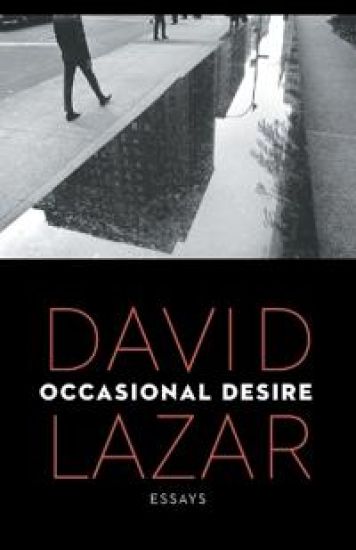
In his new collection of essays, Occasional Desire, David Lazar meditates on random violence and vanished phone booths, on the excessive relationship to jewelry that links Kobe Bryant and Elizabeth Taylor, on Hitchcock, Francis Bacon, and M. F. K. Fisher. He explores, in his concentrically self-aware, amused, and ironic voice, what it means to be occasionally aware that we are surviving by our wits, and that our desires, ulterior or obvious, are what keep us alive. Lazar also turns his attention on the essay itself, affording us a three-dimensional look at the craft and the art of reading and writing a literary form that maps the world as it charts the peregrinations of the mind.Lazar is especially interested in the trappings of memory, the trapdoors of memory, the way we gild or codify, select, soften, and self-delude ourselves based on our understanding of the past. His own process of selection and reflection reminds us of how far this literary form can take us, bound only by the limits of desire and imagination.
Who's Afraid of Helen of Troy?: An Essay on Love
David Lazar extends the language of prose poetry, mixing the classical and the high modern, the song and dance man and the Odyssean. Nothing, he finds, is as far apart as we think, except for the chaos and order, innocence and experience. Lazar's voice is a sacred last resort: something's gotta give.The voice in these poems is semi-autobiographical and performative: masked yet emotionally raw. Each poem draws on the features of modernist poetry, using an arch, cadenced sentence as its primary unit, but drawing on the Iliad, Odyssey , and other classical myths as part of its internal cosmos.
Markets and Ideology in the City of London

Markets and Ideology in the City of London

David Lazar

Palgrave Macmillan
1990
nidottu
Markets and Ideology in the City of London is the first fieldwork-based sociological study of how participants in City of London financial markets view the markets in which they work and the market mechanism in general. But it is more than a narrow study of financial market participants because it is also an empirical investigation into how ideologies function and it develops a critique of pro-market ideologies such as 'Thatcherism'. Finally, it is one of a small number of sociological studies into the privileged world of high earners and the wealthy - sociologists too frequently study the powerless and the 'deviant' or 'marginal' groups.
Celeste Holm Syndrome

Celeste Holm Syndrome

David Lazar

University of Nebraska Press
2020
pokkari
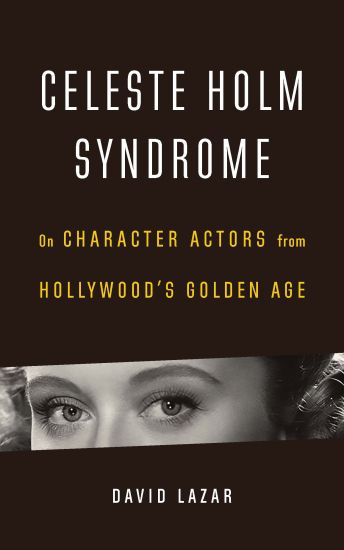
Longlisted for the PEN/Diamonstein-Spielvogel Award for the Art of the Essay In this essay collection David Lazar looks to our intimate relationships with characters, both well-known and lesser known, from Hollywood’s Golden Age. Veering through considerations of melancholy and wit, sexuality and gender, and the surrealism of comedies of the self in an uncanny world, mixed with his own autobiographical reflections of cinephilia, Lazar creates an alluring hybrid of essay forms as he moves through the movies in his mind.Character actors from the classical era of the 1930s through the 1950s including Thelma Ritter, Oscar Levant, Martin Balsam, Nina Foch, Elizabeth Wilson, Eric Blore, Edward Everett Horton, and the eponymous Celeste Holm all make appearances in these considerations of how essential character actors were, and remain, to cinema.
I'll Be Your Mirror

I'll Be Your Mirror

David Lazar

University of Nebraska Press
2017
pokkari
In his third book of essays, David Lazar blends personal meditations on sex and death with considerations of popular music and coping with anxiety through singing, bowling, and other distractions. He sets his work apart as both in the essay and of the essay by throwing himself into the form’s past-interviewing or speaking to past masters and turning over rocks to find lost gems of the essay form.I’ll Be Your Mirror further expands the dimensions of contemporary nonfiction writing by concluding with a series of aphorisms. Surreal, comical, and urban moments of being, they are part Cioran, part Kafka, and part Lenny Bruce. These are accompanied by Heather Frise’s illustrations, whose looking-glass visions of motherhood-funny and grotesque-meet the vision of the aphorist in this most unusual nonfiction book.
Stories of the Street

Stories of the Street

David Lazar

University of Nebraska Press
2024
pokkari
When walking down the street, it is not uncommon to see lost items that have escaped their proper receptacles, but how often does one stop to read the messages left behind? David Lazar has stopped often, capturing the pieces of a “lost world on the streets” and thinking about the life of the discarder from the fragments left behind.Stories of the Street is a series of imaginative meditations-through prose poems, short-short essays, microfictions, and prose pieces without precise genre distinction-of what it means to encounter lost or discarded texts. Rather than simply deconstructing the lists, notes, receipts, or book pages he finds strewn in various cities, Lazar uses them as suggestive, capable of inspiring possible narratives that are at most latent in the text itself. The encounter, then, is an encounter with oneself and the mysteries of cities, where detritus frequently doubles as a sign saying, “Consider this.” Lazar’s narrative voice ranges in tone from the comically antic to the melancholy. By photographing what he describes as “messages that had escaped their bottles” on-location as found, Lazar has become a flaneur of paper debris, puzzling over the evidence of urban human life.