
Kirjahaku
Etsi kirjoja tekijän nimen, kirjan nimen tai ISBN:n perusteella.
6 kirjaa tekijältä David M Levinson
This book describes how to create the 30-Minute City. The first part of the book explains accessibility. We next consider access through history (chapter 2). Access is the driving force behind how cities were built. Its use today is described when looking at access and the Greater Sydney Commission's plan for Sydney. We then examine short-run fixes: things that can be done instantaneously, or nearly so, at low budget to restore access for people, which include retiming traffic signals (chapter 3) and deploying bike sharing (chapter 5) supported by protected bike lane networks (chapter 4), as well public transport timetables (chapter 6). We explore medium-run fixes that include implementing rapid bus networks (chapter 7) and configuring how people get to train stations by foot and on bus (chapter 8). We turn to longer-run fixes. These are as much policy changes as large investments, and include job/worker balance (chapter 10) and network restructuring (chapter 9) as well as urban restoration (chapter 11), suburban retrofit (chapter 12), and greenfield development (chapter 13). We conclude with thoughts about the 'pointlessness' of cities and how to restructure practice (chapter 14). The appendices provide detail on access measurement (Appendix A), the idea of accessibility loss (B), valuation (C), the rationale for the 30-minute threshold (D), and reliability (E). It concludes with what should we research (F).

As cities around the globe respond to rapid technological changes and political pressures, coordinated transport and land use planning is an often targeted aim.Metropolitan Transport and Land Use, the second edition of Planning for Place and Plexus, provides unique and updated perspectives on metropolitan transport networks and land use planning, challenging current planning strategies, offering frameworks to understand and evaluate policy, and suggesting alternative solutions.The book includes current and cutting-edge theory, findings, and recommendations which are cleverly illustrated throughout using international examples. This revised work continues to serve as a valuable resource for students, researchers, practitioners, and policy advisors working across transport, land use, and planning.
As cities around the globe respond to rapid technological changes and political pressures, coordinated transport and land use planning is an often targeted aim.Metropolitan Transport and Land Use, the second edition of Planning for Place and Plexus, provides unique and updated perspectives on metropolitan transport networks and land use planning, challenging current planning strategies, offering frameworks to understand and evaluate policy, and suggesting alternative solutions.The book includes current and cutting-edge theory, findings, and recommendations which are cleverly illustrated throughout using international examples. This revised work continues to serve as a valuable resource for students, researchers, practitioners, and policy advisors working across transport, land use, and planning.
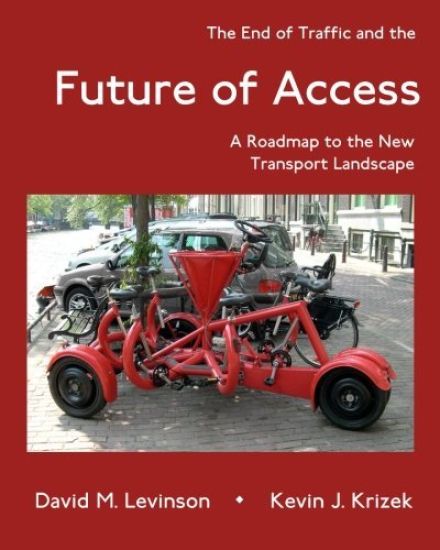
The End of Traffic and the Future of Access
Kevin J Krizek; David M Levinson
Createspace Independent Publishing Platform
2017
pokkari
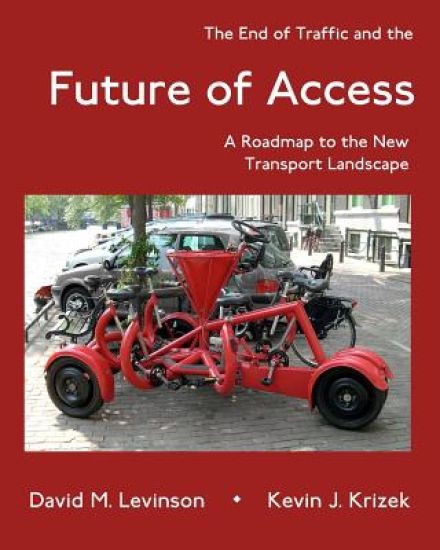
In this book we propose the welcome notion that traffic-as most people have come to know it-is ending and why. We depict a transport context in most communities where new opportunities are created by the collision of slow, medium, and fast moving technologies. We then unfold a framework to think more broadly about concepts of transport and accessibility. In this framework, transport systems are being augmented with a range of information technologies; it invokes fresh flows of goods and information. We discuss large scale trends that are revolutionizing the transport landscape: electrification, automation, the sharing economy, and big data. Based on all of this, the final chapters offer strategies to shape the future of infrastructure needs and priorities.We aim for a quick read-and to encourage you and other readers to think outside your immediate realm. By the end of this book (today, if you so choose) you will appreciate the changing times in which you live. You will hopefully appreciate what is new about transport discussions and how definitions of accessibility are being reframed. You will be provided with new ways of thinking about the planning of transport infrastructure that coincide with this changing landscape. Even if transport is not your bailiwick, we like to think there is something interesting for you here. We aim to share new perspectives and reframe debates about the future of transport in cities.