Kirjojen hintavertailu. Mukana 11 717 486 kirjaa ja 12 kauppaa.

Kirjahaku

Etsi kirjoja tekijän nimen, kirjan nimen tai ISBN:n perusteella.

10 kirjaa tekijältä David M. Carr

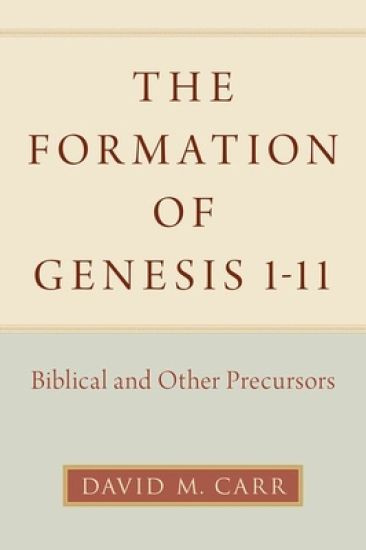
The Formation of Genesis 1-11

The Formation of Genesis 1-11

David M. Carr

Oxford University Press Inc
2020
sidottu
There is general agreement in the field of Biblical studies that study of the formation of the Pentateuch is in disarray. David M. Carr turns to the Genesis Primeval History, Genesis 1-11, to offer models for the formation of Pentateuchal texts that may have traction within this fractious context. Building on two centuries of historical study of Genesis 1-11, this book provides new support for the older theory that the bulk of Genesis 1-11 was created out of a combination of two originally separate source strata: a Priestly source and an earlier non-Priestly source that was used to supplement the Priestly framework. Though this overall approach contradicts some recent attempts to replace such source models with theories of post-Priestly scribal expansion, Carr does find evidence of multiple layers of scribal revision in the non-P and P sources, from the expansion of an early independent non-Priestly primeval history with a flood narrative and related materials to a limited set of identifiable layers of Priestly material that culminate in the P-like redaction of the whole. This book synthesizes prior scholarship to show how both the P and non-Priestly strata of Genesis also emerged out of a complex interaction by Judean scribes with non-biblical literary traditions, particularly with Mesopotamian textual traditions about primeval origins. The Formation of Genesis 1-11 makes a significant contribution to scholarship on one of the most important texts in the Hebrew Bible and will influence models for the formation of the Hebrew Bible as a whole.
Writing on the Tablet of the Heart

Writing on the Tablet of the Heart

David M. Carr

Oxford University Press Inc
2005
sidottu
This book explores a new model for the production, revision, and reception of Biblical texts as Scripture. Building on recent studies of the oral/written interface in medieval, Greco-Roman and ancinet Near Eastern contexts, David Carr argues that in ancient Israel Biblical texts and other texts emerged as a support for an educational process in which written and oral dimensions were integrally intertwined. The point was not incising and reading texts on parchment or papyrus. The point was to enculturate ancient Israelites - particularly Israelite elites - by training them to memorize and recite a wide range of traditional literature that was seen as the cultural bedorck of the people: narrative, prophecy, prayer, and wisdom.
Writing on the Tablet of the Heart

Writing on the Tablet of the Heart

David M. Carr

Oxford University Press Inc
2009
nidottu
This book explores a new model for the production, revision, and reception of Biblical texts as Scripture. Building on recent studies of the oral–written interface in medieval, Greco-Roman and ancient Near Eastern contexts, David Carr argues that in ancient Israel Biblical texts and other texts emerged as a support for an educational process in which written and oral dimensions were integrally intertwined. The point was not incising and reading texts on parchment or papyrus. The point was to enculturate ancient Israelites -- particularly Israelite elites - by training them to memorize and recite a wide range of traditional literature that was seen as the cultural bedrock of the people: narrative, prophecy, prayer, and wisdom. Generally, mastery was exercised through remarkably exact recall and reproduction of the tradition - whether through oral performance or through production of written "performances." Crises like exile, however, could prompt the creation of radically new versions of the classic tradition, incorporating verbal recall of ancient tradition with various extensions, recontextualizations and supplements. This educational process took place on a one-to-one basis and focused on the cultivation of an educated elite. A major change took place with the arrival of the Hellenistic empires in the fourth and following centuries. This, says Carr, led to the emergence of a democratized Jewish "school" as well as the marking off of the standard Israelite texts as an "anti-canon" to the Hellenistic canon of educational texts that were used in the Greek schools of the Eastern Mediterranean.
The Formation of the Hebrew Bible

The Formation of the Hebrew Bible

David M. Carr

Oxford University Press Inc
2011
sidottu
In The Formation of the Hebrew Bible David Carr rethinks both the methods and historical orientation points for research into the growth of the Hebrew Bible into its present form. Building on his prior work, Writing on the Tablet of the Heart (Oxford, 2005), he explores both the possibilities and limits of reconstruction of pre-stages of the Bible. The method he advocates is a ''methodologically modest'' investigation of those pre-stages, utilizing criteria and models derived from his survey of documented examples of textual revision in the Ancient Near East. The result is a new picture of the formation of the Hebrew Bible, with insights on the initial emergence of Hebrew literary textuality, the development of the first Hexateuch, and the final formation of the Hebrew Bible. Where some have advocated dating the bulk of the Hebrew Bible in a single period, whether relatively early (Neo-Assyrian) or late (Persian or Hellenistic), Carr uncovers specific evidence that the Hebrew Bible contains texts dating across Israelite history, even the early pre-exilic period (10th-9th centuries). He traces the impact of Neo-Assyrian imperialism on eighth and seventh century Israelite textuality. He uses studies of collective trauma to identify marks of the reshaping and collection of traditions in response to the destruction of Jerusalem and Babylonian exile. He develops a picture of varied Priestly reshaping of narrative and prophetic traditions in the Second Temple period, including the move toward eschatological and apocalyptic themes and genres. And he uses manuscript evidence from Qumran and the Septuagint to find clues to the final literary shaping of the proto-Masoretic text, likely under the Hasmonean monarchy.
Holy Resilience

Holy Resilience

David M. Carr

Yale University Press
2018
pokkari
A leading biblical scholar offers a powerful reexamination of the Bible’s origins and its connections to human suffering Human trauma gave birth to the Bible, suggests eminent religious scholar David Carr. The Bible’s ability to speak to suffering is a major reason why the sacred texts of Judaism and Christianity have retained their relevance for thousands of years. In his fascinating and provocative reinterpretation of the Bible’s origins, the author tells the story of how the Jewish people and Christian community had to adapt to survive multiple catastrophes and how their holy scriptures both reflected and reinforced each religion’s resilient nature. Carr’s thought-provoking analysis demonstrates how many of the central tenets of biblical religion, including monotheism and the idea of suffering as God’s retribution, are factors that provided Judaism and Christianity with the strength and flexibility to endure in the face of disaster. In addition, the author explains how the Jewish Bible was deeply shaped by the Jewish exile in Babylon, an event that it rarely describes, and how the Christian Bible was likewise shaped by the unspeakable shame of having a crucified savior.
The Hebrew Bible

The Hebrew Bible

David M. Carr

Wiley-Blackwell
2021
nidottu
Discover the historical and social context of one of the most influential works ever written with this authoritative new resource The newly revised second edition of The Hebrew Bible: A Contemporary Introduction to the Christian Old Testament and Jewish Tanakh delivers a brief and up-to-date introduction to the Hebrew Bible/Old Testament in the broader context of world history. Its treatment of the formation of the Bible amidst different historical periods allows readers to understand the biblical texts in context. It also introduces readers to scholarly methods used to explore the formation of the Hebrew Bible and its later interpretation by Jews and Christians. Written by a leading scholar in the field, this new edition incorporates the most recent research on the archaeology and history of early Israel, the formation of the Pentateuch, and the development of the historical and poetic books. Students will benefit from the inclusion of study questions in each chapter, focus texts from the Bible that illustrate major points, timelines, illustrations, photographs and a glossary to help them retain knowledge. The book also includes: A deepened and up-to-date focus on recent methods of biblical study, including trauma studies, African American, womanist, and ecocritical approaches to the BibleAn orientation to multiple bibles, translations and digital resources for study of the BibleAn exploration of the emergence of ancient Israel, its first oral traditions and its earliest writingsDiscussions of how major features of the Bible reflect communal experiences of trauma and resilience as Israel survived under successive empires of the Ancient Near East.Fuller treatment of the final formation of biblical books in early Judaism, including coverage of diverse early Jewish texts (e.g. Ben Sira, Enoch, Judith) that were revered as scripture before there were more clearly defined Jewish and Christian Bibles Designed for students of seminary courses and undergraduate students taking an introduction to the Hebrew Bible/Old Testament, this second edition of The Hebrew Bible also will interest general readers with interest in the formation of the Bible.
An Introduction to the Old Testament

An Introduction to the Old Testament

David M. Carr

Wiley-Blackwell (an imprint of John Wiley Sons Ltd)
2010
sidottu
This comprehensive, introductory textbook is unique in exploring the emergence of the Hebrew Bible in the broader context of world history. It particularly focuses on the influence of pre-Roman empires, empowering students with a richer understanding of Old Testament historiography. Provides a historical context for students learning about the development and changing interpretations of biblical textsExamines how these early stories were variously shaped by interaction with the Mesopotamian and Egyptian, Assyrian, Babylonian, Persian, and Hellenistic empiresIncorporates recent research on the formation of the PentateuchReveals how key biblical texts came to be interpreted by Jewish, Christian, and Muslim faithsIncludes numerous student-friendly features, such as study questions, review sections, bibliographies, timelines, and illustrations and photos
From Sources to Scrolls and Beyond

From Sources to Scrolls and Beyond

David M. Carr

Mohr Siebeck
2024
sidottu
This volume collects thirteen essays by David M. Carr which join the study of the formation of the Pentateuch with research on other topics, from material history to animal studies. It begins with a detailed history of the last half-century of scholarship on the formation of the Pentateuch along with more general essays on the rationale for such study and on other methodological issues in Pentateuchal research. Two subsequent sections collect essays on intertextuality and on the material history of the five-scroll Pentateuchal collection. The volume concludes with essays linking such research with other areas, e.g. the question of the "author" in literary studies and questions about relations between humans and other animals in animal studies. Each chapter is prefaced with an introduction providing background on the context and problems addressed in the essay.
Genesis 1-11

Genesis 1-11

David M. Carr

Kohlhammer
2024
sidottu
Carr analysiert die biblische Urgeschichte eng am Text und ordnet sie zugleich in den Kontext des Alten Orients ein. Die Interpretation der bedeutungsschweren und vielschichten Erzahlungen wird jeweils eingeleitet von einer annotierten Ubersetzung sowie einem Blick auf Entstehung und Vorstufen des tradierten Textes. Daran schlieat sich die Auslegung des Endtextes an, die alte und neue exegetische Einsichten verbindet und dabei auch feministische, queere, okologische und andere Zugange berucksichtigt.
Unmaking Eden

Unmaking Eden

David M. Carr

Cambridge University Press
2026
sidottu
Domestication is not just something that humans impose on animals, but an ancient structure binding both creatures within shared systems of subjugation. Advancing trenchant new ideas, David Carr unpacks Genesis 1–11 to reveal ways in which embedded human–animal, gender, and group hierarchies constitute our world. Drawing on animal studies and Indigenous perspectives alike, he treats the Bible's origin stories as an invitation to rethink inter-species flourishing and re-imagine community based on intrinsic worth rather than mere utility. Tracing human rule over creation in Eden to slavery and concentrated human power at Babel, the author exposes an escalating trajectory of domination. Yet these foundational stories also suggest that global subjugation is not inevitable, but instead the consequence of a fall from an earlier relational, reciprocal mode of living. Here is a hopeful framework that recognizes this crisis while offering alternatives rooted in respectful relations and multispecies kinship.