Kirjojen hintavertailu. Mukana 11 244 527 kirjaa ja 12 kauppaa.

Kirjahaku

Etsi kirjoja tekijän nimen, kirjan nimen tai ISBN:n perusteella.

9 kirjaa tekijältä David M. Gold

The Shaping of Nineteenth-Century Law

The Shaping of Nineteenth-Century Law

David M. Gold

Praeger Publishers Inc
1990
sidottu
John Appleton was a prominent American lawyer who practiced in and around Bangor, Maine, beginning in the early 1820s and earned a national reputation as Chief Justice of Maine's supreme court. Through a study of Appleton's life and thought, Gold shows how the commitment to individual liberty and personal responsibility helped shape nineteenth-century American law. By tracing Appleton's life and law practice, the book addresses an aspect of early American culture that has received little attention--the nature of American individualism as embodied in the law. The book contributes to American legal historiography in other ways. It is one of just a handful of serious studies of state judges. It adds to the current revisionist interpretation of laissez-faire constitutionalism. Finally, it sheds light on some little studied areas of legal history, in particular the history of the law of evidence.Recently some historians have recognized that law in the nineteenth century incorporated broadly held social values or world-views, and a few have written on the relationship between law and individualism. Gold contends these scholars have associated American individualism with self-reliance in the nineteenth century and nonconformity in the twentieth. Gold shows there is another side to individualism with self-reliance in the nineteenth century and nonconformity in the twentieth. Americans lived in society, therefore, their relations with one another had to be ordered. While they believed in freedom of action, they also believed that individuals had to be responsible for the effects of their actions on others. The book is ideal reading for all students of American legal history in particular and American history in general.
An Exemplary Whig

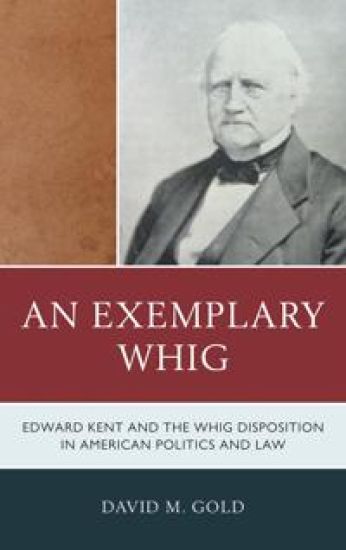
An Exemplary Whig

David M. Gold

Lexington Books
2012
sidottu
Historians have paid surprisingly little attention to state-level political leaders and judges. Edward Kent (1802–77) was both. He served three terms as a state legislator, two as mayor of Bangor, two as governor, and two as a judge of the state supreme court. He represented Maine in the negotiations that resolved the long-running northeastern border dispute between the United States and Great Britain and served for four years as the American consul in Rio de Janeiro. The foremost Whig in Maine state politics and later a Republican judge, Kent articulated classic Whig political views and carried them forward into his Whig-Republican jurisprudence. In examining Kent's career as Maine's quintessential Whig, An Exemplary Whig reveals his characteristically conservative Whig outlook, including an aversion toward disorder and a deep respect for law, for existing institutions, and for the wisdom of experience. Kent brought his conservative disposition into the Republican Party. He had no use for radical abolitionism, preferring moderation and compromise to measures that endangered social order or the integrity of the Union. Kent saw the "slave power," not abolitionism, as the disrupter of the Union, and he urged the “fusion” of all antislavery elements into a new Republican party. In 1859, Maine's Republican governor appointed Kent to the state supreme court. During his fourteen-year tenure, Kent adopted a Whiggish jurisprudence, pragmatic and commonsensical, and displayed a reverence for the common law and a distrust of “theoretic speculation.” After his retirement, he chaired a constitutional revision commission, admonishing his fellow commissioners to bear in mind the “practical wisdom” that kept dangerous innovation in check. As a politician during the Jacksonian era, Kent exemplified Whig leadership at the local and state levels. In his jurisprudence, he carried the Whig persuasion into the Republican ascendancy and the beginnings of the Gilded Age.
Democracy in Session

Democracy in Session

David M. Gold

Ohio University Press
2009
sidottu
For more than 200 years no institution has been more important to the development of the American democratic polity than the state legislature, yet no political institution has been so neglected by historians. Although more lawmaking takes place in the state capitals than in Washington D.C., scholars have lavished their attention on Congress, producing only a handful of histories of state legislatures. Most of those histories have focused on discrete legislative acts rather than on legislative process, and all have slighted key aspects of the legislative environment: the parliamentary rules of play, the employees who make the game possible, the physical setting—the arena—in which the people's representatives engage in conflict and compromise to create public policy. This book relates in fascinating detail the history of the Ohio General Assembly from its eighteenth-century origins in the Northwest Territory to its twenty-first-century incarnation as a full-time professional legislature. Democracy in Session explains the constitutional context within which the General Assembly functions, examines the evolution of legislative committees, and explores the impact of technology on political contests and legislative procedure. It sheds new light on the operations of the House and Senate clerks' offices and on such legislative rituals as seat selection, opening prayers, and the Pledge of Allegiance. Partisan issues and public policy receive their due, but so do ethics and decorum, the election of African American and female legislators, the statehouse, and the social life of the members. Democracy in Session is, in short, the most comprehensive history of a state legislature written to date and an important contribution to the story of American democracy.
The Jacksonian Conservatism of Rufus P. Ranney

The Jacksonian Conservatism of Rufus P. Ranney

David M. Gold

Ohio University Press
2017
sidottu
Ohio's Rufus P. Ranney embodied many of the most intriguing social and political tensions of his time. He was an anticorporate campaigner who became John D. Rockefeller's favorite lawyer. A student and law partner of abolitionist Benjamin F. Wade, Ranney acquired an antislavery reputation and recruited troops for the Union army; but as a Democratic candidate for governor he denied the power of Congress to restrict slavery in the territories, and during the Civil War and Reconstruction he condemned Republican policies. Ranney was a key delegate at Ohio's second constitutional convention and a two-time justice of the Ohio Supreme Court. He advocated equality and limited government as understood by radical Jacksonian Democrats. Scholarly discussions of Jacksonian jurisprudence have primarily focused on a handful of United States Supreme Court cases, but Ranney's opinions, taken as a whole, outline a broader approach to judicial decision making. A founder of the Ohio State Bar Association, Ranney was immensely influential but has been understudied until now. He left no private papers, even destroying his own correspondence. In The Jacksonian Conservatism of Rufus P. Ranney, David M. Gold works with the public record to reveal the contours of Ranney's life and work. The result is a new look at how Jacksonian principles crossed the divide of the Civil War and became part of the fabric of American law and at how radical antebellum Democrats transformed themselves into Gilded Age conservatives.
Democracy and the Courts

Democracy and the Courts

David M. Gold

UNIVERSITY OF SOUTH CAROLINA PRESS
2025
sidottu
The first comprehensive examination of the development of judicial elections in the American South The practice of choosing state judges by popular election is a unique aspect of American democracy. First appearing in Mississippi in 1832 and then sweeping across the United States, judicial elections had a distinctly Southern origin. Prior scholarship seeking to explain the broad acceptance of the elected judiciary mainly relied on the records of northern-state constitutional conventions. In Democracy and the Courts, David M. Gold, focusing on the nineteenth-century American South, offers the first comprehensive e exploration of the advent of this often-controversial democratic reform in the nineteenth-century American South. Making intensive use of primary sources, such as constitutional convention proceedings, legislative journals, and newspapers, in Democracy and the Courts Gold explores the various paths taken by southern states toward the elective judiciary and the reasons why some states accepted judicial elections only partially or rejected them altogether. He considers the impact of judicial elections on judicial review before the Civil War and looks to the last quarter of the nineteenth century, assessing the final and ironic triumph of the elective judiciary during the decidedly undemocratic Jim Crow era.