Kirjojen hintavertailu. Mukana 11 699 587 kirjaa ja 12 kauppaa.

Kirjahaku

Etsi kirjoja tekijän nimen, kirjan nimen tai ISBN:n perusteella.

11 kirjaa tekijältä David M. Harland

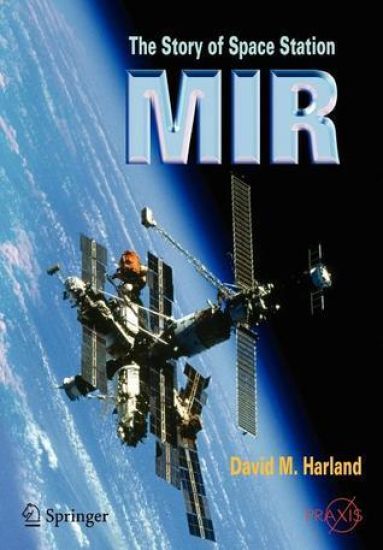
The Story of Space Station Mir

The Story of Space Station Mir

David M. Harland

Springer-Verlag New York Inc.
2005
nidottu
This successor edition picks up the story where the first edition left off in 1997, and runs through to Mir’s de-orbiting in March 2001, providing the definitive account of the Mir Space Station. The book reviews the origins of the Soviet space station programme, in particular the highly successful Salyuts 6 and 7, describes Mir’s structure, environment, power supply and maneuvering systems, and provides a comprehensive account of how it was assembled and how it operated in orbit. Tells how the Soviet Union's experience with a succession of Salyut space stations led to the development of Mir, which was assembled in space, piece by piece, between 1982 and 1996 and became an international research laboratory whose technology went on to form the 'core modules' of the International Space Station.
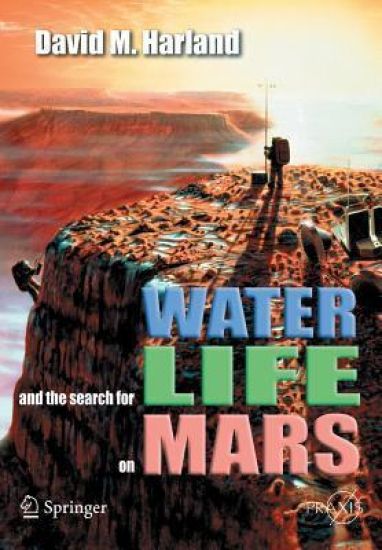
Water and the Search for Life on Mars

Water and the Search for Life on Mars

David M. Harland

Springer-Verlag New York Inc.
2005
nidottu
Mars has long been believed to have been cold, dead and dry for aeons, but there is now striking new proof that not only was Mars a relatively warm and wet place in geologically recent times, but that even today there are vast reserves of water frozen beneath the planet’s surface. As well as casting fascinating new insights into Mars’ past, this discovery is also forcing a complete rethink about the mechanisms of global planetary change and the possibility that there is microbial life on Mars. David Harland considers the issue of life on Mars in parallel with the origin of life on Earth. At the time the Viking instruments were designed, it was thought that all terrestrial life ultimately derived its energy from sunlight, and that the earliest form of life was the cyanobacteria with chlorophyll for photosynthesis. It was assumed the same would be the case on Mars and that microbial life would be on or near the surface that the Vikings had sampled. In parallel with these NASA projects, the European Space Agency developed the Mars Express remote-sensing orbiter, which has detected traces of methane that may have been released by microbes. If microbial life is found on Mars, will it be based on DNA? Will this indicate that life developed independently? Or that it has characteristics in common with the most ancient forms of terrestrial life? If life is found on two planets in the same planetary system, this would favour the panspermia hypothesis. And if martian life is radically different, then in light of the discovery of planetary systems around other stars, this would, as remarked by Philip Morrison of MIT, "transform life from the status of a miracle to that of a statistic". These are all questions that the exploration of Mars for life are aimed to answer.
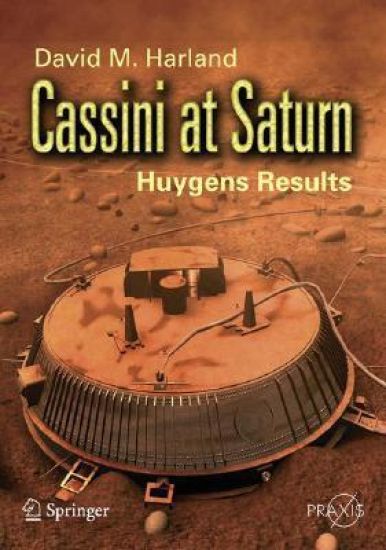
Cassini at Saturn

Cassini at Saturn

David M. Harland

Springer-Verlag New York Inc.
2007
nidottu
Cassini At Saturn – Huygens Results brings the story of the Cassini-Huygens mission and their joint exploration of the Saturnian system right up to date. Cassini entered orbit around Saturn June 2004 so this update includes 8 months of scientific data available for review, including the most spectacular images of Saturn, its rings and satellites ever obtained by a space mission. As the Cassini spacecraft approached its destination in spring 2004, the quality of the images already being returned by the spacecraft clearly demonstrated the spectacular nature of the close-range views that will be obtained. The book contains a 16-page colour section, comprising a carefully chosen selection of the most stunning images to be released during the spacecraft’s initial period of operation. The Huygens craft, released by Cassini, parachuted through the clouds of Saturn’s largest moon, Titan, in January 2005. David Harland tells the exciting story of the this craft’s journey to the surface of one of the most enigmatic bodies on the Solar System, the only moon to have a dense atmosphere and possibly lakes of liquid gas at -190ºC on its surface. Titan is considered to be an early Earth in deep freeze, possibly with the building blocks of life in its atmosphere. There will undoubtedly be enormous interest in the first results and images of Titan’s surface, and this book is the first incisive summary of this groundbreaking material.
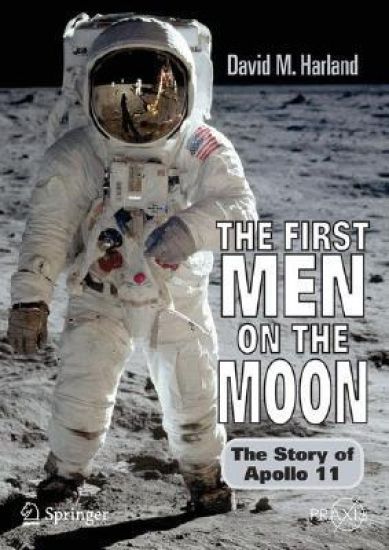
The First Men on the Moon

The First Men on the Moon

David M. Harland

Springer-Verlag New York Inc.
2006
nidottu
On 12 April 1961 Yuri Gagarin became the first man to orbit the Earth. One month later, President John F. Kennedy challenged the American nation to land a man on the Moon before the decade was out. On 16 July 1969, Neil Armstrong, Michael Collins and Buzz Aldrin set off in Apollo 11 to attempt this audacious mission, and succeeded magnificently. This book tells the story of Apollo 11, starting with crew selection and training, the choice of the landing site, and the assembly of the space vehicle, then a detailed account of the mission, featuring the lunar landing and moonwalk, and a review of how our knowledge of the Moon's history was revolutionised as a result. The story is enlivened by dialogue between the astronauts in space and the flight controllers in Mission Control.
NASA's Moon Program

NASA's Moon Program

David M. Harland

Springer-Verlag New York Inc.
2009
nidottu
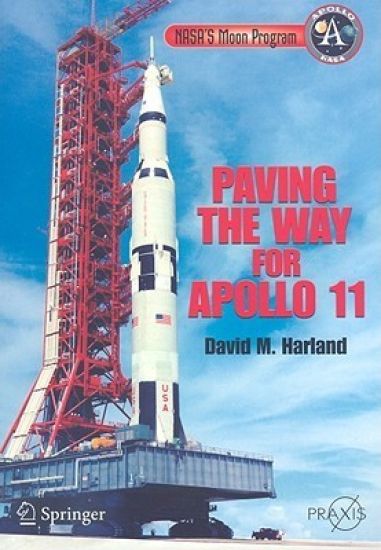
In 'Paving the Way for Apollo 11' David Harland explains the lure of the Moon to classical philosophers, astronomers, and geologists, and how NASA set out to investigate the Moon in preparation for a manned lunar landing mission. It focuses particularly on the Lunar Orbiter and Surveyor missions.
Exploring the Moon

Exploring the Moon

David M. Harland

Springer-Verlag New York Inc.
2008
nidottu
David Harland opens with a review of the robotic probes, namely the Rangers which returned television before crashing into the Moon, the Surveyors which 'soft landed' in order to investigate the nature of the surface, and the Lunar Orbiters which mapped prospective Apollo landing sites. He then outlines the historic landing by Apollo 11 in terms of what was discovered, and how over the next several missions the program was progressively geared up to enable the final three missions each to spend three days on comprehensive geological investigations. He concludes with a review of the robotic spacecraft that made remote-sensing observations of the Moon. Although aimed at the enthusiast, and can be read as an adventure in exploration, the book develops the scientific theme of lunar geology, and therefore will be of use as background reading for undergraduate students of planetary sciences. In addition, with the prospect of a resumption of human missions, it will help journalists understand what Apollo achieved after the 'flags and footprints' of the Apollo 11 landing in July 1969 and will commemorate the fortieth anniversary of that momentous event.
Apollo 12 - On the Ocean of Storms

Apollo 12 - On the Ocean of Storms

David M. Harland

Praxis
2011
nidottu
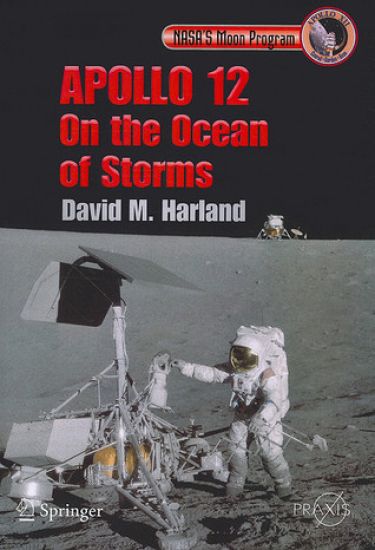
In July 1969 the ‘amiable strangers’ that made up the crew of the historic Apollo 11 flight successfully achieved the first manned lunar landing. Several months later, three close friends set off on an even more challenging mission. Free of the burden of making history, the Apollo 12 astronauts were determined to really enjoy their experience while taking care of business. This is the story of their mission, told largely in their own words. Their exploits and accomplishments showed how conservative the inaugural mission had been. With its two moonwalks, deployment of the first geophysical station on the Moon, and geological sampling, Apollo 12 did what many had hoped would be achieved by the first men to land on the Moon. The Apollo 12 mission also spectacularly demonstrated the precision landing capability required for success in future lunar surface explorations. In addition to official documents, published prior to and after the mission, APOLLO 12 – ON THE OCEAN OF STORMS draws on the flight transcript and post-mission debriefing to recreate the drama.
Jupiter Odyssey

Jupiter Odyssey

David M. Harland

Springer London Ltd
2000
nidottu
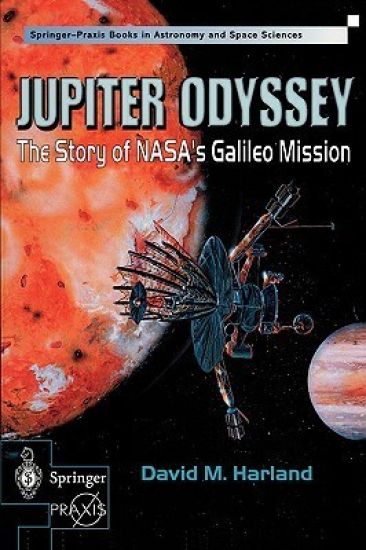
Focusing on the Galileo Mission, the story will relate this remarkable spacecraft's protracted gestation and the ordeal of its long haul out to Jupiter and its ultimate triumph: 5 years exploration within the Jovian system. The story spans a full quarter of a century, drawing on the press conferences, technical papers and essays of engineers and scientists involved in the mission which provide a real sense of participation as the discoveries poured in - it will bring the mission of the Galileo spacecraft to life and provide a more engaging account than would simply be achieved by recounting scientific results. The book will conclude with a snapshot "look ahead" into the Cassini flyby of Jupiter in December 2000 shortly after publication - the book released to coincide with this media event.
The Earth in Context

The Earth in Context

David M. Harland

Springer London Ltd
2001
nidottu
The Earth in Context: A Guide to the Solar System tells a tale of scientific discovery, with two interwoven strands - one tracing the development of understanding the Earth's geological history, and the other placing this in the context of processes at work on the other planets of the solar system. Although planetology is assigned half of the text, the primary focus of the book is the Earth. It is discussed in two parts, the first summing up our knowledge of the Earth as it is today and the other considering it as it was long ago.
Mission to Saturn

Mission to Saturn

David M. Harland

Springer London Ltd
2002
nidottu
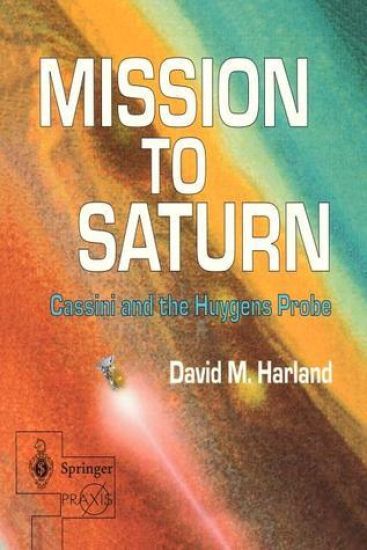
Saturn is back in the news! The Cassini/Huygens spacecraft, a joint venture by NASA and the European Space Agency, is on its way to Saturn, where it will arrive in July 2004. During 2005 it will explore beneath the clouds of Titan, Saturn's largest moon and potential home for extraterrestrial life. Written by an established space historian and experienced author, Mission To Saturn - Cassini and the Huygens Probe is an up-to-date and timely review of our knowledge of Saturn and its enigmatic moon, Titan, on which the Huygens probe will land to search for prebiotic chemistry or even life. It explains how the mission was planned, how it will operate and, as the spacecraft nears its target, puts into context the discoveries that are sure to follow from this once-in-a-lifetime mission.
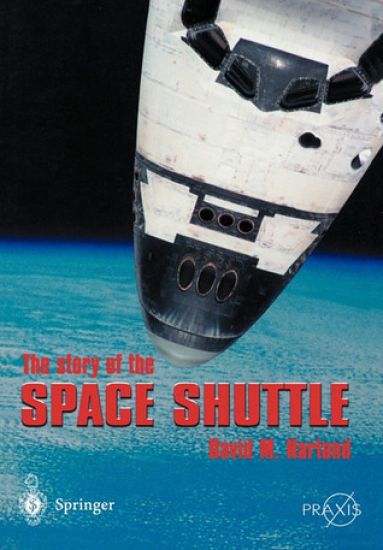
The Story of the Space Shuttle

The Story of the Space Shuttle

David M. Harland

Springer London Ltd
2004
nidottu
In spite of the Challenger and Columbia disasters, the US Space Shuttle, which entered service in 1981, remains the most successful spacecraft ever developed. Conceived and designed as a reusable spacecraft to provide cheap access to low Earth orbit, and to supersede expendable launch vehicles, serving as the National Space Transportation System, it now coexists with a new range of commercial rockets. David Harland’s definitive work on the Space Shuttle explains the scientific contribution the Space Shuttle has made to the international space programme, detailing missions to Mir, Hubble and more recently its role in the assembly of the International Space Station. This substantial revision to existing chapters and extension of ‘The Space Shuttle’, following the loss of Columbia, will include a comprehensive account of the run-up to resumption of operations and conclude with a chapter beyond the Shuttle, looking at possible future concepts for a partly or totally reusable space vehicle which are being considered to replace the Shuttle.