Kirjojen hintavertailu. Mukana 12 390 323 kirjaa ja 12 kauppaa.

Kirjahaku

Etsi kirjoja tekijän nimen, kirjan nimen tai ISBN:n perusteella.

8 kirjaa tekijältä David M. Kreps

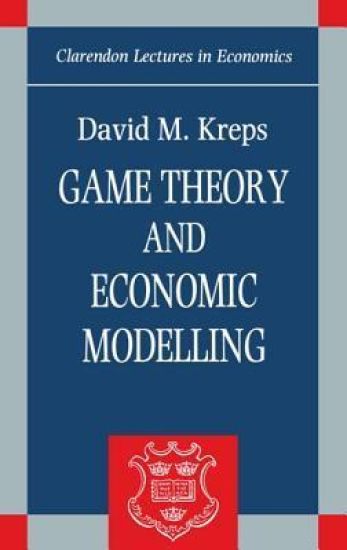
Game Theory and Economic Modelling

Game Theory and Economic Modelling

David M. Kreps

Clarendon Press
1990
nidottu
Over the past two decades, academic economics has undergone a mild revolution in methodology. The language, concepts and techniques of noncooperative game theory have become central to the discipline. This book provides the reader with some basic concepts from noncooperative theory, and then goes on to explore the strengths, weaknesses, and future of the theory as a tool of economic modelling and analysis. The central theses are that noncooperative game theory has been a remarkably popular tool in economics over the past decade because it allows analysts to capture essential features of dynamic competition and competition where some parties have proprietary information. The theory is weakest in providing a sense of when it - and equilibrium analysis in particular - can be applied and what to do when equilibrium analysis is inappropriate. Many of these weaknesses can be addressed by the consideration of individuals who are boundedly rational and learn imperfectly from the past. Written in a non-technical style and working by analogy, the book, first given as part of the Clarendon Lectures in Economics, is readily accessible to a broad audience and will be of interest to economists and students alike. Knowledge of game theory is not required as the concepts are developed as the book progresses.
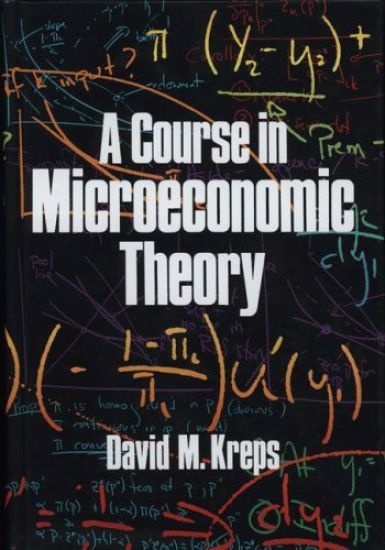
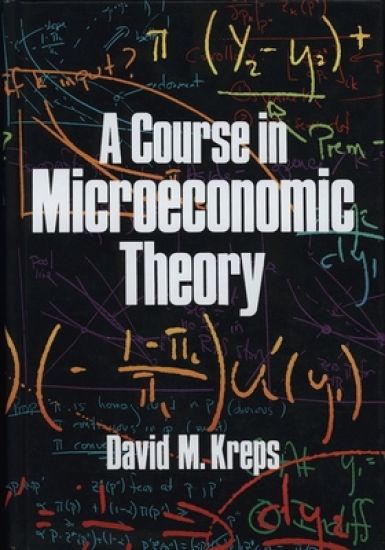
A Course in Microeconomic Theory

A Course in Microeconomic Theory

David M. Kreps

PRINCETON UNIVERSITY PRESS
1990
sidottu
David M. Kreps has developed a text in microeconomics that is both challenging and user-friendly. The work is designed for the first-year graduate microeconomic theory course and is accessible to advanced undergraduates as well. Placing unusual emphasis on modern noncooperative game theory, it provides the student and instructor with a unified treatment of modern microeconomic theory--one that stresses the behavior of the individual actor (consumer or firm) in various institutional settings. The author has taken special pains to explore the fundamental assumptions of the theories and techniques studied, pointing out both strengths and weaknesses. The book begins with an exposition of the standard models of choice and the market, with extra attention paid to choice under uncertainty and dynamic choice. General and partial equilibrium approaches are blended, so that the student sees these approaches as points along a continuum. The work then turns to more modern developments. Readers are introduced to noncooperative game theory and shown how to model games and determine solution concepts. Models with incomplete information, the folk theorem and reputation, and bilateral bargaining are covered in depth. Information economics is explored next. A closing discussion concerns firms as organizations and gives readers a taste of transaction-cost economics.
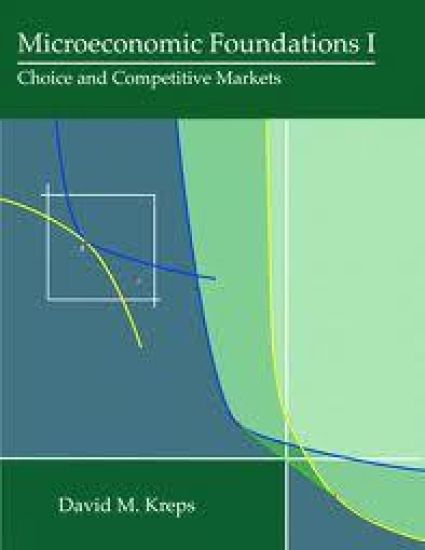
Microeconomic Foundations I

Microeconomic Foundations I

David M. Kreps

PRINCETON UNIVERSITY PRESS
2012
sidottu
Microeconomic Foundations I develops the choice, price, and general equilibrium theory topics typically found in first-year theory sequences, but in deeper and more complete mathematical form than most standard texts provide. The objective is to take the reader from acquaintance with these foundational topics to something closer to mastery of the models and results connected to them. * Provides a rigorous treatment of some of the basic tools of economic modeling and reasoning, along with an assessment of the strengths and weaknesses of these tools * Complements standard texts * Covers choice, preference, and utility; structural properties of preferences and utility functions; basics of consumer demand; revealed preference and Afriat's Theorem; choice under uncertainty; dynamic choice; social choice and efficiency; competitive and profit-maximizing firms; expenditure minimization; demand theory (duality methods); producer and consumer surplus; aggregation; general equilibrium; efficiency and the core; GET, time, and uncertainty; and other topics * Features a free web-based student's guide, which gives solutions to approximately half the problems, and a limited-access instructor's manual, which provides solutions to the rest of the problems * Contains appendixes that review most of the specific mathematics employed in the book, including a from-first-principles treatment of dynamic programming
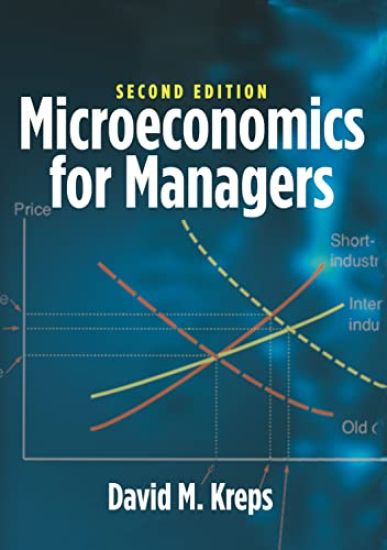
Microeconomics for Managers, 2nd Edition

Microeconomics for Managers, 2nd Edition

David M. Kreps

Princeton University Press
2019
sidottu
A thoroughly revised new edition of a leading textbook that equips MBA students with the powerful tools of economicsThis is a thoroughly revised and substantially streamlined new edition of a leading textbook that shows MBA students how understanding economics can help them make smarter and better-informed real-world management decisions. David Kreps, one of the world’s most influential economists, has developed and refined Microeconomics for Managers over decades of teaching at Stanford’s Graduate School of Business. Stressing game theory and strategic thinking and driven by in-depth, integrated case studies, the book shows future managers how economics can provide practical answers to critical business problems.Focuses on case studies and real companies, such as Amazon, Microsoft, General Motors, United Airlines, and XeroxCovers essential topics for future managers—including price discrimination, Porter’s five forces, risk sharing and spreading, signaling and screening, credibility and reputation, and economics and organizational behaviorFeatures an online supplement (available at micro4managers.stanford.edu) for students that provides solutions to the problems in the book, longer caselike exercises, review problems, a calculus review, and more
A Course in Microeconomic Theory

A Course in Microeconomic Theory

David M. Kreps

Princeton University Press
2020
pokkari
David M. Kreps has developed a text in microeconomics that is both challenging and "user-friendly." The work is designed for the first-year graduate microeconomic theory course and is accessible to advanced undergraduates as well. Placing unusual emphasis on modern noncooperative game theory, it provides the student and instructor with a unified treatment of modern microeconomic theory--one that stresses the behavior of the individual actor (consumer or firm) in various institutional settings. The author has taken special pains to explore the fundamental assumptions of the theories and techniques studied, pointing out both strengths and weaknesses.The book begins with an exposition of the standard models of choice and the market, with extra attention paid to choice under uncertainty and dynamic choice. General and partial equilibrium approaches are blended, so that the student sees these approaches as points along a continuum. The work then turns to more modern developments. Readers are introduced to noncooperative game theory and shown how to model games and determine solution concepts. Models with incomplete information, the folk theorem and reputation, and bilateral bargaining are covered in depth. Information economics is explored next. A closing discussion concerns firms as organizations and gives readers a taste of transaction-cost economics.
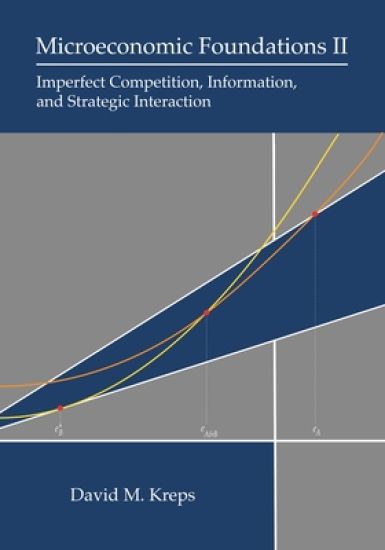
Microeconomic Foundations II

Microeconomic Foundations II

David M. Kreps

PRINCETON UNIVERSITY PRESS
2023
sidottu
A cutting-edge introduction to key topics in modern economic theory for first-year graduate students in economics and related fieldsVolume II of Microeconomic Foundations introduces models and methods at the center of modern microeconomic theory. In this textbook, David Kreps, a leading economic theorist, emphasizes foundational material, concentrating on seminal work that provides perspective on how and why the theory developed. Because noncooperative game theory is the chief tool of modeling and analyzing microeconomic phenomena, the book stresses the applications of game theory to economics. And throughout, it underscores why theory is most useful when it supports rather than supplants economic intuition.Introduces first-year graduate students to the models and methods at the core of microeconomic theory todayCovers an extensive range of topics, including the agency theory, market signaling, relational contracting, bilateral bargaining, auctions, matching markets, and mechanism designStresses the use—and misuse—of theory in studying economic phenomena and shows why theory should support, not replace, economic intuitionIncludes extensive appendices reviewing the essential concepts of noncooperative game theory, with guidance about how it should and shouldn’t be usedFeatures free online supplements, including chapter outlines and overviews, solutions to all the problems in the book, and more
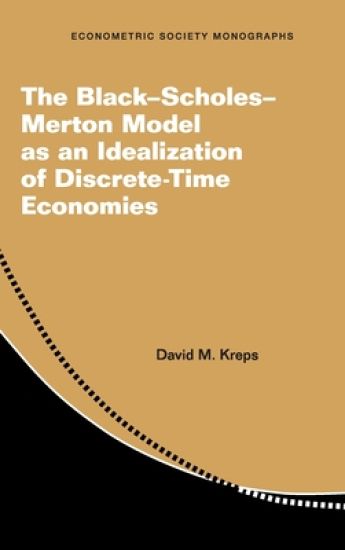
The Black–Scholes–Merton Model as an Idealization of Discrete-Time Economies
This book examines whether continuous-time models in frictionless financial economies can be well approximated by discrete-time models. It specifically looks to answer the question: in what sense and to what extent does the famous Black-Scholes-Merton (BSM) continuous-time model of financial markets idealize more realistic discrete-time models of those markets? While it is well known that the BSM model is an idealization of discrete-time economies where the stock price process is driven by a binomial random walk, it is less known that the BSM model idealizes discrete-time economies whose stock price process is driven by more general random walks. Starting with the basic foundations of discrete-time and continuous-time models, David M. Kreps takes the reader through to this important insight with the goal of lowering the entry barrier for many mainstream financial economists, thus bringing less-technical readers to a better understanding of the connections between BSM and nearby discrete-economies.
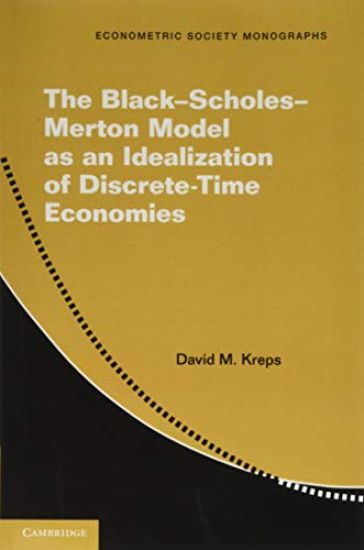
The Black–Scholes–Merton Model as an Idealization of Discrete-Time Economies
This book examines whether continuous-time models in frictionless financial economies can be well approximated by discrete-time models. It specifically looks to answer the question: in what sense and to what extent does the famous Black-Scholes-Merton (BSM) continuous-time model of financial markets idealize more realistic discrete-time models of those markets? While it is well known that the BSM model is an idealization of discrete-time economies where the stock price process is driven by a binomial random walk, it is less known that the BSM model idealizes discrete-time economies whose stock price process is driven by more general random walks. Starting with the basic foundations of discrete-time and continuous-time models, David M. Kreps takes the reader through to this important insight with the goal of lowering the entry barrier for many mainstream financial economists, thus bringing less-technical readers to a better understanding of the connections between BSM and nearby discrete-economies.